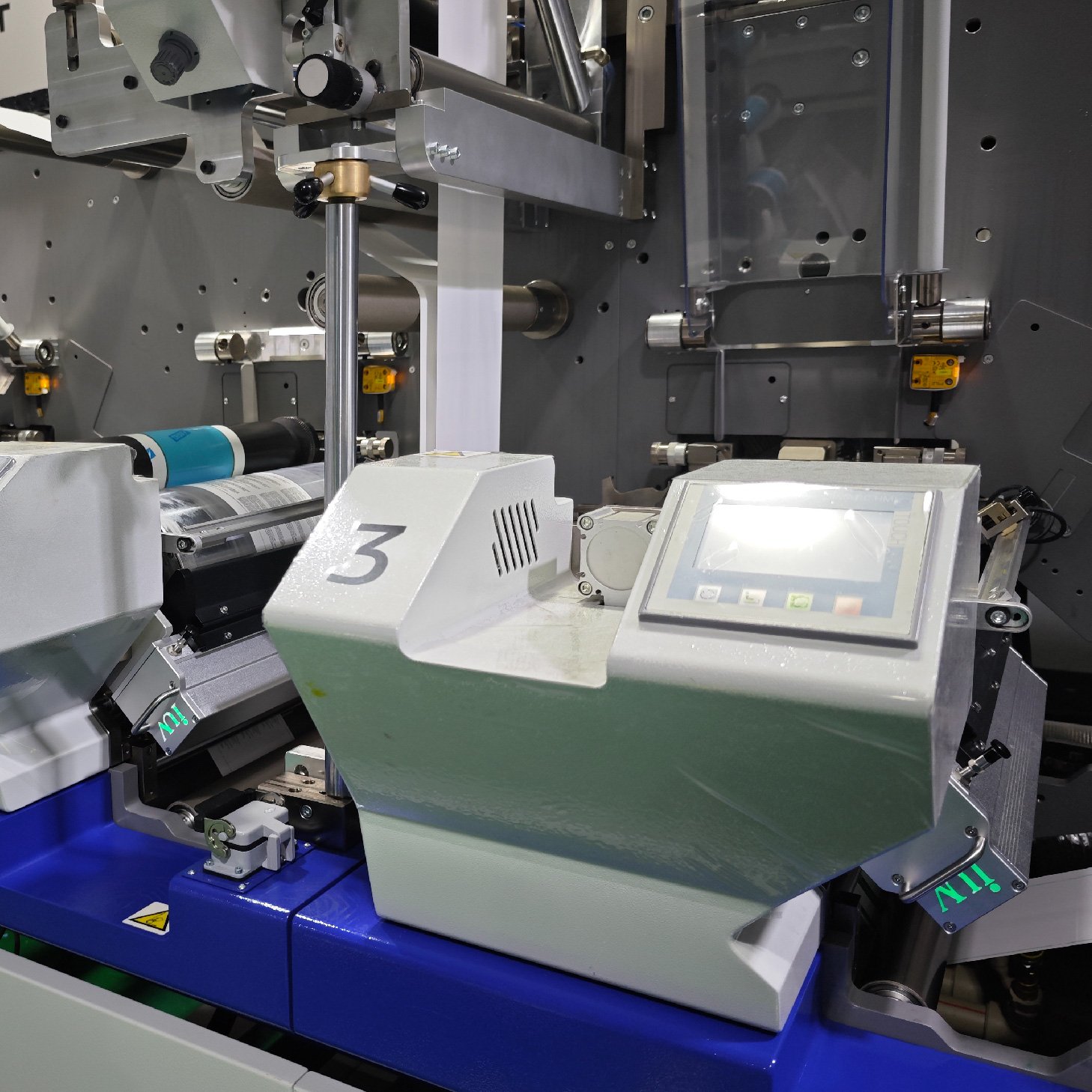
In high-speed narrow web label production, UV curing is no longer a secondary finishing step but a core process parameter that directly defines press stability, ink performance, and downstream converting reliability. As line speeds in flexographic printing regularly exceed 150–250 m/min, the interaction between UV spectrum characteristics and UV ink chemistry becomes increasingly sensitive. Within this context, UV Spectrum Optimization in LED UV Curing Systems for High-Speed Narrow Web Label Printing is fundamentally an engineering problem of matching photon energy distribution with photoinitiator absorption behavior under constrained exposure time.
In practical production environments, narrow web label presses operate with frequent job changes, variable ink coverage, and different substrate structures ranging from paper to BOPP and PET films. Each of these variables modifies UV dose absorption behavior. When spectrum is not optimized, operators typically compensate with higher irradiance, which increases energy consumption without guaranteeing full polymerization. This is where UV Spectrum Optimization in LED UV Curing Systems for High-Speed Narrow Web Label Printing becomes critical for both process stability and energy efficiency.
Spectral control and photoinitiator activation efficiency
In UV curing technology, polymerization is driven by photoinitiators that respond to specific wavelength ranges. Traditional mercury lamps emit a broad spectrum, which includes multiple UV peaks but also significant infrared energy. While this broad emission provides tolerance for different ink formulations, it also reduces spectral efficiency because only part of the emitted energy is chemically active.
LED UV systems fundamentally change this behavior. They operate within a narrow spectral window, typically around 385 nm or 395 nm, enabling more precise control of photon energy distribution. In UV Spectrum Optimization in LED UV Curing Systems for High-Speed Narrow Web Label Printing, this spectral narrowing is not simply an efficiency improvement; it is a constraint that requires precise matching between UV LED emission and UV ink chemistry.
In high-speed flexographic printing, exposure time is extremely short. This means that even small mismatches in spectral absorption result in incomplete radical generation. The most common symptom in production is surface cure appearing acceptable while bulk polymerization remains insufficient, leading to poor UV ink adhesion during finishing processes such as lamination or die cutting.
UV dose behavior under high-speed printing conditions
UV dose is defined as irradiance multiplied by exposure time, but in real narrow web production, this relationship is heavily influenced by press speed stability, substrate reflectivity, and ink film thickness. At high speeds, exposure time decreases significantly, forcing the system to rely on higher spectral efficiency rather than higher power.
In UV Spectrum Optimization in LED UV Curing Systems for High-Speed Narrow Web Label Printing, spectral optimization directly affects how efficiently UV dose is converted into chemical reaction energy. If the emission spectrum is not aligned with the absorption peak of photoinitiators, a large portion of UV dose becomes thermally dissipated or reflected without contributing to polymerization.
This explains why two systems with identical measured UV irradiance can produce completely different curing results in production. One may achieve full crosslinking, while the other shows residual tackiness or poor scratch resistance.
Ink chemistry limitations and oxygen inhibition effects
UV ink chemistry in label printing is highly sensitive to both spectral distribution and oxygen exposure. Oxygen inhibition is particularly relevant in thin ink layers typical of narrow web applications. Oxygen molecules interfere with free radical polymerization, preventing complete surface curing even when UV dose appears sufficient.
In LED UV systems, this effect becomes more visible because energy delivery is more controlled and less thermally driven compared to mercury systems. Operators sometimes misinterpret this as insufficient curing power, leading to unnecessary increases in LED output.
However, in UV Spectrum Optimization in LED UV Curing Systems for High-Speed Narrow Web Label Printing, the correct engineering response is not increasing intensity but optimizing spectral match and photoinitiator reactivity. In many cases, adjusting ink formulation is more effective than modifying curing power.
White inks and high-opacity coatings are especially sensitive because titanium dioxide particles scatter UV light, reducing penetration depth. This makes spectral efficiency even more critical for achieving full volumetric polymerization.
Thermal stability and substrate behavior in narrow web systems
Thermal management plays a decisive role in high-speed label printing. Mercury UV systems generate significant infrared radiation, which increases substrate temperature and can cause dimensional instability in thin films such as PET or shrink sleeve materials.
LED UV systems significantly reduce infrared output, improving substrate stability. In UV Spectrum Optimization in LED UV Curing Systems for High-Speed Narrow Web Label Printing, this thermal reduction allows more stable web handling and reduces tension fluctuations during continuous production.
However, LED systems introduce a different thermal challenge at the semiconductor level. Junction temperature directly affects wavelength stability. If thermal control is insufficient, spectral drift occurs, reducing photoinitiator activation efficiency and destabilizing UV dose consistency.
This creates a direct link between thermal engineering and spectral optimization, meaning UV curing performance depends not only on optical design but also on cooling system architecture.
Process integration and real-time spectral stability
Modern narrow web printing lines are increasingly integrated with digital control systems that synchronize UV output with press speed, ink coverage, and job parameters. In this environment, UV Spectrum Optimization in LED UV Curing Systems for High-Speed Narrow Web Label Printing becomes part of a closed-loop control strategy rather than a static system configuration.
Unlike mercury lamps, LED systems can be modulated instantly without warm-up delays. This allows dynamic adjustment of UV dose during acceleration, deceleration, and job transitions. However, spectral stability must remain constant during modulation; otherwise, polymerization behavior becomes inconsistent.
In real production troubleshooting, spectral instability is often misdiagnosed as a power issue, when the actual root cause is thermal drift or photoinitiator mismatch.
Material compatibility and adhesion performance
UV ink adhesion is strongly influenced by the balance between surface cure and bulk cure. If the surface polymerizes too quickly due to excessive spectral concentration, internal layers may remain undercured, leading to delamination or cracking during finishing.
In label printing, substrates vary widely from coated papers to synthetic films. Each material interacts differently with UV wavelength and energy distribution. In UV Spectrum Optimization in LED UV Curing Systems for High-Speed Narrow Web Label Printing, achieving consistent adhesion requires balancing spectral intensity with penetration depth and ink reactivity.
LED systems offer improved repeatability, but only when ink chemistry and spectral output are properly aligned. Otherwise, curing defects shift from thermal issues to chemical mismatch issues.