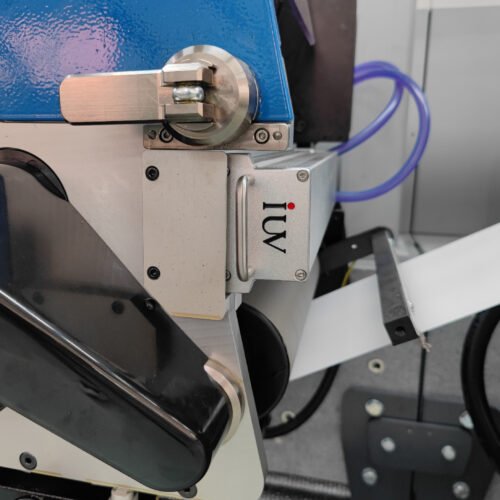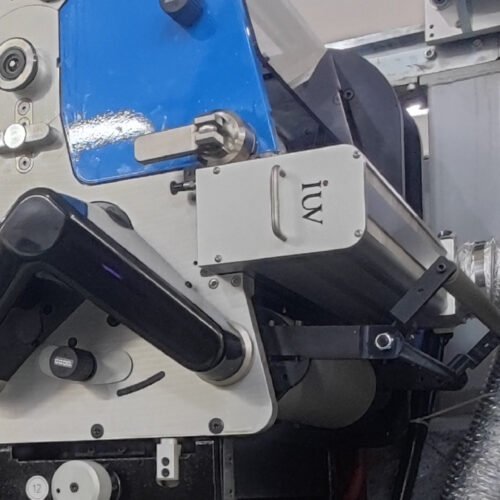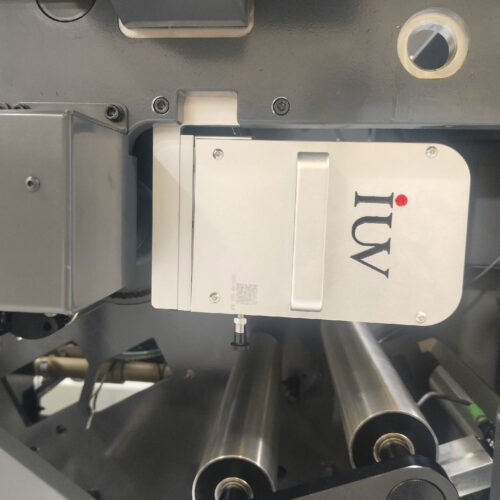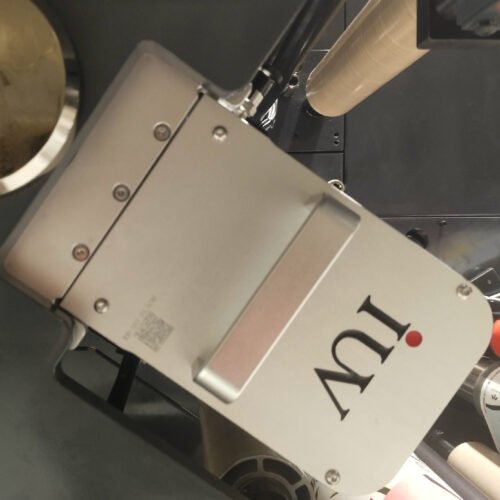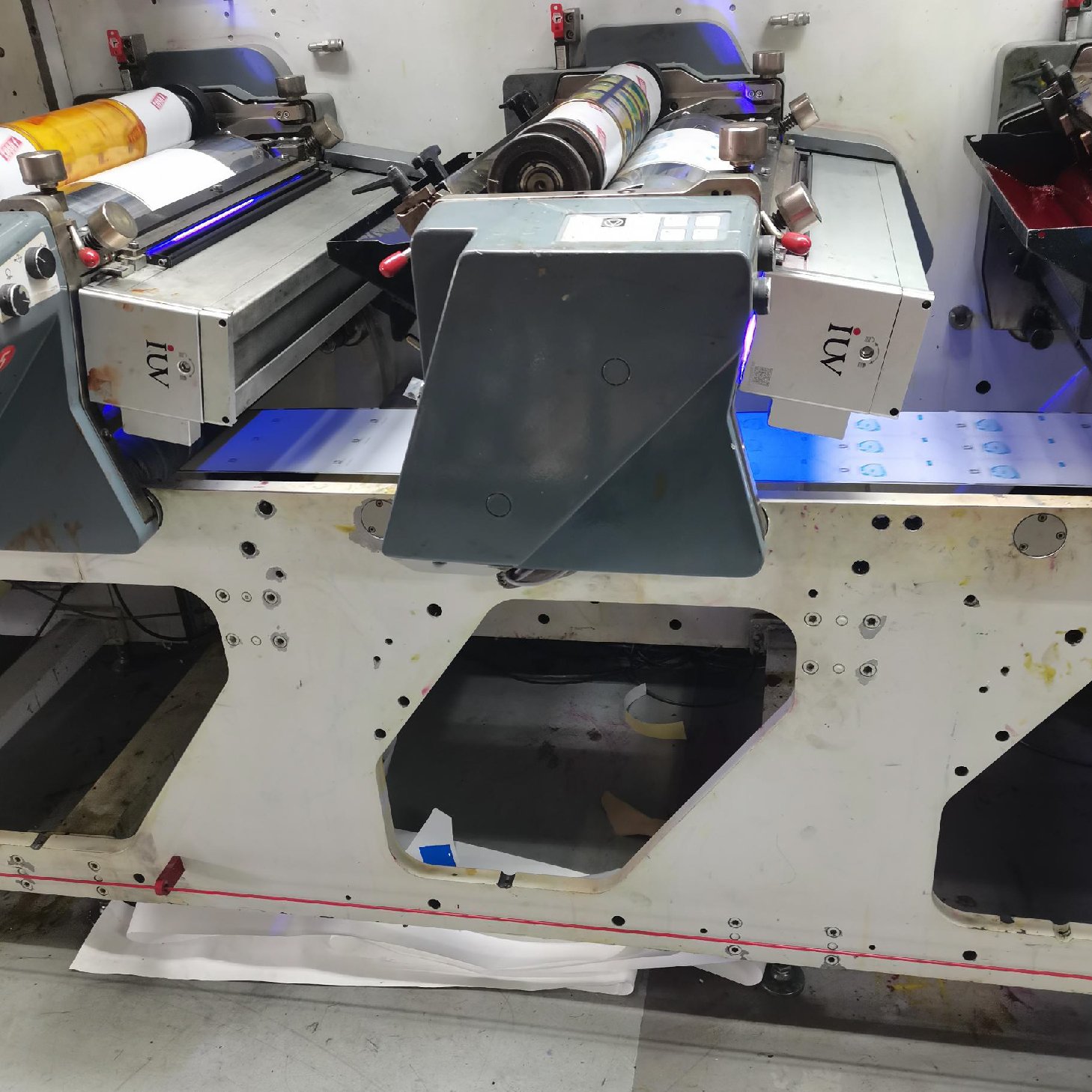
Energy-efficient UV curing systems have become increasingly dependent on precise spectrum control rather than only high irradiance output. In modern flexographic printing, offset printing, and narrow web label production, UV spectrum management directly influences curing efficiency, energy consumption, substrate stability, and production consistency. As industrial printing lines move toward higher speed and lower thermal impact processing, LED UV curing systems require tighter spectral coordination between optical output and photochemical response behavior.
Traditional UV curing systems relied on broad-spectrum mercury lamps that emitted multiple wavelength ranges simultaneously. While these systems provided wide photoinitiator compatibility, they also introduced high energy loss, thermal accumulation, and reduced curing precision. LED UV curing systems changed this operational model by introducing narrow-spectrum light control using wavelengths such as 365 nm, 385 nm, and 395 nm.
In production environments, UV spectrum control is no longer treated as an isolated optical parameter. It functions as an engineering strategy directly connected to curing penetration, energy density stability, line speed synchronization, and substrate compatibility. In practice, incomplete curing, poor adhesion, and unstable coating performance are often linked to spectral mismatch rather than insufficient UV power.
Spectral wavelength selection and photoinitiator response optimization
The foundation of UV spectrum control begins with wavelength selection. LED UV curing systems typically operate at fixed spectral peaks, most commonly 365 nm, 385 nm, and 395 nm. Each wavelength produces different photochemical activation behavior depending on the photoinitiator structure inside the ink and coating formulation.
In production, 395 nm systems are widely used because they provide higher electrical efficiency and lower thermal generation. However, their longer wavelength reduces photon energy, which can limit curing penetration in thick ink layers and high-opacity coatings.
365 nm systems provide stronger photon energy and improved polymerization depth. In flexographic printing applications involving dense white inks or multilayer varnish structures, shorter wavelengths often improve curing penetration. However, higher photon concentration may also increase localized energy density, making substrate temperature management more sensitive.
385 nm systems are frequently selected for narrow web label printing because they provide balanced spectral performance across mixed substrate production involving PET, BOPP, coated paper, and unsupported film materials.
Typically observed production conditions include:
- Surface cure with incomplete internal polymerization
- Adhesion inconsistency between substrate batches
- Variable curing behavior during job transitions
In practice, these conditions occur when the spectral output of the LED UV system does not align correctly with the photoinitiator absorption characteristics of the ink system.
Energy-efficient UV curing therefore depends not only on reducing electrical consumption but also on maximizing photochemical conversion efficiency through spectral alignment.
Irradiance distribution and spectral energy efficiency under high-speed operation
Once wavelength compatibility is established, energy efficiency becomes heavily dependent on irradiance distribution across the curing width. UV irradiance determines instantaneous optical intensity, while total energy density defines the cumulative exposure delivered to the substrate.
In narrow web flexographic printing systems, exposure time decreases rapidly as line speed increases. This creates a strong dependency between spectrum control and curing stability because high-speed production leaves less tolerance for uneven energy delivery.
LED UV systems produce directional spectral output with high optical concentration. However, in production environments, curing inconsistency often appears due to localized irradiance variation rather than insufficient nominal power.
Typically observed conditions include:
- Edge-to-center curing imbalance
- Gloss inconsistency across coated surfaces
- Localized under-curing during acceleration phases
Flexographic printing systems are especially sensitive because ink film thickness varies dynamically depending on anilox transfer volume and substrate surface behavior. Offset printing systems show more uniform coating thickness but remain affected by irradiance inconsistency during high-speed operation.
Engineering optimization strategies commonly include:
- Uniform optical lens configuration
- Stable lamp-to-substrate distance control
- Real-time irradiance monitoring during speed variation
- Dynamic output adjustment linked to line speed
In practice, energy-efficient UV curing is achieved by delivering stable usable energy to the ink layer rather than maximizing electrical input power alone.
Low heat impact spectrum management and substrate stability behavior
One of the major advantages of LED UV curing systems is low heat impact. Unlike conventional mercury UV lamps, LED systems generate minimal infrared radiation, reducing substrate temperature accumulation during production.
This low thermal behavior becomes critical in narrow web printing applications involving PET and BOPP films. Excessive heat exposure in traditional UV systems often causes substrate shrinkage, web tension instability, and registration variation during high-speed operation.
In production environments, low heat impact improves dimensional stability and reduces mechanical distortion across multi-station curing systems. This is especially important in unsupported film applications and multilayer label constructions.
However, reduced thermal assistance also changes curing behavior. Conventional UV systems partially relied on heat to improve coating flow and surface leveling. LED UV systems depend primarily on photochemical efficiency controlled by spectrum optimization.
As a result, curing penetration becomes increasingly sensitive to:
- Ink film thickness
- Pigment density
- Exposure duration
- Spectral compatibility
White inks and opaque coatings frequently reveal these limitations because reduced UV transmission restricts curing depth within lower ink layers.
Typically observed production behavior includes:
- Stable web handling with reduced substrate deformation
- Increased sensitivity to photoinitiator mismatch
- Reduced tolerance for excessive coating thickness
In practice, low heat impact improves substrate protection but requires tighter spectrum control to maintain curing efficiency under high-speed production conditions.
Curing penetration behavior and spectrum interaction with ink layer structure
Curing penetration is one of the most critical engineering variables in UV spectrum management. In flexographic printing systems, ink layer thickness changes continuously due to anilox configuration, plate pressure variation, and substrate surface energy differences.
LED UV curing systems emit concentrated spectral energy, but penetration depth decreases when UV transmission through the ink layer becomes restricted. High-opacity white inks, metallic pigments, and dense varnishes significantly reduce energy propagation into lower layers.
In production, incomplete curing is commonly observed in:
- Thick solid color regions
- Multi-layer varnish structures
- High-density white ink applications
Paper substrates absorb part of the UV energy before it reaches deeper coating layers, while PET and BOPP films often reveal surface polymerization with incomplete internal bonding.
Engineering correction strategies usually involve balancing:
- Wavelength selection
- Irradiance intensity
- Exposure duration
- Ink layer thickness
In some narrow web systems, dual-wavelength curing configurations are introduced to improve penetration consistency without excessively increasing peak irradiance.
In practice, curing penetration efficiency is controlled more effectively through spectral optimization than through power increase alone.
Line speed synchronization and system-level spectrum control in hybrid printing environments
Modern industrial printing environments increasingly combine flexographic printing, offset printing, coating stations, and converting processes within a single narrow web production line. This creates significant complexity in UV spectrum management because curing requirements change continuously during operation.
In production, instability frequently appears during speed transitions or substrate changes. A spectral configuration optimized for coated paper may not maintain stable curing on unsupported BOPP film at higher transport speed. Similarly, curing parameters suitable for flexographic inks may not fully support offset coating systems.
LED UV curing systems provide rapid electronic response capability and stable wavelength output, making dynamic spectrum management possible. However, synchronization between spectral energy delivery and mechanical production speed remains essential.
Typically observed operational risks include:
- Adhesion instability during acceleration phases
- Localized under-curing during speed transitions
- Variable gloss development between print stations
To improve energy efficiency and curing stability, modern UV systems increasingly implement:
- Speed-linked irradiance adjustment
- Substrate-specific curing profiles
- Real-time optical feedback systems
- Dynamic thermal and spectral monitoring
In practice, energy-efficient UV curing systems achieve stable production when wavelength control, irradiance stability, curing penetration, and line speed remain synchronized within the same operational window.
UV spectrum control strategies are therefore not limited to optical design. They function as integrated engineering processes connecting photochemistry, substrate behavior, thermal management, and production dynamics across the entire industrial printing environment.