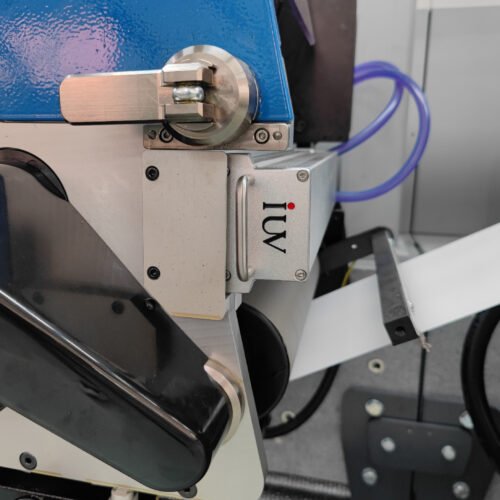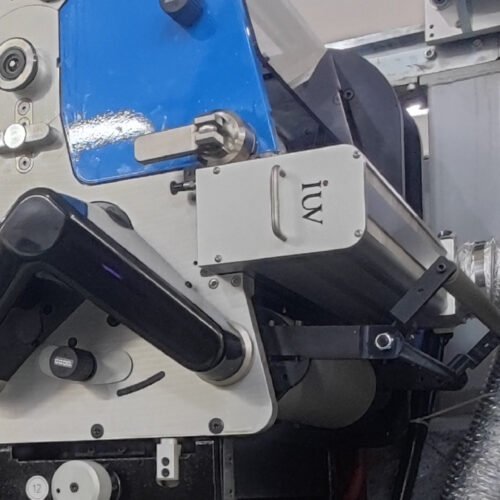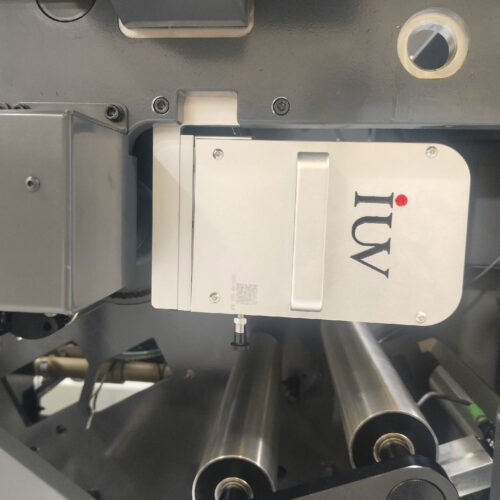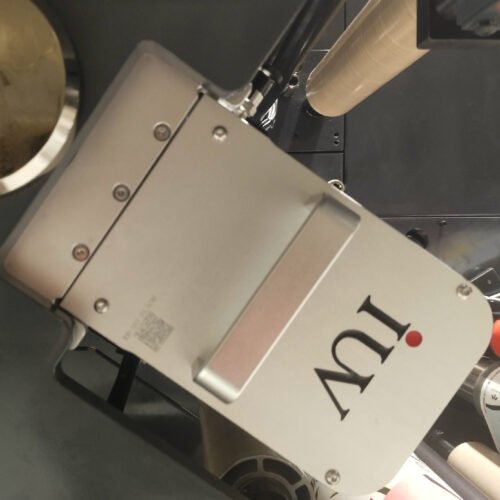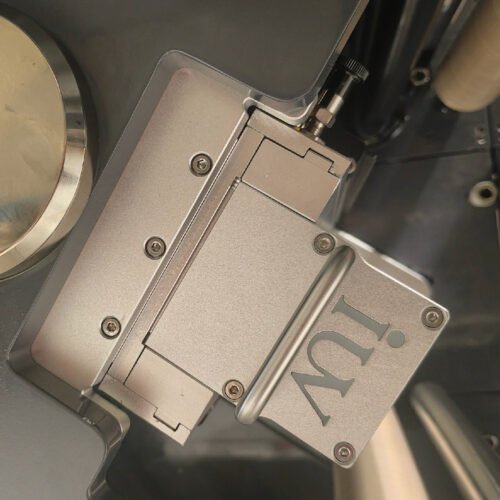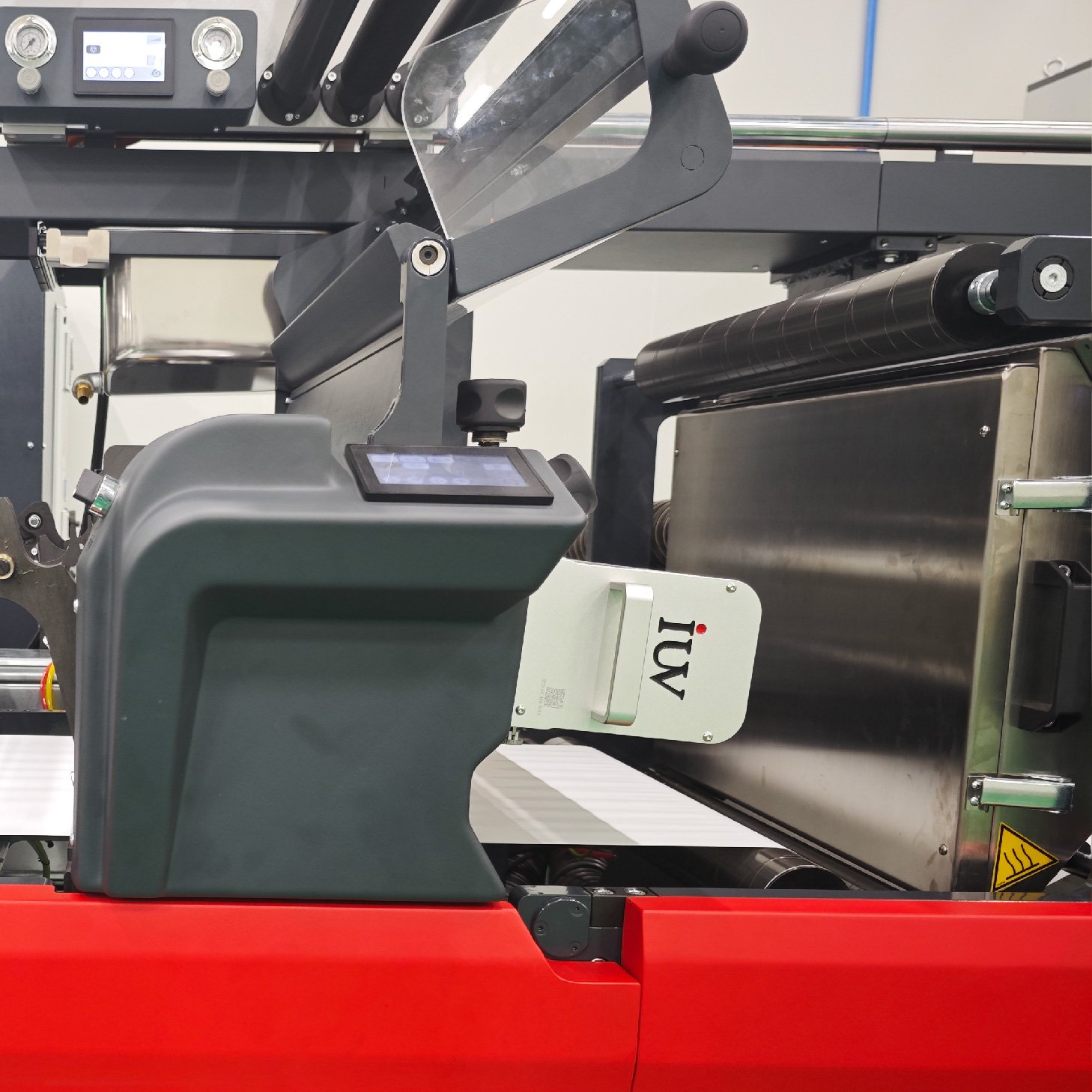
In LED UV flexographic and label printing, curing uniformity is one of the most important factors behind stable print quality and dependable converting performance. Many production issues that appear to be related to ink, substrate, or press setup are often caused by uneven polymerization across the web or inconsistent energy delivery through the printed layer. In narrow web production, this problem can remain hidden during printing and only become visible later during slitting, die-cutting, lamination, or end-use handling.
That is why curing should never be judged only by whether the ink feels dry at the exit of the press. In professional label production, the real benchmark is whether the printed structure has cured evenly enough to maintain adhesion, surface integrity, gloss consistency, color stability, and mechanical resistance across the entire job. This is especially important for converters running high-value label work on demanding substrates and at increasingly high production speeds.
For printers operating modern flexographic and hybrid label lines, including those working with established industry platforms such as Nilpeter, curing uniformity has become a key process control target rather than a simple lamp specification. The value of a UV LED system is not just its nominal output. Its value lies in how evenly and repeatably it cures under real production conditions.
Why Curing Uniformity Is More Important Than Peak Lamp Power
One of the most common misunderstandings in UV LED printing is the idea that higher irradiance automatically means better curing. While strong output is useful, especially for opaque whites, dense blacks, and heavy coatings, peak power alone does not guarantee a reliable result.
A lamp may show impressive intensity values in a static measurement, but if the energy is not distributed evenly across the print width or if the curing response varies from one zone to another, the job may still suffer from undercured or overreactive areas. In label production, these inconsistencies can lead to lane-specific defects, uneven adhesion, variable gloss, rub weakness, and unstable downstream finishing.
For this reason, process evaluation must focus on uniform curing response rather than isolated output numbers. In real flexographic printing, a stable and balanced curing field often delivers better production reliability than a system with higher nominal power but poorer distribution control.
Why Curing Uniformity Must Be Evaluated as a Full Process
In narrow web and label printing, curing is not determined by the lamp alone. It is the result of a complete process chain involving ink chemistry, film thickness, substrate behavior, web stability, cooling performance, optical cleanliness, and press mechanics.
This is why the same LED UV system can perform differently from one press to another. A converter may install a capable curing system and still experience inconsistent results if the ink transfer is unstable, the substrate is moving unevenly through the curing zone, or the optical path is being compromised by contamination or incorrect mounting geometry.
A proper process evaluation should therefore look at the entire production environment. Curing uniformity is not a standalone hardware attribute. It is a process outcome created by multiple interacting variables.
Ink Film Thickness Is One of the Most Important Variables
In flexographic label printing, the printed ink layer is rarely uniform in a simple sense. Film thickness changes with anilox volume, cell geometry, plate condition, press pressure, viscosity control, and graphic design. As a result, different image areas may require different effective curing behavior even within the same print repeat.
A heavy solid area needs more total energy and better penetration than a fine tint or a small text element. If the curing field is only marginally balanced, these differences can create inconsistent polymerization across the image. The press may appear stable on simple work, yet struggle on dense or technically demanding jobs.
This is why curing uniformity should always be evaluated using realistic printed structures rather than only instrument-based lamp readings. The lamp cures ink, not air. The true performance standard is whether it can deliver a consistent result through the actual film architecture being printed.
Why Opaque White and High-Density Colors Reveal Problems Faster
In label production, opaque white is often the fastest way to expose curing inconsistency. It typically carries a heavier film weight and a more demanding pigment load than standard process colors. Black solids, metallic effects, and high-build coatings can behave similarly. These layers are less forgiving and tend to reveal differences in cure depth and surface response much earlier than lighter graphics.
A press may run process cyan, magenta, or yellow with acceptable surface cure while still showing weak polymerization in white flood areas or dense solids. That weakness may later appear as adhesion loss, reduced scuff resistance, poor lamination behavior, or inconsistent die-cutting performance.
This is why a serious process evaluation should always include challenging layers that reflect real label production conditions. Easy-to-cure graphics rarely reveal the true limits of the curing system.
Web Stability and Lamp Distance Directly Influence Uniformity
UV LED curing performance is highly sensitive to the distance between the lamp head and the printed substrate. If this working gap changes, the delivered energy profile also changes. In narrow web production, this becomes especially important when printing unsupported films, lightweight facestocks, heat-sensitive materials, or substrates with curl and tension instability.
Even a well-designed curing system can produce uneven results if the web is not moving consistently through the optical field. A small variation in substrate position may cause measurable changes in effective irradiance and exposure time, particularly at high speed.
This is why process evaluation should include web handling and substrate presentation as part of the curing assessment. Stable optical geometry is essential for stable polymerization. In flexographic and label printing, curing uniformity begins with web control.
Thermal Control Still Plays a Major Role in LED UV Stability
LED UV systems are widely used because they reduce infrared load and help protect sensitive label materials. However, lower substrate heating does not mean thermal behavior can be ignored. Inside the curing head, diode temperature still has a strong effect on output consistency and long-run stability.
If the cooling system is not balanced, one section of the LED array may operate at a different junction temperature than another. Over time, this can cause subtle cross-web output variation and gradually reduce curing consistency. The effect may not be obvious at startup, but it often becomes more noticeable during extended production runs.
For this reason, curing uniformity should be evaluated both at initial startup and after the system has reached steady operating temperature. Stable optical performance depends heavily on stable thermal conditions behind the lamp face.
Optical Cleanliness Has a Direct Impact on Production Results
In real pressroom conditions, UV LED optics are exposed to contamination from ink mist, coating particles, paper dust, adhesive vapors, silicone residue, and airborne debris. This contamination rarely accumulates evenly. Instead, it tends to build in localized patterns based on press layout, airflow, substrate type, and operating conditions.
When the optical surface becomes unevenly contaminated, the result is not simply lower output. It is distorted curing uniformity. One part of the web may receive slightly less effective energy than another, which can lead to isolated adhesion issues, lane-specific rub weakness, uneven gloss, or inconsistent converting performance.
This is one of the reasons why some curing problems are difficult to diagnose. The lamp may still be on, the ink may still appear dry, and the press may still be running at speed, yet the polymerization profile is no longer truly balanced. That is why optical cleanliness should be treated as a core part of UV LED process control.
Static Lamp Checks Are Not Enough for Real Evaluation
A UV LED system can appear well balanced in a static test while behaving differently under live production conditions. During real printing, the curing process is influenced by web movement, press vibration, speed variation, thermal buildup, substrate tension changes, and differences in ink coverage from job to job.
This means that static output checks alone are not enough to understand true curing uniformity. A system should be evaluated under realistic production load, using actual job structures and practical press speeds. What matters is not only whether the lamp performs well in isolation, but whether it maintains a stable curing field during the dynamic conditions of commercial label production.
In high-speed flexographic printing, the gap between laboratory performance and production performance can be significant. That is why process-based evaluation is far more meaningful than isolated hardware verification.
Why Converting Performance Is Often the Real Proof of Uniform Cure
Many UV curing issues do not fully reveal themselves at the print station. They become visible later when the printed material is subjected to downstream stress. In label production, this includes die-cutting, slitting, matrix stripping, lamination, varnishing, rewinding, and final application performance.
If the curing response is uneven across the web, the print may still look acceptable at first glance but behave unpredictably during converting. One area may show better adhesion than another. One lane may resist scuffing while another fails. One zone may laminate cleanly while another shows bond inconsistency.
This is why process evaluation must include downstream behavior as part of the curing assessment. In many cases, converting performance is the most accurate indicator of whether the UV LED system is curing uniformly enough for commercial production.
Why Flexo, Offset, and Hybrid Lines Need Different Evaluation Priorities
Although the core chemistry of UV polymerization remains the same, the way curing uniformity should be evaluated can differ between printing processes. In flexographic label printing, anilox-driven ink volume and plate transfer behavior make film thickness control especially important. In narrow web offset, thinner films, trapping behavior, and surface set may become more critical. In hybrid lines, the interaction between multiple print technologies adds further complexity.
This means there is no single universal method for interpreting curing stability across every press platform. The evaluation must be linked to the actual process architecture being used. A curing profile that works well for one print configuration may not be optimal for another.
That is why converters running diverse label applications should evaluate UV LED curing in direct relation to the print method, substrate family, ink system, and finishing requirements involved.
Long-Term Stability Is the True Measure of a Good UV LED Process
A curing system may perform well on installation day and still become inconsistent over time if the process is not properly managed. Ink changes, substrate shifts, temperature variation, maintenance gaps, and production wear all affect the long-term stability of curing performance.
This is where disciplined process evaluation becomes especially valuable. A strong UV LED workflow is not built only on lamp selection. It is built on maintaining stable conditions over weeks, months, and repeat production cycles. The real goal is not to achieve cure once. The goal is to maintain predictable curing performance across the life of the press and across changing job conditions.
For converters working in competitive label markets, this long-term consistency is often what separates stable production from recurring troubleshooting.
Conclusion
Process evaluation of curing uniformity in LED UV flexographic and label printing systems is essential for achieving dependable print quality and converting performance. Uniform polymerization cannot be defined by lamp output alone. It must be understood through the interaction of optics, ink film structure, web stability, thermal control, contamination management, and real production dynamics.
In narrow web printing, even small differences in curing behavior can lead to measurable quality variation and downstream instability. That is why professional UV LED process control should focus on repeatable, cross-web, job-relevant curing performance rather than isolated power figures.
When curing uniformity is properly evaluated and consistently maintained, flexographic and label converters can run more confidently, reduce hidden process variation, and achieve better long-term production stability.