Process Control Strategies for Maintaining Curing Stability in LED UV Flexographic Printing
In LED UV flexographic printing, curing stability is one of the most important foundations of print quality, production speed, and downstream converting performance. A press can produce visually attractive labels for several minutes and still be operating in an unstable process window. The real measure of performance is not whether the job looks good at startup. It is whether the press can maintain consistent cure quality through the full production run, across speed changes, roll changes, substrate changes, and environmental variation.
That is why process control matters more than nominal lamp power. In modern label printing and narrow web flexographic production, most curing failures are not caused by a total lack of UV energy. They are caused by process drift. Small changes in temperature, ink film weight, web speed, optics cleanliness, cooling efficiency, substrate surface condition, and ink transfer can gradually move the job outside a stable curing range. Once that happens, the symptoms begin to appear in different forms: poor adhesion, scuffing, blocking, odor retention, die-cutting issues, color shift, gloss inconsistency, and intermittent print defects that are difficult to trace.
A stable LED UV curing process is therefore not just a lamp issue. It is a controlled manufacturing condition. The most successful converters treat curing stability as a monitored process variable that must be protected throughout the press line.
Why Curing Stability Matters More Than Peak UV Output
Many operators focus on maximum irradiance when evaluating LED UV performance. High output can be useful, especially for dense colors, opaque whites, and demanding coatings. But curing stability is not simply about how much energy a lamp can produce at its highest setting. It is about whether the system can deliver the right curing condition repeatedly under actual production load.
A press that cures well at the beginning of the shift but gradually loses consistency is not running a strong process. A press that requires frequent power increases to maintain adhesion is already drifting. In label printing, especially on narrow web lines running mixed jobs, the true goal is not peak lamp intensity. It is repeatable polymerization behavior.
This is particularly important in flexographic printing because cure performance depends on a chain of interacting variables. The lamp may be working correctly while the process around it is quietly becoming unstable.
The Ink Film Must Be Controlled Before the Lamp Can Be Effective
No UV LED curing system can compensate indefinitely for an unstable ink film. In flexographic printing, the curing module acts on the ink layer that has already been transferred, leveled, and presented to the substrate. If that layer varies too much, curing consistency will always be difficult to maintain.
This is why process control starts upstream. Anilox condition, cell volume consistency, doctor blade performance, plate condition, impression setting, and ink rheology all influence the final film geometry. If the film is too heavy, too uneven, or too inconsistent across the web, cure behavior will drift even if the lamp settings remain unchanged.
In practical label production, many curing complaints are actually ink transfer control problems in disguise. Stable curing begins with a stable printed film.
Why Temperature Control Is Central to Cure Repeatability
LED UV curing is often chosen because it reduces heat compared with conventional mercury systems. That benefit is real, but thermal control still remains essential. The LED module itself, the print environment, the substrate, and the ink all respond to temperature changes. Even moderate thermal drift can influence curing consistency over time.
As the print run continues, ink temperature may rise, viscosity may shift, substrate response may change, and the cooling loop of the LED system may experience performance variation. These changes do not always create immediate visible defects, but they can alter how efficiently the ink polymerizes. In long production runs, that can gradually reduce adhesion or rub resistance even when visual appearance remains acceptable.
This is why curing stability should always be evaluated as a thermal management issue as well as an optical one. The press must keep the process thermally balanced if it expects the cure to remain stable.
Cooling System Performance Has a Direct Effect on Output Stability
In LED UV flexographic printing, the cooling system is not just a support utility. It is part of the curing process itself. The performance of the LED array depends heavily on thermal control because diode behavior changes as operating temperature rises.
If coolant flow becomes restricted, heat exchange declines, or fluid quality deteriorates, diode junction temperature can increase and output consistency may fall. In some cases, the reduction is gradual enough that operators do not notice until curing problems begin appearing on press. That is why cooling performance must be treated as a live process variable, not a background maintenance item.
Stable curing requires stable thermal conditions inside the curing head. Without that, the press may still run, but the process window becomes narrower and less predictable.
Why Optics Cleanliness Directly Influences Curing Stability
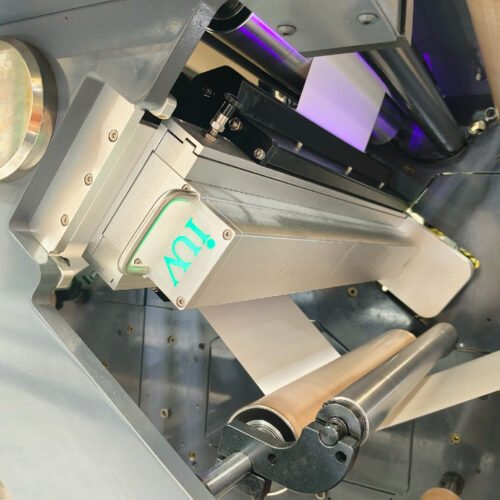
In real press environments, curing modules do not operate in clean laboratory conditions. They are exposed to paper dust, coating mist, silicone contamination, adhesive vapors, ink debris, and general airborne process residue. Over time, these contaminants can affect the optical path and reduce the amount of usable UV energy reaching the ink film.
This reduction may not happen uniformly. One side of the lamp may lose efficiency faster than the other. A local contamination area may create a weak cure band that only affects certain graphics or coating zones. In narrow web printing, that kind of inconsistency can lead to difficult troubleshooting because the system may still appear functional overall.
A press that wants stable curing must maintain stable optical transmission. That means optical cleanliness should be treated as part of process control, not just periodic housekeeping.
Why Web Speed and Cure Output Must Stay Synchronized
One of the most important control relationships in LED UV flexographic printing is the connection between web speed and curing output. If speed changes but curing conditions do not adjust correctly, polymerization behavior will shift immediately.
This is especially relevant during acceleration, deceleration, job setup, splice events, and operator intervention. A curing system that performs well at one stable speed may become inconsistent if the line changes speed frequently without appropriate output coordination. In some cases, the issue is not low power but poor synchronization between production speed and delivered energy.
For stable narrow web production, curing should follow the real dynamics of the press, not just a static setpoint. The closer the curing response matches actual line conditions, the more reliable the process becomes.
Why Substrate Variation Changes the Cure Window
In label and flexible packaging printing, converters often run a wide range of materials on the same press. Paper, coated paper, PE, PP, PET, filmic label stock, metallized materials, and synthetic constructions all respond differently to UV LED curing. Surface energy, heat sensitivity, holdout, and film behavior can all change how the ink cures.
This means a curing condition that is stable on one substrate may be marginal on another, even with the same artwork and ink set. If the press is not controlled with substrate behavior in mind, curing stability can appear inconsistent from job to job even when the hardware is unchanged.
The most stable production environments recognize that curing is substrate-dependent. They build control strategy around the actual behavior of the web, not only around lamp settings.
Why Ink Chemistry Drift Can Destabilize a Previously Stable Process
A job can start with strong cure performance and still become unstable later if the ink chemistry changes during the run. This often happens through temperature rise, viscosity drift, contamination, or recirculation imbalance. In LED UV systems, ink chemistry must remain within a relatively controlled process window if polymerization is expected to stay consistent.
For example, if viscosity shifts enough to increase film thickness or reduce leveling quality, the same UV dose may no longer produce the same result. If contamination changes the surface condition of the ink, cure behavior may also become less predictable. In these cases, the lamp is not necessarily failing. The chemistry reaching the lamp has changed.
That is why curing stability must always include ink condition control as part of the process strategy.
Why Cross-Web Uniformity Is Essential in Label Production
In narrow web flexographic printing, curing must remain stable not only over time but also across the print width. If one side of the web receives a different effective cure condition than the other, the result may be uneven adhesion, variable gloss, inconsistent rub resistance, or converting problems that appear only on certain lanes.
Cross-web instability can be caused by optical contamination, cooling imbalance, mechanical positioning error, inconsistent ink film thickness, or non-uniform substrate behavior. In multi-lane label production, even small cross-web variations can create large quality issues once the job is slit and finished.
This is why curing stability should always be evaluated as both a longitudinal and transverse process condition. A stable press must cure evenly in both directions.
Why Converting Performance Is Often the Best Stability Indicator
A printed label may appear fully acceptable at press exit and still reveal cure instability later in finishing. This is common in LED UV production because some forms of undercure or inconsistent polymerization do not show immediately as visible defects.
Instead, the first signs may appear during die-cutting, matrix stripping, slitting, lamination, rewinding, or end-use handling. Labels may scuff too easily, adhesive performance may be affected, or the film may fail under mechanical stress even though the print looked fine at inspection.
That is why the best process control systems do not judge curing only by visual appearance. They judge it by how the printed structure performs through the full manufacturing chain. In label production, converting reliability is often the clearest proof of curing stability.
Why Stable Curing Requires a Whole-Press Mindset
The most common mistake in curing control is treating the LED UV module as an isolated device. In real flexographic production, it is only one part of a much larger system. Curing stability depends on how the entire press behaves together.
Ink transfer, substrate handling, cooling, optics, speed control, press mechanics, environmental cleanliness, and production discipline all influence the curing result. If even one of those areas drifts too far, the process may begin to fail despite the lamp operating within specification.
The strongest production teams understand that curing is not a separate department of the press. It is an integrated outcome of the whole process. That mindset is what creates stable, repeatable, high-speed UV LED production.
Process Discipline Is What Separates Stable Production from Temporary Success
Many presses can produce a few hundred meters of acceptable labels under favorable conditions. Far fewer can maintain the same curing quality over long runs, mixed substrates, repeat jobs, and high-speed schedules without constant adjustment.
That difference usually comes down to process discipline. Stable curing is built on repeatable setup, monitored conditions, consistent cleaning, controlled ink delivery, reliable cooling, and a press team that understands where drift begins. Once those disciplines are in place, UV LED curing becomes far more predictable and productive.
In flexographic label printing, the goal is not simply to cure the ink. The goal is to keep curing performance stable enough that the entire production system can run with confidence.
Conclusion
Maintaining curing stability in LED UV flexographic printing requires much more than sufficient lamp power. It requires process control across ink transfer, thermal balance, cooling efficiency, optics condition, substrate behavior, speed synchronization, and cross-web consistency.
In narrow web label production, curing stability is one of the clearest indicators of process maturity. When the press is controlled as a system, UV LED curing delivers reliable adhesion, consistent print quality, and stronger downstream converting performance. When process drift is ignored, even advanced curing hardware will eventually struggle.
For converters aiming to improve uptime, print consistency, and production confidence, curing stability should be treated as a core operating discipline rather than a final-stage check.