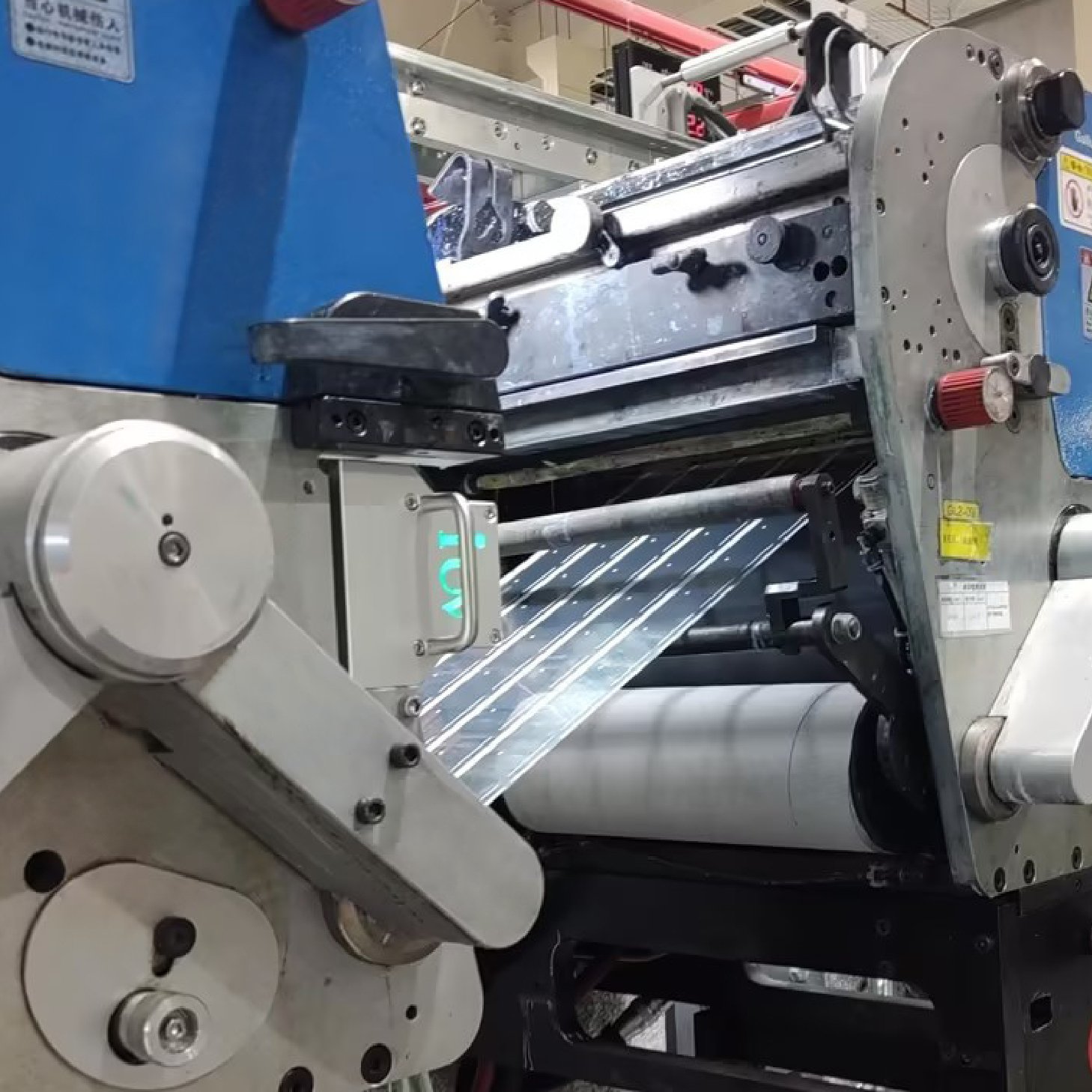
Introduction to Automatic Speed-Matching in LED UV Curing
Automatic speed-matching is one of the most important control functions in modern LED UV curing systems used in label printing production. In narrow web printing, flexographic printing systems, and hybrid offset press configurations, the curing process must remain stable while the press continuously changes operating conditions. Acceleration, deceleration, short-run job changes, splice recovery, and operator intervention all create variations in web speed that directly affect the energy delivered to the printed ink film.
If the LED UV curing system does not adjust correctly to these speed changes, the result is often unstable polymerization. In practical production, this can lead to ink adhesion variation, incomplete cure on dense solids, overexposure of thin substrates, or inconsistent low migration performance. For engineers and system integrators, programming automatic speed-matching is therefore not simply a convenience feature. It is a critical process control function that directly influences curing stability, print durability, substrate behavior, and production efficiency.
In a well-integrated press environment, the curing controller should respond to web speed as part of a coordinated closed-loop process rather than as an isolated lamp power adjustment. This requires a programming strategy that accounts for the relationship between line speed, exposure time, ink film structure, substrate sensitivity, and the thermal behavior of the LED curing system.
What Automatic Speed-Matching Means in UV LED Curing Systems
In technical terms, automatic speed-matching refers to the controller logic that adjusts LED UV curing output in response to changes in press speed so that the UV ink curing process remains within a stable operating window. The goal is to maintain a repeatable curing response even when the substrate dwell time beneath the curing unit changes.
In narrow web printing, dwell time is directly linked to web speed. When the press accelerates, the ink film spends less time under the curing zone. If the curing system output remains unchanged, the total energy absorbed by the ink decreases. If the press slows down and the output remains constant, the opposite occurs. Both situations can create process instability if not managed correctly.
Programming automatic speed-matching therefore involves more than simply linking lamp power to line speed. The controller must interpret speed changes in a way that maintains effective polymerization while avoiding excessive thermal load, unstable edge curing, or unnecessary power cycling. This becomes especially important in flexographic printing systems and hybrid offset presses where different stations may apply different ink film thicknesses or coating structures that respond differently to the same curing profile.
Why Speed-Matching Is Critical in Label Printing Production
In practical label printing production, press speed is rarely constant over the full job. Operators slow down for register checks, accelerate after splice events, and often run different jobs with different substrate and ink combinations during the same shift. Without automatic speed-matching, the curing process becomes highly dependent on operator intervention and manual lamp adjustments, which reduces repeatability and increases production risk.
One common failure mode occurs during short slow-speed setup runs. If the curing system is not matched correctly to reduced speed, thin film label materials may receive excessive exposure and experience substrate deformation, overcure, or altered release characteristics. Conversely, when production returns to full operating speed, the same system may undercure dense flexographic solids or heavily pigmented offset areas if the output does not scale appropriately.
This issue becomes even more significant in low migration printing environments. If curing conditions drift outside the validated process window during speed transitions, residual uncured components may remain in the ink film. That creates not only a print quality problem but also a potential compliance issue for sensitive packaging applications.
For this reason, speed-matching logic should be treated as a process validation tool as much as a machine control feature.
Defining the Control Objective Before Programming
Before programming the controller, engineers must define what the system is intended to maintain during speed changes. In many cases, the practical objective is not constant output, but constant curing response. This distinction is important because the relationship between lamp output and actual polymerization is influenced by ink chemistry, substrate characteristics, and press geometry.
For example, some UV ink curing processes are more sensitive to insufficient exposure than to slight overexposure, while others may show acceptable surface cure but weak interlayer adhesion if the energy profile changes too rapidly during acceleration. In hybrid offset and flexographic printing systems, this sensitivity may vary by print station depending on the ink type and film thickness being cured.
The controller logic should therefore be built around a realistic process objective. That objective may be stable adhesion, repeatable cure depth, consistent varnish hardness, or maintenance of a validated low migration window. Once this target is defined, speed-matching parameters can be programmed to support actual production performance rather than theoretical electrical behavior.
Selecting the Correct Speed Reference from the Press
The quality of any speed-matching strategy depends on the quality of the speed signal being supplied to the curing controller. In integrated narrow web printing systems, the speed reference may be derived from the main drive, encoder feedback, or a synchronized control network within the press.
The critical engineering requirement is that the speed signal must represent actual substrate transport behavior rather than only motor command status. If the curing controller receives a nominal speed value that does not accurately reflect what the web is doing during transient conditions, the output correction may occur too early, too late, or at the wrong magnitude.
This issue is particularly relevant in older press retrofits where the curing system is being integrated into legacy flexographic printing systems that were not originally designed for coordinated digital process control. In these cases, the controller may need signal filtering, validation logic, or timing compensation to avoid unstable lamp behavior during speed fluctuations.
In practical terms, the best speed reference is the one that most accurately represents the real movement of the substrate through the curing zone under production conditions.
Building the Speed-to-Output Mapping Logic
Once a reliable speed reference is available, the next engineering task is defining how LED UV curing output should respond to that speed signal. A common mistake is to assume that output should scale in a simple linear relationship with line speed. While this may work as a rough starting point, it often does not provide optimal curing stability across real production conditions.
The actual curing response depends on how the UV ink curing process behaves at different dwell times. Some inks respond predictably to proportional changes in exposure, while others show threshold behavior where cure quality changes sharply below a certain effective exposure condition. Substrate thermal sensitivity may also require a more conservative response at lower speeds to prevent overheating.
In flexographic printing systems, thick white inks, opaque colors, and specialty coatings may require different speed-to-output behavior than thin process colors or offset-applied graphics. In hybrid press environments, the controller may therefore need programmable operating profiles based on job type, substrate family, or curing station function.
A well-designed mapping logic should reflect actual process behavior observed on press, not just the electrical capability of the curing hardware.
Managing Acceleration and Deceleration Transitions
One of the most important parts of speed-matching programming is handling transient motion rather than steady-state speed. In real label printing production, many curing-related defects occur not during stable running, but during speed transitions when the web and curing system are moving between operating states.
If the LED UV curing output responds too aggressively to rapid speed changes, the result can be unnecessary output oscillation, thermal instability, or curing inconsistency between sequential labels. If the response is too slow, the curing process may lag behind the actual web condition and create localized undercure or overcure.
Controller programming should therefore include transition logic that smooths the response to acceleration and deceleration without sacrificing process accuracy. This often involves response shaping, update timing control, and stabilization windows that prevent abrupt output jumps during short press events.
In hybrid offset and flexographic printing systems, this becomes especially important because the curing process may influence not only the current print layer but also the adhesion and receptivity of downstream layers. A transient curing disturbance in one station can create defects that only appear later in the press or during converting.
Coordinating Speed-Matching with Thermal Management
LED UV curing output changes are not only optical events. They are also thermal events. Every output adjustment affects the thermal load on the LED array, the cooling system, and in some cases the substrate itself. For this reason, speed-matching logic must be programmed with thermal behavior in mind.
If the controller commands large and frequent output changes without considering the thermal response of the curing system, the result may be unstable module temperature and drift in optical performance. Over time, this can reduce cross-web consistency and create variation in curing response even when the speed logic appears correct.
Thermal coordination is especially important in compact narrow web press installations where airflow and heat dissipation may already be constrained. In these systems, the controller may need to include thermal guard logic that limits output behavior under certain conditions or delays full response until thermal stability is confirmed.
This is also relevant for substrate stability. Flexible label materials may tolerate normal production curing conditions but react poorly to excessive exposure during low-speed operation if thermal compensation is not handled properly. Good speed-matching logic therefore protects both curing quality and substrate behavior.
Integrating Speed-Matching with Job Recipes and Press Modes
In practical production, one curing profile rarely fits every application. Label printing production often includes paper labels, filmic labels, varnished jobs, laminated constructions, and low migration packaging work, each with different curing demands. For this reason, automatic speed-matching should ideally be integrated into job-specific operating recipes rather than programmed as a single universal response.
A well-designed controller allows the speed-matching logic to adapt according to press mode, substrate family, or curing station assignment. For example, a station curing a heavy flexographic white ink may require different output scaling than a station stabilizing a thin offset image or a coating layer.
This recipe-based approach improves repeatability and reduces setup time because the curing controller behaves according to known process conditions rather than relying on manual correction during every job. It also supports more stable production efficiency by reducing trial-and-error adjustments during job changes.
For retrofitted systems, recipe integration may require additional communication with the press control architecture, but the operational benefit is often significant.
Validating the Program Under Real Production Conditions
A speed-matching program should never be considered complete until it has been validated on press under realistic production conditions. Simulation or bench testing can confirm electrical function, but only actual label printing production can confirm whether the programmed logic maintains stable curing behavior across the full operating range.
Validation should include observation of cure consistency during startup, acceleration, deceleration, substrate changeover, and normal steady-state running. The evaluation should focus on practical outputs such as ink adhesion behavior, cure response on dense solids, varnish performance, substrate dimensional stability, and any known low migration validation requirements.
This stage is critical because it often reveals interactions that are not obvious during initial programming. For example, a speed-matching curve that works well on paper labels may produce marginal curing on filmic constructions, or a transition response that appears smooth electrically may still create thermal drift over long runs.
Validation therefore turns the controller program from a machine function into a true process control tool.
Common Programming Errors in LED UV Speed-Matching
Several recurring mistakes can reduce the effectiveness of automatic speed-matching in UV LED curing systems. One is relying too heavily on theoretical linear scaling without correlating the response to actual print performance. Another is using an unstable or delayed speed reference that causes the controller to react out of sync with the web.
A further issue is neglecting the effect of thermal lag, especially in long production runs or in presses with constrained cooling airflow. Some systems also fail because they are programmed as universal solutions even though the curing demands of different stations and substrates vary significantly.
These errors do not always create immediate visible defects, which is why they often remain embedded in production systems for long periods. However, they frequently appear later as inconsistent adhesion, unexplained cure drift, operator dependence, or reduced process confidence during demanding jobs.
Avoiding these issues requires an engineering approach grounded in actual press-floor behavior rather than only control theory.
Conclusion
Programming automatic speed-matching for UV LED curing systems controllers is a critical engineering task in modern narrow web printing, flexographic printing systems, and hybrid offset label production. It directly affects curing stability, ink adhesion performance, substrate behavior, low migration reliability, and overall production efficiency.
A successful implementation begins with a clear process objective, a reliable speed reference, and a response logic based on actual UV ink curing behavior rather than simple theoretical scaling. It must also account for thermal management, press integration constraints, and the real variability of label printing production.
When properly programmed and validated, automatic speed-matching transforms the LED UV curing system from a passive output device into an active process control element that supports repeatable, stable, and production-ready curing performance across the full operating range of the press.