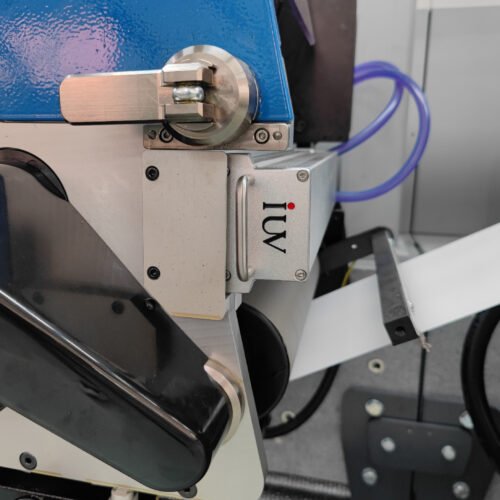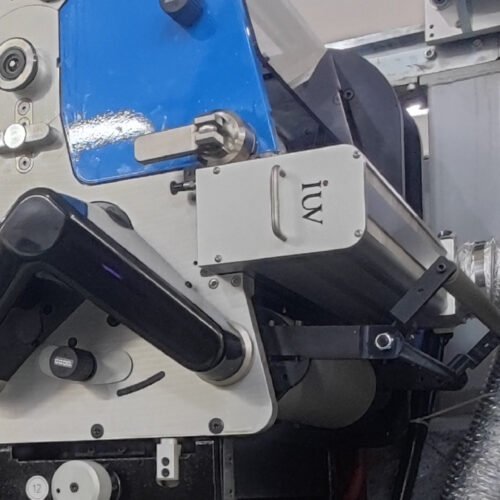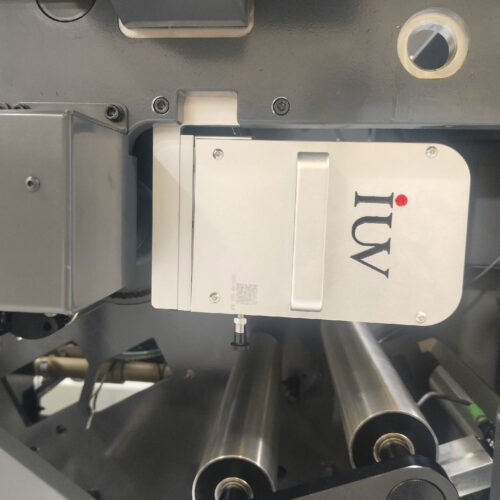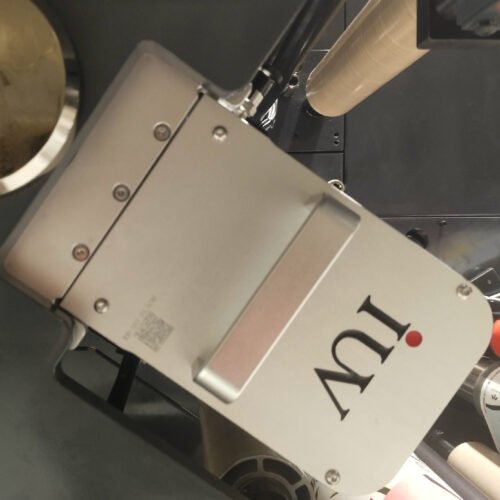
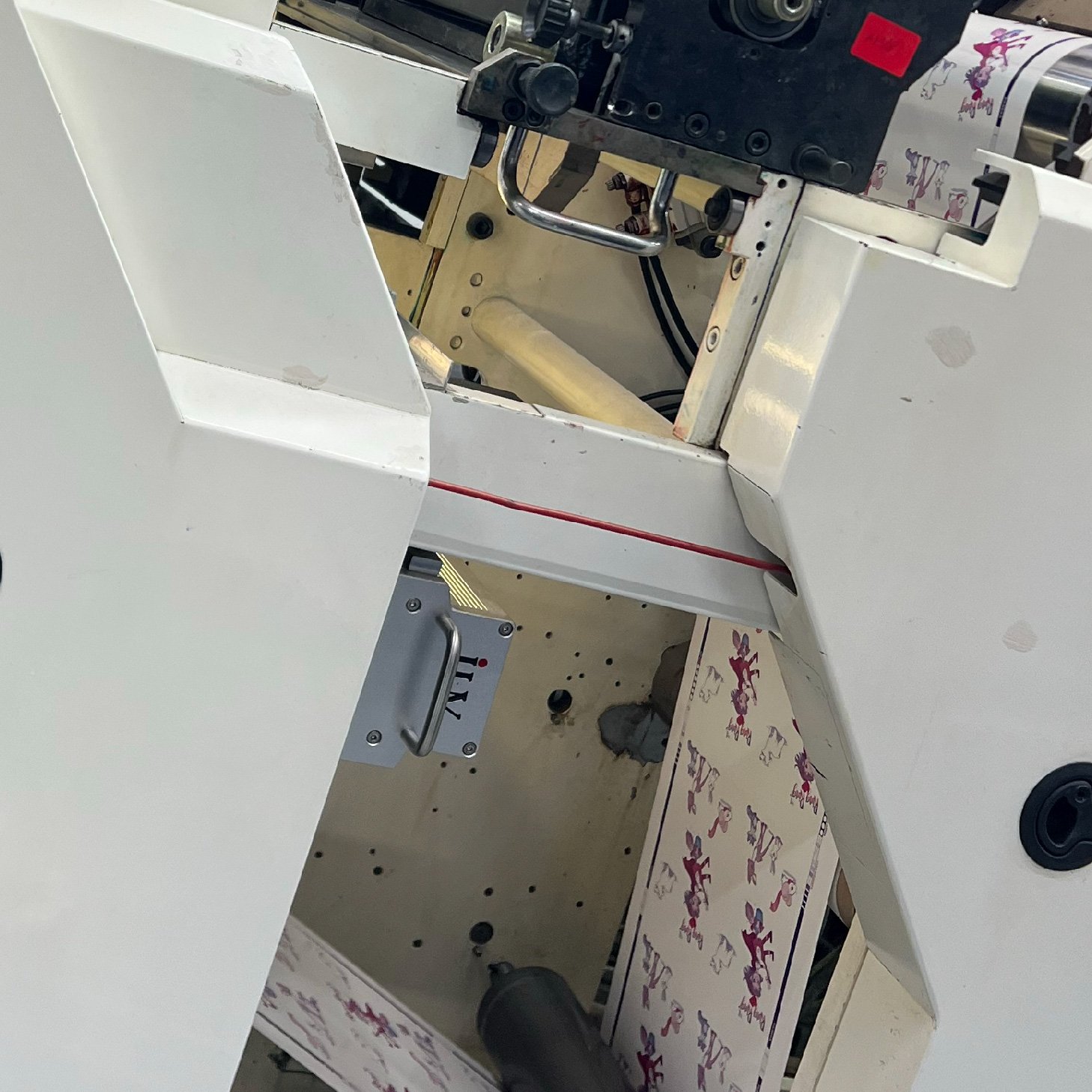
In industrial printing environments such as offset printing and narrow web label production, the interaction between UV curable ink and the UV LED curing system is not simply a matter of “turning on lamps and drying ink.” From an engineering standpoint, curing efficiency is the result of a tightly balanced system involving UV dose control, spectral matching, ink chemistry response, substrate thermal behavior, and press speed synchronization. When any of these variables drift out of range, production instability appears immediately in the form of incomplete cure, poor adhesion, or unpredictable gloss variation.
In modern flexographic printing and label printing lines, the transition from mercury-based UV lamps to UV LED curing systems has fundamentally changed how curing stability is managed. Unlike broadband UV lamps, LED systems operate at specific wavelengths, typically 365 nm, 385 nm, or 395 nm, which means UV curable ink formulations must be photoinitiator-matched to the emission spectrum. If the absorption peak of the photoinitiator does not align with the LED wavelength, curing efficiency drops even if the system appears to be operating at full power. This mismatch is one of the most common hidden causes of instability in high-speed label production.
From a production engineering perspective, curing efficiency is defined not only by surface dryness but by full polymerization depth. UV curable ink in UV LED curing system curing efficiency optimization for offset and label printing production performance improvement depends heavily on UV dose, which is the product of irradiance and exposure time. In narrow web presses running at high line speeds, exposure time is extremely short, so the system compensates with higher irradiance or optimized reflector geometry. However, increasing irradiance without managing temperature control can introduce ink surface overheating, which changes viscosity during polymerization and leads to internal stress in the cured film.
In offset printing systems, particularly on coated paper or synthetic substrates, oxygen inhibition plays a critical role in curing efficiency. UV curable ink in UV LED curing system curing efficiency optimization for offset and label printing production performance improvement is significantly affected by the oxygen layer at the ink-air interface. Free radical polymerization is suppressed by oxygen molecules, which results in a tacky surface even when bulk curing appears complete. In high-speed production environments, this issue becomes more severe because ink film thickness is often reduced to maintain dot gain control. The engineering solution is not simply increasing UV power, but adjusting nitrogen inerting or optimizing photoinitiator concentration to improve surface reaction kinetics.
Thermal management is another critical parameter that is often underestimated. Although UV LED curing systems are classified as “cold UV,” they still generate localized heat at the substrate interface. Heat-sensitive films used in label and flexible packaging applications react strongly to temperature fluctuations, which can lead to dimensional instability or shrinkage. When UV curable ink in UV LED curing system curing efficiency optimization for offset and label printing production performance improvement is evaluated in real production, substrate temperature must be monitored alongside UV dose. In practice, stable curing is achieved when ink polymerization rate and heat dissipation rate are in equilibrium.
Material compatibility also defines curing success. In flexographic printing, inks are often formulated for low-viscosity transfer through anilox rollers, but this same formulation may behave differently under LED spectral conditions. If pigment loading is too high, UV penetration depth is reduced, leading to undercured lower layers. This is particularly visible in opaque white inks and high-density black formulations used in label printing. Engineers often observe that surface hardness tests pass while scratch resistance fails, indicating incomplete cross-linking beneath the surface.
In high-speed label production, press synchronization becomes another limiting factor. UV curable ink in UV LED curing system curing efficiency optimization for offset and label printing production performance improvement is not only a chemistry problem but also a mechanical timing problem. If press speed increases without recalibration of UV dose delivery, curing margin collapses. This is why modern systems integrate closed-loop power modulation, adjusting LED output in real time based on line speed feedback.
From a troubleshooting perspective, inconsistent curing often originates from three interacting variables: wavelength mismatch, insufficient UV dose, or excessive ink film thickness. Engineers typically begin diagnostics by measuring actual irradiance at substrate level rather than relying on system-rated power. Over time, dust accumulation on optical windows and reflector degradation can reduce effective UV output by more than 20%, which directly affects curing reliability.
Another overlooked factor is ink formulation variability. Even within the same UV curable ink series, batch-to-batch variation in photoinitiator distribution can shift curing response curves. This becomes visible in offset printing where large surface areas amplify small differences in cure kinetics. In such cases, process stability depends more on system tuning than on raw lamp power.
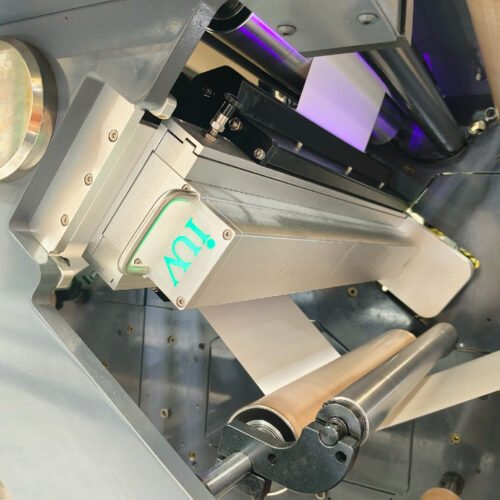
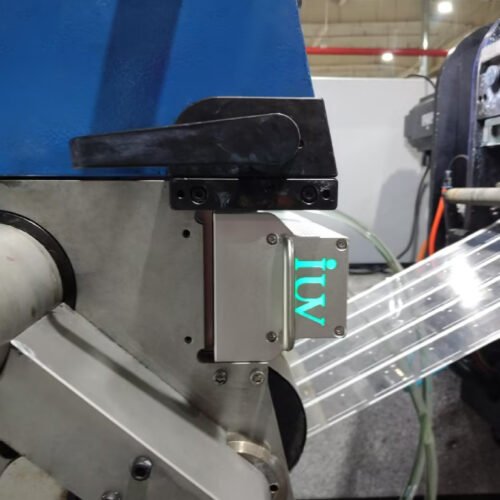
In advanced production environments, UV LED systems are increasingly integrated with spectral monitoring and thermal feedback loops. Some systems, including solutions developed by IUV, incorporate adaptive UV dose control to maintain consistent curing energy across different press speeds and substrate types. This allows UV curable ink in UV LED curing system curing efficiency optimization for offset and label printing production performance improvement to remain stable even under variable production loads, such as job changeovers in narrow web label printing.
Ultimately, curing efficiency is not a single parameter but a system-level equilibrium. UV curable ink chemistry, LED wavelength selection, oxygen exposure, temperature control, and mechanical speed must all operate within defined tolerance bands. When these variables are properly balanced, both offset printing and flexographic label production achieve higher throughput, improved adhesion strength, and reduced rework rates without increasing energy consumption.