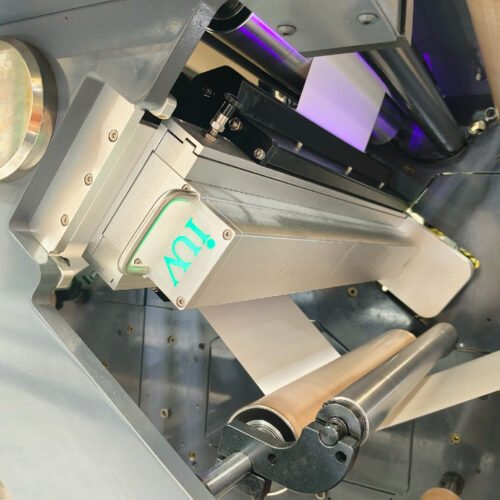
Print defects caused by insufficient UV dose are among the most common production issues in narrow web label printing. Although they often appear as ink adhesion failure, poor scratch resistance, surface tackiness, or inconsistent gloss, the root cause is frequently an imbalance between UV wavelength, irradiance, exposure time, ink chemistry, substrate characteristics, and press speed. Modern UV LED Curing Equipment for the Label Industry: Troubleshooting Print Defects Caused by Insufficient UV Dose requires engineers to evaluate the complete curing process rather than simply increasing lamp power. Proper UV dose management improves curing consistency, print durability, production efficiency, and overall press stability.
Understanding Why Insufficient UV Dose Creates Printing Defects
In flexographic label printing, UV curing is a photochemical reaction rather than a heating process. When UV-curable ink is exposed to ultraviolet energy, photoinitiators absorb photons at specific wavelengths—typically 365 nm, 385 nm, or 395 nm—and generate reactive radicals that initiate polymerization. The objective is to form a fully crosslinked ink film with sufficient mechanical strength and chemical resistance before the printed web reaches the next converting operation.
Many operators assume insufficient curing simply means the LED lamp output is too low. In reality, UV LED Curing Equipment for the Label Industry: Troubleshooting Print Defects Caused by Insufficient UV Dose begins with understanding that UV dose is the product of irradiance and exposure time. A high-power LED array cannot compensate for excessive press speed, while longer exposure cannot fully compensate for inadequate irradiance if the photoinitiator absorption spectrum is not properly matched.
When UV dose falls below the curing threshold required by the ink formulation, polymer chains remain partially developed. This incomplete crosslinking often causes ink transfer during rewinding, blocking between labels, reduced abrasion resistance, poor die-cutting performance, and insufficient adhesion on films commonly used in label production.
Because these defects may appear gradually during production, engineers should avoid treating them as isolated print quality problems. Instead, they should evaluate the entire curing system as an integrated engineering process involving UV LED wavelength, optical efficiency, cooling stability, ink formulation, substrate properties, and machine operating conditions.
UV Dose Is Influenced by More Than Lamp Output
A stable UV curing process depends on several variables working together simultaneously. Wavelength selection directly determines how efficiently photoinitiators absorb energy. Most narrow web label applications today are optimized around 385 nm or 395 nm LED curing systems because these wavelengths provide excellent compatibility with modern UV flexographic inks while significantly reducing infrared heat compared with conventional mercury lamps.
However, wavelength alone cannot guarantee complete curing. Energy density delivered to the ink surface depends on optical focus, curing distance, LED irradiance, web speed, and optical contamination. Even a thin layer of ink mist or paper dust on the quartz protection window can reduce transmitted UV energy enough to create localized curing defects.
Temperature control is another frequently overlooked factor. Although UV LED systems generate much less radiant heat than conventional UV lamps, junction temperature inside the LED modules directly affects optical output stability. Insufficient cooling gradually reduces irradiance during long production runs, causing curing consistency to deteriorate without obvious warning.
Modern UV LED Curing Equipment for the Label Industry: Troubleshooting Print Defects Caused by Insufficient UV Dose therefore requires continuous monitoring of both optical performance and thermal management rather than relying solely on nominal electrical power ratings.
Ink Chemistry and Oxygen Inhibition Affect Polymerization Efficiency
UV curing performance also depends heavily on ink chemistry. Different UV inks contain different photoinitiator packages designed for specific LED wavelengths and curing speeds. An ink optimized for mercury lamps may absorb energy inefficiently under LED irradiation, producing incomplete polymerization even when irradiance appears sufficient.
Ink film thickness further influences curing behavior. Thick opaque white inks require much deeper UV penetration than transparent process colors. Pigments scatter and absorb ultraviolet energy, reducing the amount of radiation reaching lower ink layers. As a result, the surface may appear dry while the lower portion of the ink film remains under-cured.
Oxygen inhibition presents another common challenge, particularly with varnishes and low-viscosity coatings. Oxygen molecules compete with free radicals generated during polymerization, slowing the curing reaction at the ink surface. The result may be surface tackiness despite adequate curing beneath the surface. Engineers often misinterpret this condition as insufficient lamp power when the actual limitation is oxygen interference combined with marginal UV dose.
Material compatibility also plays an important role. Films such as PET, PP, PE, and shrink sleeves exhibit different thermal characteristics and surface energies, influencing both adhesion and curing behavior. A UV dose suitable for coated paper labels may not provide identical curing performance on highly flexible polymer films.
In practical troubleshooting, evaluating substrate characteristics together with ink formulation often identifies the true source of recurring adhesion failures far more effectively than increasing LED output alone.