The transition to LED-UV curing has brought unprecedented control and efficiency to printing processes. Yet, one of the most critical and often misunderstood decisions is selecting the optimal peak wavelength for the application. The choice between 365nm, 385nm, and 395nm is not merely a matter of cost or availability; it fundamentally influences ink chemistry interaction, curing depth, and final print performance. This technical review dissects the photochemical and practical implications of each wavelength, providing a clear framework for selecting the right light for your specific printing needs in flexo, offset, and label production.
The Photochemical Foundation: How Wavelength Governs Polymerization
UV curing is a photochemical reaction initiated by photoinitiators (PIs) within the ink or coating. These molecules absorb photons of specific energies, corresponding to particular wavelengths, to generate reactive species that start the polymerization chain reaction. The absorption spectrum of a PI is therefore paramount. Shorter wavelengths, like 365nm, carry higher photon energy. This can lead to more efficient cleavage of certain PI types and potentially better surface cure. Longer wavelengths, like 395nm, penetrate deeper into the ink film with less scattering, which is beneficial for through-cure, especially in pigmented or thick layers. The selection is essentially about matching the emission peak of your LED system to the optimal absorption bands of the photoinitiator package in your chosen ink.
365nm: The High-Energy Specialist for Surface-Sensitive Applications
Emitting at the shorter end of the UVA spectrum, 365nm LEDs offer distinct advantages and trade-offs. The higher photon energy is excellent for initiating surface cure rapidly, making it suitable for applications requiring immediate scratch resistance. In sheetfed offset printing, this can help achieve high gloss finishes quickly. However, the higher energy also correlates with increased sensitivity to oxygen inhibition at the surface. More critically, the penetration depth of 365nm light is less than that of longer wavelengths. This can pose a challenge for fully curing dense white inks or thick varnish layers in label and packaging printing. Its use often requires ink formulations with specifically tuned PIs that absorb strongly at this wavelength to maximize efficiency.
385nm: The Balanced Performer for Broad Adaptability
Positioned between the extremes, 385nm has emerged as a highly versatile and recommended choice for many commercial and industrial printing applications. It strikes an effective balance between sufficient photon energy for reliable surface initiation and good depth penetration for thorough curing. This wavelength demonstrates broader compatibility with a wide range of commercially available LED-specific and hybrid ink systems. For converters running diverse jobs on narrow-web or wide-web flexo presses, from clear films to paper labels, 385nm provides operational stability and reduces the risk of cure-related defects. Industry experience suggests that 385nm often offers a wider processing window and greater tolerance to variations in ink film thickness compared to 395nm. This adaptability makes it a strategic choice for operations seeking to minimize ink-related validation hurdles.
395nm: The Penetration Leader for Challenging Formulations
The 395nm wavelength sits at the boundary of UVA and visible light. Its primary strength is superior depth of penetration with minimal scattering. This makes it exceptionally effective for curing heavily pigmented systems, such as opaque whites and metallics, which are common in premium label and flexible packaging. It is also less susceptible to oxygen inhibition. However, the lower photon energy means the selection of photoinitiators is crucial; the formulation must be meticulously designed to absorb efficiently at this longer wavelength to achieve a rapid surface cure. While popular, it may not provide the same breadth of compatibility as 385nm with off-the-shelf ink systems. Its ideal use case is in dedicated, high-performance applications where deep cure is the paramount concern.
Critical Application Factors Beyond Wavelength
Selecting a wavelength cannot be done in isolation. Several interconnected factors must be evaluated concurrently to ensure success.
- Ink Chemistry Compatibility: This is the foremost constraint. Always consult with your ink supplier. Using conventional mercury-lamp UV inks under a single-peak LED source carries a high risk of incomplete cure, regardless of the chosen wavelength. Insist on inks formulated or validated for LED curing at your specific target wavelength.
- Substrate and Opacity: For clear films and thin inks, 365nm or 385nm may suffice. For opaque, reflective, or thick layers (common in packaging), the deeper penetration of 385nm or 395nm becomes critical.
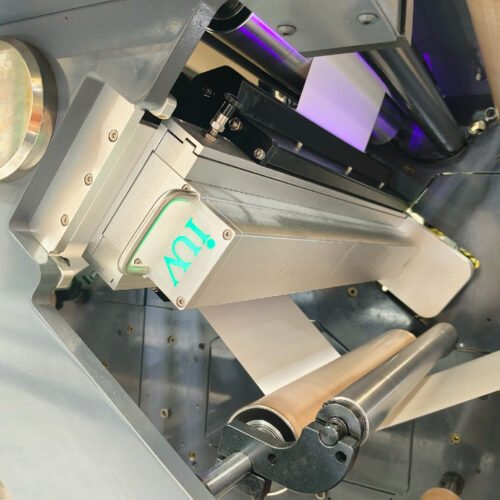
- System Irradiance and Dose: Wavelength is just one variable. The irradiance (W/cm²) and the resulting energy dose (J/cm²) delivered are equally vital. A high-irradiance 385nm system may outperform a low-power 395nm system. Ensure your equipment, like modern modular systems, can deliver the necessary high energy output (e.g., ≥30 W/cm²) uniformly across the web.
- Operational Flexibility: If your shop handles a wide variety of jobs, a wavelength with broader inherent compatibility, such as 385nm, reduces changeover complexity and inventory needs for different inks.
The Myth of “Best” Wavelength and Strategic Decision-Making
There is no universal “best” wavelength. The optimal choice is a strategic decision based on your specific production portfolio. A label printer specializing in wine bottle labels with dense whites might lean towards 395nm for its penetration power. A commercial sheetfed offset house printing a mix of marketing materials may find 385nm offers the best all-around reliability and ink vendor options. A wide-web flexible packaging converter could implement a dual-strategy, using 385nm for standard jobs and 395nm modules for specific high-opacity structures. The decision should be guided by a thorough process qualification with your actual materials, not by marketing claims or initial hardware cost alone.
Conclusion: Matching Light to Purpose for Future-Proof Performance
The evolution of LED-UV curing is moving towards intelligent, application-driven solutions. Understanding the nuanced roles of 365nm, 385nm, and 395nm wavelengths empowers printers to move beyond a one-size-fits-all approach. By aligning the photochemical properties of the light source with the specific demands of their inks, substrates, and end-use requirements, converters can unlock consistent quality, maximize production efficiency, and minimize waste. In an industry increasingly defined by specialization and sustainability, this technical mastery of wavelength selection is not just an engineering detail—it is a foundational element of a competitive, agile, and future-ready printing operation.