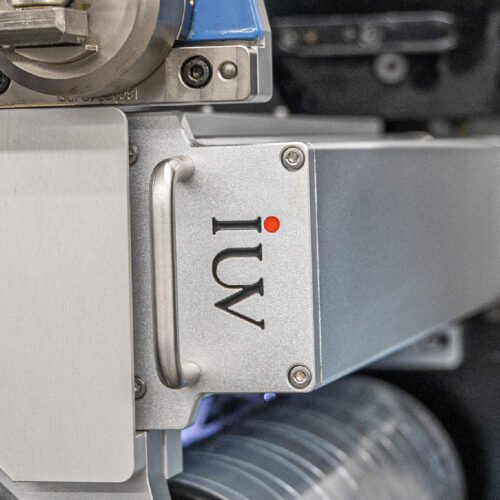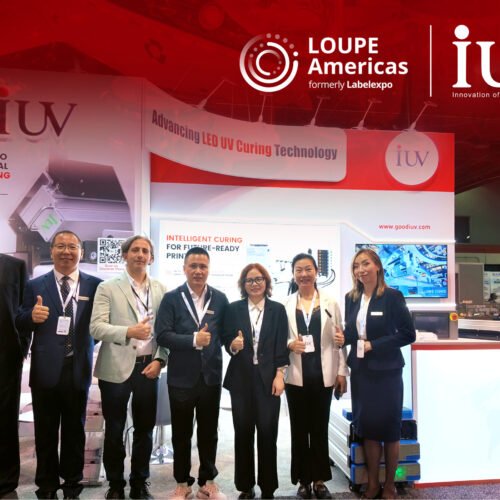

IUV will participate in Labeling-Tech Poland 2026, the International Trade Fair for Labeling Technology, from November 17 to 19 at Ptak Warsaw Expo in Poland. Visit IUV at Hall D11, Booth D60b to explore UV curing solutions for label printing, flexographic printing, offset printing, and narrow web applications.
As a UV curing equipment manufacturer, IUV provides LED UV curing systems, mercury UV curing systems, interchangeable curing solutions, and customized retrofit options. These solutions support printing equipment manufacturers, label converters, and production teams looking to improve curing performance and production efficiency.
Modern label printing requires more than high press speed. Printers must maintain consistent ink adhesion, accurate image reproduction, reliable curing, and stable substrate handling. The UV curing system must also work with the ink formulation, printing process, and finishing requirements.
IUV develops UV curing equipment around these practical production needs. At Labeling-Tech Poland 2026, visitors can discuss new press integration, existing machine upgrades, and OEM projects with the IUV team.
UV Curing Technology for Modern Label Production
UV curing is widely used in label printing because it allows compatible inks, coatings, and varnishes to cure rapidly under ultraviolet exposure. The process relies on photoinitiators that absorb UV energy and initiate polymerization within the ink or coating.
Unlike conventional drying methods that depend on solvent evaporation, UV curing forms a solid film through a chemical reaction. This can support immediate handling and faster movement into downstream converting processes.
However, successful UV curing depends on several factors. These include wavelength, irradiance, UV dose, ink chemistry, film thickness, substrate properties, and press speed.
Insufficient curing can cause poor adhesion, surface tack, weak rub resistance, or problems during rewinding and finishing. Excessive heat can also affect thin films and dimensional stability.
For this reason, selecting UV curing equipment requires an understanding of the complete printing process. IUV works with customers to evaluate curing requirements and identify suitable system configurations for different printing applications.
IUV LED UV Curing Systems for Narrow Web Printing
Narrow web printing combines compact machine layouts with demanding production requirements. A single press may include flexographic printing, rotary screen printing, varnishing, coating, foil application, and die-cutting.
Each station has different curing requirements. Some applications need controlled ink setting before the next printing unit, while others require complete curing before winding or finishing.
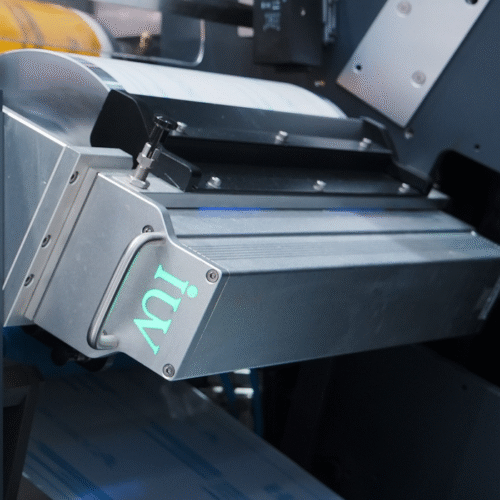
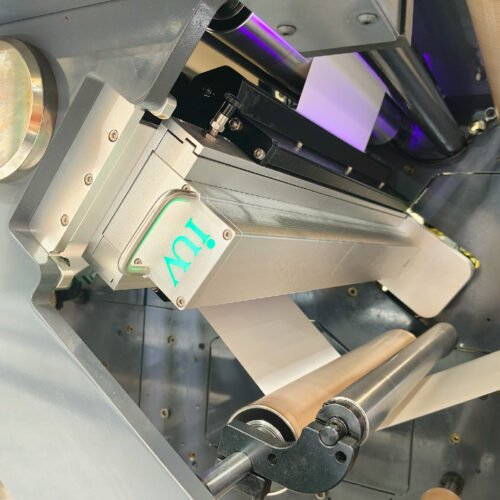
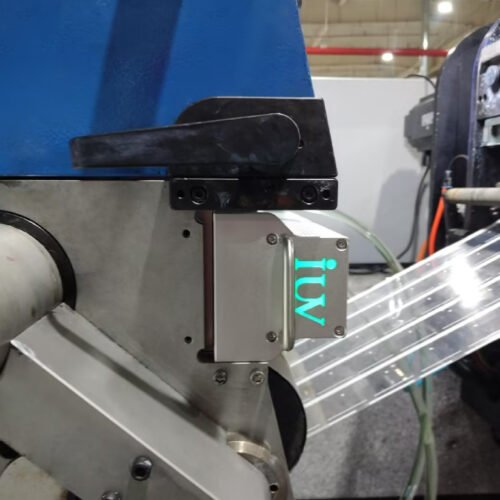
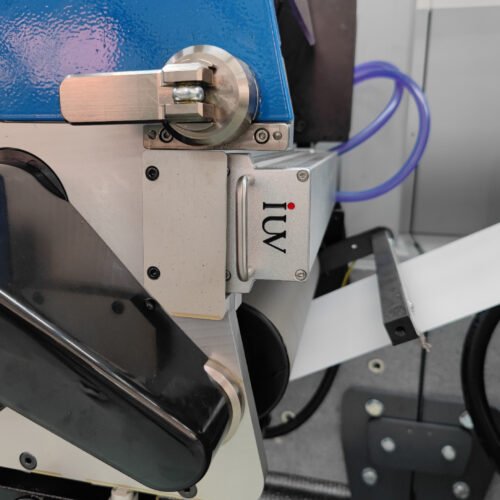
IUV LED UV curing systems are designed for integration into suitable narrow web presses. Their compact configuration can help accommodate the limited installation space commonly found between printing stations.
LED UV curing offers instant on/off operation and adjustable output. These features help reduce unnecessary energy consumption during press stops, setup, and job changes.
Automatic web-width adjustment can also help match the active curing area to the material width. This is particularly useful for converters handling different label formats on the same press.
Water-cooled LED modules help control operating temperatures during continuous production. Stable thermal management supports reliable operation and consistent curing performance.
For narrow web converters, the correct LED UV curing system should match the press speed, working width, ink chemistry, and available installation space. IUV can discuss these requirements with printing companies and press manufacturers.
LED UV Curing for Flexographic Label Printing
Flexographic printing is widely used for pressure-sensitive labels, shrink sleeves, and flexible packaging. The process supports high-speed production and a broad range of paper and film substrates.
In UV flexographic printing, the curing system must work with the ink transfer process. Anilox volume, plate characteristics, ink formulation, colour density, and press speed all influence the final result.
Highly pigmented inks and opaque colours can require careful curing evaluation. Pigments may absorb or scatter UV energy, reducing the energy available to cure deeper layers of the ink film.
The selected LED wavelength must also match the photoinitiator system in the ink. A powerful lamp alone cannot compensate for an incompatible ink formulation or unsuitable curing conditions.
IUV LED UV curing equipment provides controlled UV output for compatible flexographic inks. Correct system integration helps printers establish suitable curing conditions for different colours, substrates, and production speeds.
For multi-station flexographic presses, intermediate curing may help control ink movement before the next colour is applied. Final curing must then provide the required film properties for winding, converting, and end use.
IUV also provides mercury UV curing options for applications that use conventional UV inks and coatings. The appropriate technology depends on the existing printing process and production requirements.
UV Curing Solutions for Offset Printing
Offset printing is valued for its ability to reproduce fine details, small text, and consistent graphics. In UV offset applications, curing performance affects handling, surface properties, and the next production stage.
LED UV curing can be used with offset inks and coatings formulated for the selected LED wavelength. Conventional mercury UV systems remain suitable for many established UV offset applications.
Ink coverage, coating thickness, press speed, and substrate characteristics influence curing requirements. Each installation should be assessed according to the actual production conditions.
UV curing is especially relevant when offset printing involves non-absorbent or coated materials. These substrates cannot rely on absorption alone to set the ink. UV polymerization helps form a solid film on the printed surface.
IUV provides LED UV and mercury UV curing equipment for suitable offset printing applications. Our team can assess press layout, available space, electrical requirements, cooling, and ink compatibility when discussing a new installation or retrofit.
The objective is to achieve reliable curing while maintaining print quality and supporting efficient downstream processing.
LED UV and Mercury UV: Choosing the Right Technology
LED UV and mercury UV curing systems offer different operating characteristics. Choosing between them requires consideration of the ink system, substrate range, press design, and production targets.
LED UV curing uses semiconductor light sources that emit UV energy within a defined wavelength range. Common wavelengths for printing applications include 365, 385, and 395 nm.
LED UV systems switch on and off immediately and do not require the same warm-up period as conventional mercury lamps. They can also reduce unnecessary standby energy consumption and limit unwanted heat transfer to the substrate.
Mercury UV lamps provide a broader emission spectrum. They remain suitable for many conventional UV inks, coatings, and varnishes used in established printing processes.
For printers considering a transition to LED UV, ink compatibility is essential. Existing conventional UV inks may not cure adequately under an LED source unless their formulation supports the selected wavelength.
IUV offers LED UV, mercury UV, and interchangeable curing solutions for selected applications. These options help printers evaluate the most suitable configuration for their production requirements.
Rather than choosing a curing system based on lamp power alone, printers should consider wavelength compatibility, irradiance, UV dose, press speed, cooling, and the required properties of the finished print.
Improving Energy Efficiency in UV Printing
Energy consumption is an important consideration for label converters operating multiple shifts or handling frequent job changes. The curing system can affect both direct electricity use and the maintenance requirements of the production line.
IUV LED UV curing systems support instant switching and adjustable output. These features help reduce unnecessary energy use when the press stops or full curing output is not required.
Automatic web-width adjustment can further improve energy efficiency by limiting the active curing area to the running material width. This helps avoid unnecessary output outside the printed web.
Effective cooling and electrical control are also important. LED modules must operate within their intended temperature range to maintain stable output and reliable performance.
For conventional UV applications, IUV mercury UV systems incorporate design features intended to improve operating efficiency. These include optimized cooling, reflective aluminum optics, and electronic shutter control.
Reflectors direct UV energy toward the printed surface, while the shutter helps manage UV exposure during press stops. Appropriate cooling supports stable operation under production conditions.
Actual energy savings depend on the machine configuration, job width, production schedule, curing settings, and operating environment. Evaluating these factors helps determine the potential benefits of a UV curing upgrade.
UV Curing for Heat-Sensitive Label Materials
Label converters often process thin films and synthetic materials, including PE, PP, PET, and BOPP. These substrates are used in a wide range of product labels and packaging applications.
Unlike many paper materials, plastic films can be sensitive to heat and dimensional changes. Excessive thermal exposure may contribute to web distortion, registration problems, or difficulties during converting.
LED UV curing generally transfers less unwanted heat to the substrate than conventional mercury UV arrangements. This can make it a suitable option for applications involving heat-sensitive materials.
However, the actual substrate temperature depends on the complete process. Lamp output, press speed, cooling, web tension, and repeated exposure can all influence the result.
IUV LED UV curing systems use water cooling to manage LED module temperatures during operation. This helps maintain stable system performance during demanding production runs.
For converters processing synthetic labels, the curing system should be evaluated alongside the ink formulation and substrate characteristics. The goal is to achieve the required cure while maintaining material stability and print quality.
UV Curing Retrofits and OEM Integration
IUV supports new press integration, existing machine retrofits, and OEM projects. With extensive experience in flexographic, offset, digital, and letterpress printing, as well as finishing applications, IUV serves a wide range of printing equipment requirements.
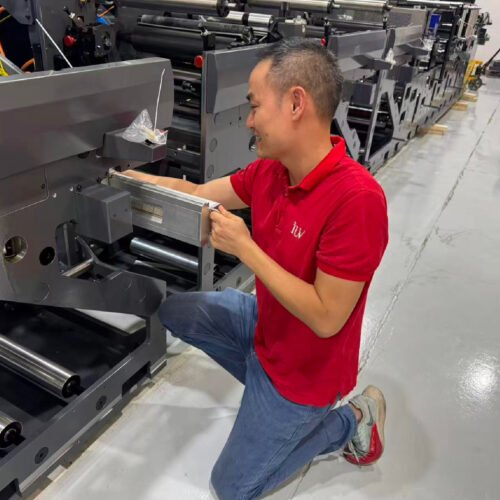
For existing presses, a UV curing retrofit can provide an option for upgrading older curing equipment without replacing the entire printing machine. Each project requires careful assessment of mounting dimensions, electrical capacity, cooling connections, web width, press speed, and control interfaces.
When changing from mercury UV to LED UV, engineers must also confirm ink and coating compatibility. The new system must provide suitable UV output for the intended production process.
IUV provides LED UV curing systems, mercury UV curing equipment, interchangeable solutions, and customized retrofit configurations. Modular power supplies and coordinated system components support integration into different machine layouts.
For printing equipment manufacturers, IUV can discuss OEM requirements and customized UV curing configurations. Mechanical installation, electrical arrangements, cooling, and control interfaces can be evaluated during project planning.
Numerous installations worldwide demonstrate IUV’s experience in integrating UV curing equipment into different printing systems. An international service and partner network, combined with local technical support, helps IUV provide customer-focused service to printing equipment manufacturers and converters.
From system integration to equipment upgrades, IUV focuses on practical solutions that address production requirements and support reliable operation.
Meet IUV at Labeling-Tech Poland 2026
Labeling-Tech Poland 2026 will bring together companies and professionals involved in labeling technology and related applications. For label converters and printing equipment manufacturers, the event provides an opportunity to explore production technologies and discuss industry requirements.
IUV will welcome visitors interested in UV curing equipment for label printing, flexographic printing, offset printing, and narrow web applications.
Whether you are planning a new press, upgrading an existing machine, or evaluating a customized OEM solution, discussing the application requirements is an important first step.
Useful information includes printing width, maximum press speed, ink and coating types, substrate range, installation space, and current curing challenges. These details help determine suitable UV wavelengths, output requirements, cooling arrangements, and control configurations.
The IUV team can discuss LED UV curing, mercury UV systems, interchangeable solutions, and retrofit options according to your production needs.
Exhibition Details
- Event: Labeling-Tech Poland 2026
- Date: November 17–19, 2026
- Venue: Ptak Warsaw Expo, Nadarzyn, Poland
- Hall: D11
- IUV Booth: D60b
Visit IUV at Hall D11, Booth D60b, to discuss UV curing solutions for label printing, flexographic printing, offset printing, and narrow web production.
Contact IUV for UV Curing Solutions
IUV provides UV curing equipment for printing, coating, and converting applications. Our product range includes LED UV curing systems, mercury UV curing systems, interchangeable solutions, and customized retrofit options.
We work with printing equipment manufacturers, label converters, and end users to evaluate curing requirements and develop suitable configurations for new installations and existing press upgrades.
If you are looking for a UV curing equipment manufacturer for label printing, flexographic printing, offset printing, or narrow web applications, IUV welcomes the opportunity to discuss your project.
Meet IUV at Labeling-Tech Poland 2026, Hall D11, Booth D60b, and explore UV curing solutions designed for the practical demands of modern printing production.