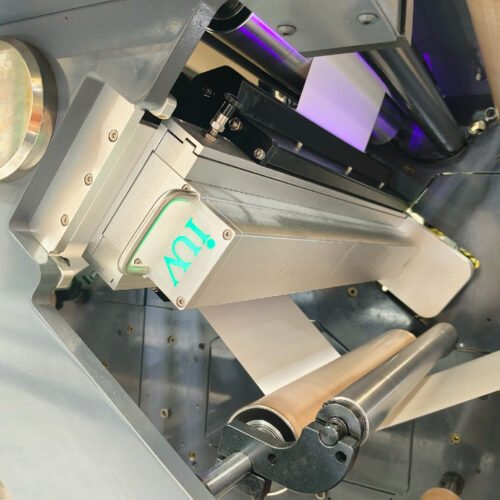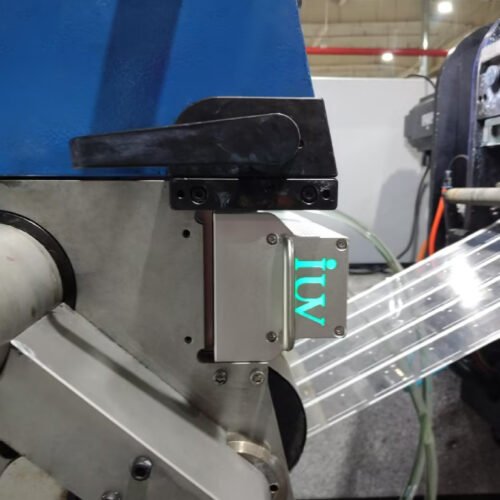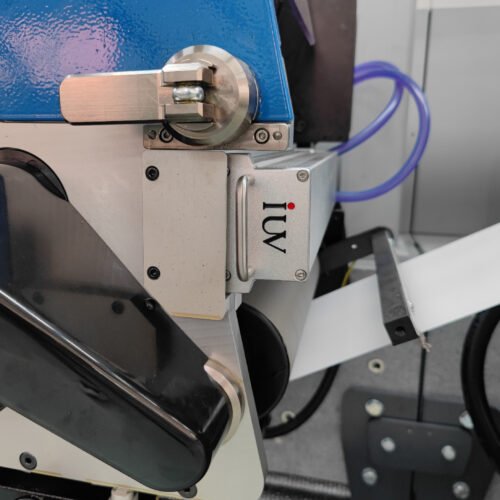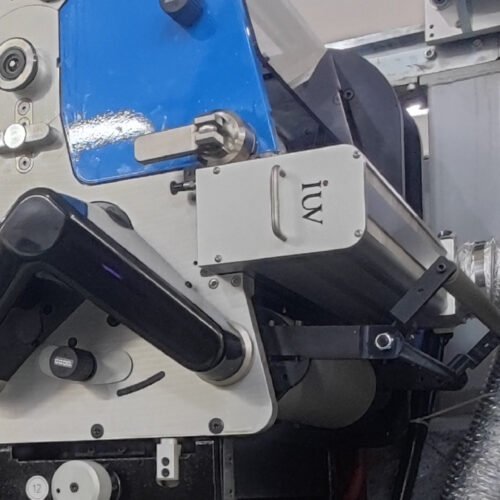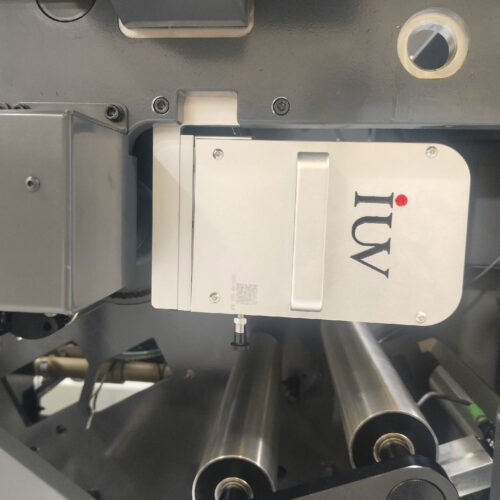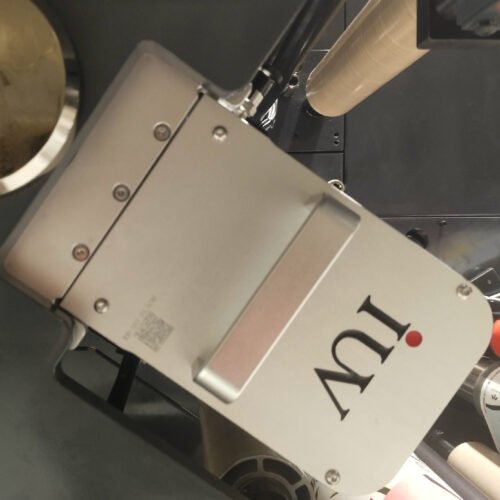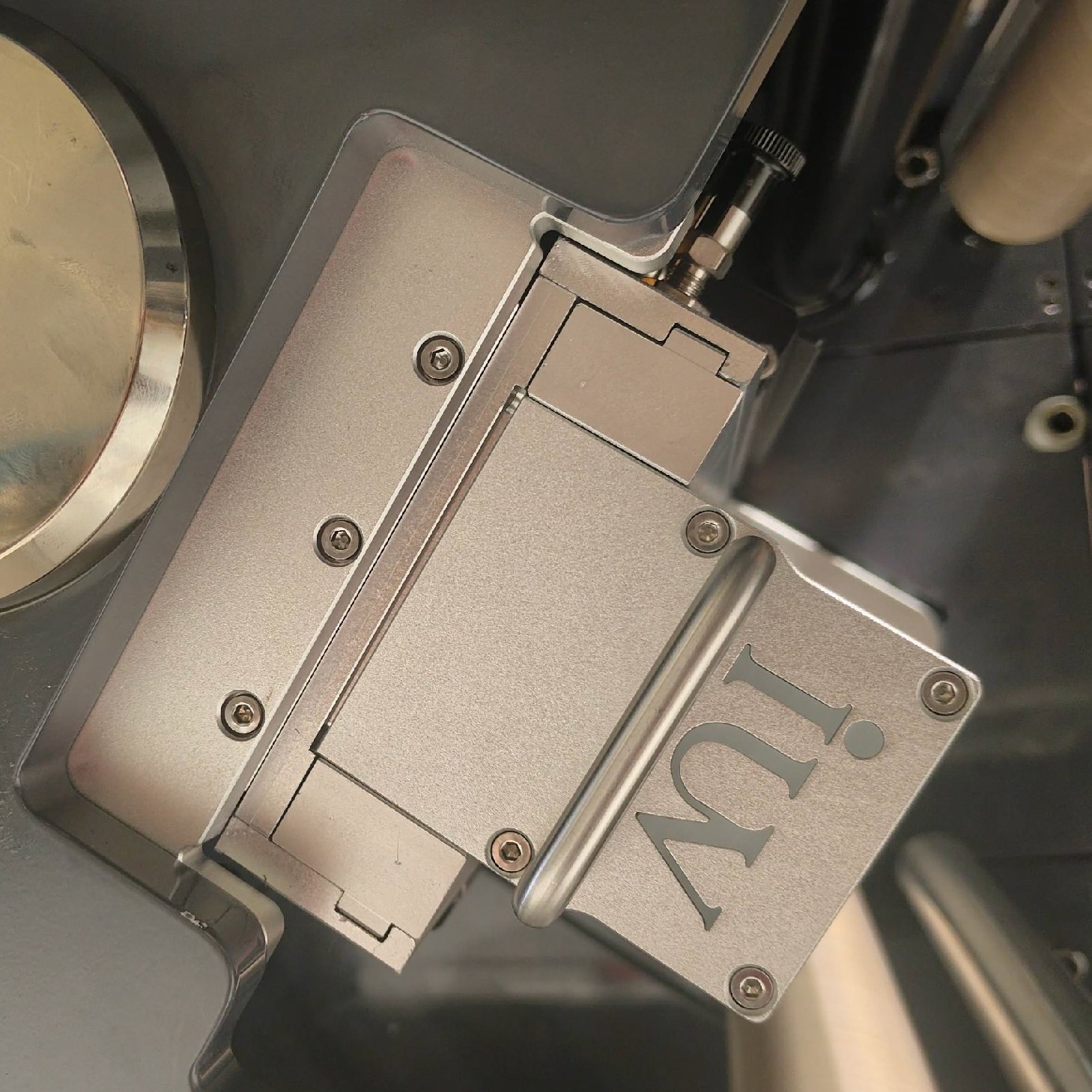
UV LED Curing Systems for Narrow Web Printing are curing solutions that use narrow-band LED ultraviolet light to polymerize UV inks, coatings, and adhesives on narrow web presses. In label printing, they improve curing consistency by delivering the right combination of wavelength, irradiance, and energy density while reducing heat generation and maintaining stable print registration.
Key Data Points
- 70% reduction in electricity consumption after replacing a 200 W/cm mercury UV system with LED UV on a 360 mm six-color flexo press (IUV field data, 2025)
- Power consumption reduced from 19.8 kW to 6.2 kW on the same production configuration (IUV field measurement, 2025)
- 20,000–30,000 hours rated LED lifetime under continuous production, compared with approximately 1,000–2,000 hours for conventional mercury lamps (IUV product data, 2025)
- Substrate surface temperature rise below 5°C on 12 μm BOPP film running at 100 m/min using a closed-loop water-cooled LED UV system (IUV laboratory validation, 2025)
- Maintenance costs reduced by up to 80% because LED UV systems eliminate routine lamp replacement and reflector cleaning (IUV application data, 2025)
Why Is Energy Density More Important Than Lamp Power in Narrow Web Printing?
Energy density is one of the most important factors affecting UV curing quality. It represents the total UV energy received by the printed surface during exposure. Simply choosing a lamp with higher wattage does not guarantee complete curing if the energy delivered to the ink film is insufficient.
In narrow web label printing, press speeds commonly range from 50 to 200 m/min. As production speed increases, exposure time becomes shorter. To maintain reliable curing, converters must balance irradiance, exposure time, and line speed. This is especially important for flexographic printing, where different anilox specifications produce different ink film thicknesses.
A high-opacity white ink illustrates this well. White inks contain large amounts of titanium dioxide pigment, which scatters UV light and makes through-cure more difficult. Even if the surface feels dry, the lower layers may remain partially uncured when energy density is too low. The result can be poor adhesion, reduced scratch resistance, or failure during die-cutting and subsequent converting.
Field experience shows that many converters focus only on lamp output while overlooking curing dose. In practice, matching the required energy density to the actual ink thickness delivers much more consistent production results than simply increasing lamp power.
“The most common mistake we see is converters comparing only the wattage specification,” notes CQ Zhu, Senior Application Engineer at IUV. “The real question is whether the UV energy reaching the ink matches the ink formulation and production speed. That determines curing quality far more than the lamp rating itself.”
How Does Curing Uniformity Affect Label Print Quality?
Uniform curing is just as important as sufficient curing energy. If irradiance varies across the web width, different areas of the printed label receive different curing conditions, leading to inconsistent print performance.
This becomes particularly noticeable on narrow web presses processing BOPP, PET, metallized films, or coated paper. Uneven curing can produce differences in gloss, hardness, ink adhesion, and abrasion resistance across the web. During die-cutting or cold foil application, these differences may cause quality variations that are difficult to trace back to the curing system.
Another factor is thermal stability. Traditional mercury lamps generate significant infrared heat, which can distort thin substrates. Even small dimensional changes may affect registration during multi-color printing.
A closed-loop water-cooled LED UV system minimizes this problem. IUV testing shows substrate surface temperature increases of less than 5°C on 12 μm BOPP at 100 m/min, allowing heat-sensitive films to maintain stable dimensions throughout production. Stable substrate temperature also helps maintain consistent web tension and repeatable print registration.
For converters producing premium labels with tight color tolerances, curing uniformity often has a greater impact on production consistency than peak irradiance alone.
What Advantages Does Intelligent Width Control Bring to Narrow Web Presses?
Many narrow web jobs use substrates much narrower than the maximum press width. Conventional mercury lamps illuminate the entire curing width regardless of the actual material size, wasting electrical power and generating unnecessary heat.
For example, a converter may run a 170 mm pharmaceutical label in the morning and a 330 mm beverage label in the afternoon on the same press. With a fixed-width lamp, large portions of the curing area remain illuminated even though no substrate is present.
IUV addresses this through intelligent regional control. Sensors automatically detect the substrate width and activate only the LED modules covering the printed area. Sections without material remain switched off, reducing energy consumption while lowering heat inside the press.
The system also uses a modular power architecture. Each LED module operates independently, allowing maintenance on one module without shutting down the entire curing system. This hot-swappable design helps reduce unexpected downtime during continuous production.
Combined with the energy efficiency of LED technology, this approach contributed to reducing electrical demand from 19.8 kW to 6.2 kW on a 360 mm six-color flexographic press, representing approximately 70% lower power consumption in IUV field measurements.
Why Does Wavelength Matching Matter More Than Many Printers Expect?
UV curing begins when the photoinitiator inside the ink absorbs ultraviolet light. Every photoinitiator has its own absorption range, so the LED wavelength should match the chemistry of the ink as closely as possible.
Most UV LED label printing today uses 395 nm systems because many modern flexographic inks are formulated for this wavelength. If the LED wavelength differs significantly from the photoinitiator’s strongest absorption range, curing efficiency decreases even when irradiance remains high.
Good wavelength matching improves polymerization, increases the degree of through-cure, and reduces the risk of residual uncured material. This becomes especially important for low-migration packaging applications where complete curing helps minimize residual monomers.
“Converters often ask whether 385 nm or 395 nm is better,” says CQ Zhu, Senior Application Engineer at IUV. “The better choice depends on the ink chemistry. The most efficient system is the one whose spectral output overlaps the photoinitiator absorption curve, not necessarily the one with the highest optical power.”
Modern LED systems also benefit from stable thermal management. By keeping LED junction temperatures consistent, the emitted wavelength remains stable during long production runs, helping maintain repeatable curing performance from the first roll to the last.
Frequently Asked Questions
Q1. What is energy density in UV LED curing?
Energy density is the total amount of UV energy delivered to the printed surface during exposure. It is usually measured in mJ/cm² and depends on irradiance, exposure time, and press speed. Proper energy density is essential for complete through-cure.
Q2. Why are white UV inks harder to cure?
White UV inks contain large amounts of titanium dioxide pigment, which scatters ultraviolet light. This reduces UV penetration through the ink layer, meaning higher energy density is usually required to achieve complete curing beneath the surface.
Q3. Why do narrow web presses benefit from LED UV more than mercury lamps?
LED UV systems generate much less heat, consume significantly less electricity, and can use intelligent width control to illuminate only the printed area. These advantages are especially valuable on narrow web presses that frequently change substrate widths.
Q4. Can an existing flexo press be upgraded to LED UV?
Yes. Many existing presses from manufacturers such as Nilpeter, Bobst, Gallus, OMET, Mark Andy, and MPS can be retrofitted with LED UV curing systems, depending on available installation space, cooling requirements, and electrical configuration.
Q5. How long does a UV LED curing system typically last?
Industrial LED curing systems are typically rated for 20,000–30,000 operating hours, significantly longer than conventional mercury lamps. The exact service life depends on operating temperature, maintenance, and production conditions.