Surface quality defines the commercial value of labels and flexible packaging. In narrow web flexographic and offset production, LED UV aqueous coatings are widely used to achieve gloss, abrasion resistance, and chemical durability. However, micro-pinholing and surface cratering remain critical challenges when process conditions drift outside the optimal window.
Micro-pinholing appears as fine voids that penetrate through the coating film. Surface cratering presents as circular depressions, often with raised edges. Both defects disrupt gloss uniformity and compromise barrier performance. In high-end label printing, even minor defects are unacceptable.
These problems are rarely caused by a single factor. They usually result from an interaction between coating rheology, substrate surface energy, ink chemistry, and LED UV curing parameters. Effective troubleshooting requires a systematic engineering approach.
Coating Rheology and Film Formation Control
LED UV aqueous coatings must level properly before final crosslinking. Unlike solvent-based systems, waterborne coatings depend on controlled evaporation followed by photopolymerization. If the balance is incorrect, surface defects develop quickly.
Viscosity plays a central role. High viscosity limits air release and traps micro-bubbles during flexographic transfer. Low viscosity reduces film stability and increases sensitivity to surface tension gradients.
In narrow web flexo presses, anilox roll selection determines coating weight and shear conditions. Excessive cell volume may introduce turbulence and foam. Insufficient volume may produce thin, unstable films.
To stabilize film formation:
- Measure viscosity at actual press temperature.
- Optimize anilox cell volume for uniform laydown.
- Reduce excessive shear at high press speeds.
- Adjust defoamer dosage carefully to avoid silicone contamination.
Proper rheological balance allows entrapped air to escape before LED exposure.
Surface Tension and Wetting Dynamics
Surface cratering often results from surface tension imbalance. When the coating surface tension is higher than the underlying ink layer, dewetting occurs. The coating retracts locally, forming circular voids.
In UV flexographic and offset label printing, inks may contain slip additives or silicone-based modifiers. These materials migrate to the surface and create localized low-energy spots.
Substrate surface energy must also be verified. Polypropylene and polyethylene films require adequate corona treatment. Levels below 38 dynes typically increase wetting failure risk.
Recommended diagnostic steps include:
- Measure substrate surface energy across the web.
- Evaluate ink surface tension before coating.
- Inspect for silicone contamination on rollers and sleeves.
- Clean press components thoroughly before test runs.
Uniform wetting is essential for consistent coating appearance.
Drying Balance Before LED UV Curing
In aqueous LED UV systems, water evaporation must occur before complete polymerization. If the coating enters the LED zone with excessive residual moisture, rapid surface curing can trap water beneath the film. This leads to micro-pinholes after cooling.
High-speed narrow web presses increase this risk because dwell time is limited. Insufficient hot air or IR pre-drying creates unstable films.
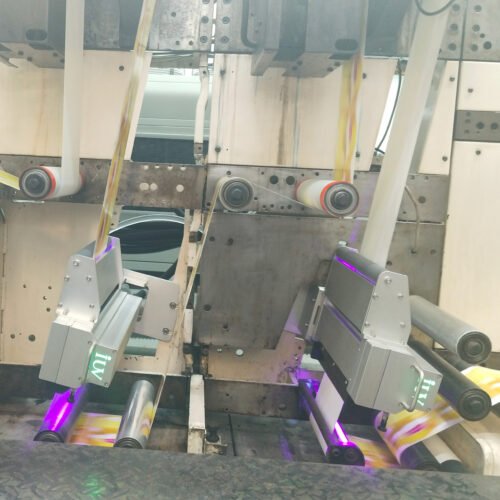
LED UV lamps emit narrow wavelengths, typically 385 nm or 395 nm. The photoinitiator package must match the emission peak to ensure proper through-cure. If surface cure is too aggressive, skinning occurs before full leveling.
To correct curing imbalance:
- Adjust hot air temperature and airflow.
- Verify water removal before LED exposure.
- Reduce peak irradiance to prevent premature skinning.
- Confirm energy density using a calibrated radiometer.
Balanced evaporation and crosslinking reduce internal void formation.
Interaction with UV Inks in Flexographic and Offset Printing
LED UV aqueous coatings are frequently applied over UV-cured inks. Incomplete ink cure beneath the coating can release volatiles during subsequent LED exposure. These vapors create micro-pinholes within the top layer.
High-opacity whites and dense solid colors are common risk areas in label production. Thick ink films may not achieve full cure at high press speeds.
Testing should include:
- Measuring ink cure with solvent rub tests.
- Confirming LED energy output consistency.
- Slowing press speed during evaluation.
- Ensuring proper lamp focus and distance.
Ink cure quality directly affects coating integrity.
Mechanical Factors in Narrow Web Presses
Mechanical variables also contribute to surface defects. Uneven nip pressure between anilox and plate cylinders can introduce streaks. These streaks may later develop into craters during curing.
Roller vibration, worn bearings, or sleeve runout can disturb coating uniformity. At speeds exceeding 150 meters per minute, small mechanical instabilities become visible in the final surface.
Regular maintenance is essential:
- Check roller parallelism.
- Inspect anilox surface under magnification.
- Verify tension control stability.
- Monitor coating weight across the web width.
Stable mechanical conditions support consistent film formation.
Defoaming Strategy and Additive Compatibility
Foam management is critical in aqueous systems. Excessive agitation during pumping or recirculation introduces micro-bubbles. If these bubbles do not collapse before curing, they form pinholes.
However, aggressive silicone defoamers may create localized low-energy spots, causing craters instead of solving the problem.
Best practices include:
- Use low-silicone or silicone-free defoamers when possible.
- Optimize pump speed to reduce aeration.
- Allow coating to deaerate before press startup.
- Avoid over-mixing in storage tanks.
Controlled foam suppression improves surface smoothness.
Environmental and Pressroom Conditions
Humidity and temperature affect water evaporation rates. High ambient humidity slows drying and increases residual moisture before LED curing. Low temperatures raise viscosity and reduce leveling efficiency.
In narrow web facilities, airflow patterns around the coating station influence drying consistency. Uneven ventilation may cause cross-web cure variation.
Environmental control measures include:
- Maintain stable pressroom temperature.
- Monitor relative humidity levels.
- Balance airflow across the web.
- Prevent cold air drafts near the coating unit.
Consistent environmental conditions stabilize coating performance.
Structured Troubleshooting Workflow
When defects appear, random adjustments often worsen the situation. A structured diagnostic sequence is more effective.
- Confirm substrate surface energy.
- Verify ink cure quality.
- Measure coating viscosity and temperature.
- Check drying efficiency before LED exposure.
- Validate LED intensity and energy density.
- Inspect mechanical alignment and anilox condition.
Change only one variable at a time. Document results carefully. Gradual optimization produces stable long-term results.
Achieving Stable Production in Label and Flexible Packaging Lines
Micro-pinholing and surface cratering are preventable with disciplined process control. LED UV aqueous coatings offer strong performance advantages in label, flexographic, offset, and narrow web printing. They provide energy efficiency, low heat load, and precise curing control.
However, their success depends on balanced evaporation, proper wetting, controlled rheology, and accurate LED curing parameters. Close coordination between formulation, press setup, and environmental management is essential.
By aligning coating chemistry with press mechanics and LED output, converters can maintain high gloss, uniform film integrity, and reliable productivity. Stable processes reduce waste, protect brand quality, and support sustainable production goals in modern UV printing operations.