Abstract
Metallic and opaque UV inks can define the curing limit of a narrow-web label press. Their pigments and ink-film thicknesses alter how LED energy enters, scatters through, and reacts within the printed layer. A lamp head that cures standard process colours may not provide reliable through-cure for opaque white, dense black, metallic silver, metallic gold, or high-opacity spot colours. Selecting LED-UV equipment for these applications requires a spectral match between the lamp and the ink photoinitiator package, verified irradiance at the web, sufficient dose at production speed, and controlled ink laydown. This article explains how OEMs, converters, and engineers can select and validate spectral output for demanding label inks.
Introduction
LED UV curing equipment for label presses must be selected around the most difficult materials the press will run. For many narrow-web flexographic operations, those materials are metallic inks and opaque inks rather than standard cyan, magenta, yellow, or black process colours.
Metallic and opaque inks can create a misleading cure result. The exposed surface may feel dry, yet the lower part of the film can remain weak. That weakness may later appear as poor rub resistance, blocking in the rewind roll, weak adhesion, ink cracking, or failure under a protective varnish.
The critical decision is not simply whether the lamp head has high output. It is whether its spectral output matches the ink chemistry and delivers usable energy through the actual ink film. The selected system must also protect heat-sensitive label constructions and preserve the print sequence needed for clean register and coating adhesion.
Metallic and Opaque Inks Alter the Optical Cure Path
Metallic inks contain reflective or scattering pigment particles that can change how curing energy moves through the ink layer. Opaque inks can contain high pigment concentrations that absorb, scatter, or attenuate incoming energy. These effects reduce the amount of useful light that reaches the lower portion of the ink film.
Opaque white deserves separate attention because titanium dioxide provides opacity by strongly scattering light. Dense black can be equally demanding because carbon-black pigments absorb broadly. Metallic silver, metallic gold, and other effect inks may also create complex reflection and scattering behaviour within the printed layer.
These materials may need more than a higher lamp setting. They may require an ink formulation with a photoinitiator package that responds effectively to the selected LED wavelength. They may also require controlled film thickness and a final cure position that delivers enough total dose after the full print stack is complete.
A standard process-colour cure test cannot establish performance for these inks. The validation must include the exact metallic or opaque material, the intended anilox specification, the actual substrate, and the required production speed.
LED UV Curing Equipment for Label Presses Must Match Spectral Output to Chemistry
Industrial LED-UV systems commonly operate near 365 nm, 385 nm, 395 nm, or 405 nm. Each lamp head provides a relatively narrow spectral band compared with a broad-spectrum conventional UV source. The ink photoinitiator system must absorb useful energy within that band.
The correct wavelength is formulation-specific. A wavelength that works for one metallic ink may not produce adequate cure in another metallic formulation. The same applies to opaque white, dense black, high-opacity red, and special-effect spot colours. The pigment system, resin package, photoinitiators, and intended ink-film thickness all influence the response.
The ink supplier should confirm LED compatibility for the selected wavelength. The review should include the expected press speed, target ink laydown, substrate, colour sequence, and any overprint varnish. It should also distinguish between pinning exposure and final cure.
Avoid selecting a lamp wavelength based only on a successful process-colour job. The final decision should be based on the highest-demand approved ink. This creates a usable cure margin and reduces the need to operate the lamp head at maximum output.
Irradiance and Energy Dose Have Separate Roles
Irradiance is the instantaneous optical power delivered to the web surface. It is usually expressed in watts per square centimetre. High irradiance helps initiate a rapid curing reaction at the exposed ink surface.
Energy dose is the total energy received during exposure. It is usually expressed in joules per square centimetre. Dose depends on irradiance, working distance, illuminated length, and press speed. It is especially important when the ink film is thick or optically resistant.
Metallic and opaque inks may show acceptable surface cure with insufficient internal cure. This occurs when surface initiation is strong but total dose is not enough to support reaction through the full film. Increasing irradiance without confirming dose can leave the process marginal.
Measurements should be taken at the substrate plane with an instrument suitable for the LED wavelength. The lamp-to-web distance, measurement locations, output uniformity, and press speed should be recorded. A controller display alone does not confirm the energy received by the printed label.
Control Ink Film Thickness Before Raising Lamp Output
Ink-film thickness is a major variable in metallic and opaque label printing. A heavier film can improve opacity or metallic appearance, but it also increases the energy needed for through-cure. The practical cure limit can be reached quickly when pigment loading is high.
In flexographic printing, anilox volume, cell geometry, chamber pressure, doctor blade condition, ink temperature, rheology, and plate design influence the deposited film. A changed anilox or inconsistent transfer can make a previously stable lamp recipe fail.
Opaque white often receives a heavier film than process colours. Metallic inks may also require a specific laydown to achieve the intended visual effect. The anilox specification should be selected for the required opacity or metallic appearance without depositing more ink than the curing process can support.
When a cure defect appears, inspect film thickness and ink transfer before increasing LED output. Excess lamp energy can raise web temperature, affect intercoat adhesion, and harden thinner image areas unnecessarily. Controlled laydown usually creates a more stable cure window than a higher controller setting.
Use the Print Sequence to Manage Cure Demand
The position of a metallic or opaque ink in the print sequence affects the cure strategy. An opaque white base may be printed first, followed by process or spot colours. Metallic ink may be printed beneath a varnish, over a white base, or as a final visual layer.
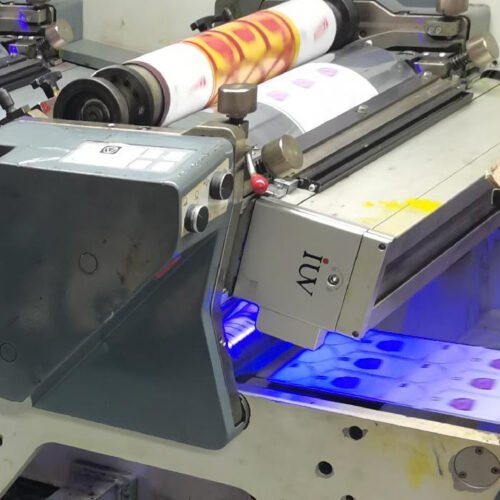
Interstation LED heads can pin an ink layer before the next flexographic unit. Controlled pinning may reduce ink movement, protect fine reverse type, and prevent contamination between a metallic solid and later colours. It should not automatically deliver full cure.
Excessive interstation cure can reduce wet trapping or make the surface less receptive to a following ink or overprint varnish. Insufficient pinning can allow a heavy metallic or opaque layer to move under later printing pressure. The required setting depends on the complete image stack.
Final cure should occur after the most demanding material layer. If a high-gloss varnish is applied over a metallic or opaque ink, the final lamp head must cure the full ink-and-varnish structure. The recipe should be validated for the completed label, not for the printed colour alone.
Evaluate Cross-Web Uniformity With Demanding Inks
Metallic and opaque inks should be used to verify usable lamp width. A lamp head may provide adequate output at the centre of the web while delivering less energy near the edges or between LED modules.
The test form should place dense metallic bars, opaque white panels, dark solids, fine type, and reverse elements across the full printable width. This identifies cure differences that may not appear with a central process-colour strip.
The validation should also account for normal web guiding movement. A dense metallic feature placed near the edge of the lamp’s validated optical zone can experience variation if the web shifts slightly during production. The lamp head should provide margin beyond the active print width.
If the system uses modular LED segments, inspect the boundaries between modules. A visible gloss change, rub-resistance difference, or blocking defect at one repeatable cross-web position can indicate a segment-transition or optical-uniformity issue.
Manage Oxygen Inhibition at the Ink Surface
Free-radical UV inks can be affected by oxygen at the exposed surface. Oxygen inhibition can cause tackiness, reduced scratch resistance, poor rub performance, and dust pickup. The risk increases when the cure condition is already marginal because of high pigment loading or thick ink films.
A metallic ink may look visually correct while its surface remains weak enough to mark on guide rollers or transfer during rewinding. An opaque ink may feel dry but lose colour under repeated rubbing. These defects should be investigated with physical tests rather than surface appearance alone.
The initial checks should include wavelength compatibility, output at the web plane, press speed, working distance, lamp-window cleanliness, and ink-film thickness. The material should then be tested after a defined conditioning period and after normal roll pressure.
If surface inhibition remains after these checks, the ink chemistry may require review. A formulation designed for the selected LED wavelength can provide a more reliable solution than raising lamp output beyond the stable thermal range of the label construction.
Protect Heat-Sensitive Label Constructions
LED-UV systems reduce direct infrared exposure compared with many conventional UV sources. However, the printed ink and coating layers still absorb energy. Metallic solids, opaque white panels, dark colours, and repeated cure stages can raise the temperature of the label web.
Thin BOPP, PE, PP, PET, shrinkable film, and laminated pressure-sensitive constructions may respond through curl, tension variation, registration movement, or dimensional change. The adhesive and liner can also react differently from the facestock.
Temperature should be measured under the most demanding approved conditions. The trial should include the highest expected coverage, the heaviest ink film, normal press speed, active interstation lamps, final cure, and the intended cooling arrangement.
If the web temperature becomes excessive, review the entire process. Confirm the spectral match, reduce unnecessary pinning, control ink laydown, and check chill-roll performance. A higher-output lamp is not the first corrective action when the actual problem is inefficient chemistry or excessive ink film.
Support Low-Migration and Sensitive Label Applications
Low-migration label work requires a controlled combination of inks, coatings, substrates, adhesives, wash-up materials, and cure settings. Metallic and opaque inks should be included in that approval process because their cure response can differ from standard colours.
The approved job record should identify the ink supplier’s material code, anilox specification, substrate construction, LED wavelength, output range, working distance, press speed, and quality checks. Any change in ink, varnish, anilox, or lamp position should be reviewed before release.
A visually dry metallic or opaque label does not prove full cure or application suitability. The finished label should be assessed according to the relevant requirements for adhesion, rub resistance, blocking, odour where relevant, and end-use performance.
Traceability is particularly useful when heavy-pigment inks are used. It allows the production team to compare a later defect with the validated spectral recipe and material combination.
Select Lamp Heads for Process Control, Not Only Peak Output
Lamp-head selection should include wavelength, usable optical width, irradiance range, working-distance tolerance, cooling method, mechanical fit, control interface, and service access. Peak output is one specification, but it does not define the full process capability.
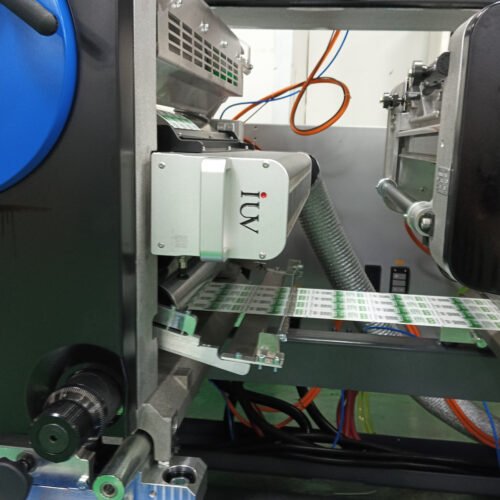
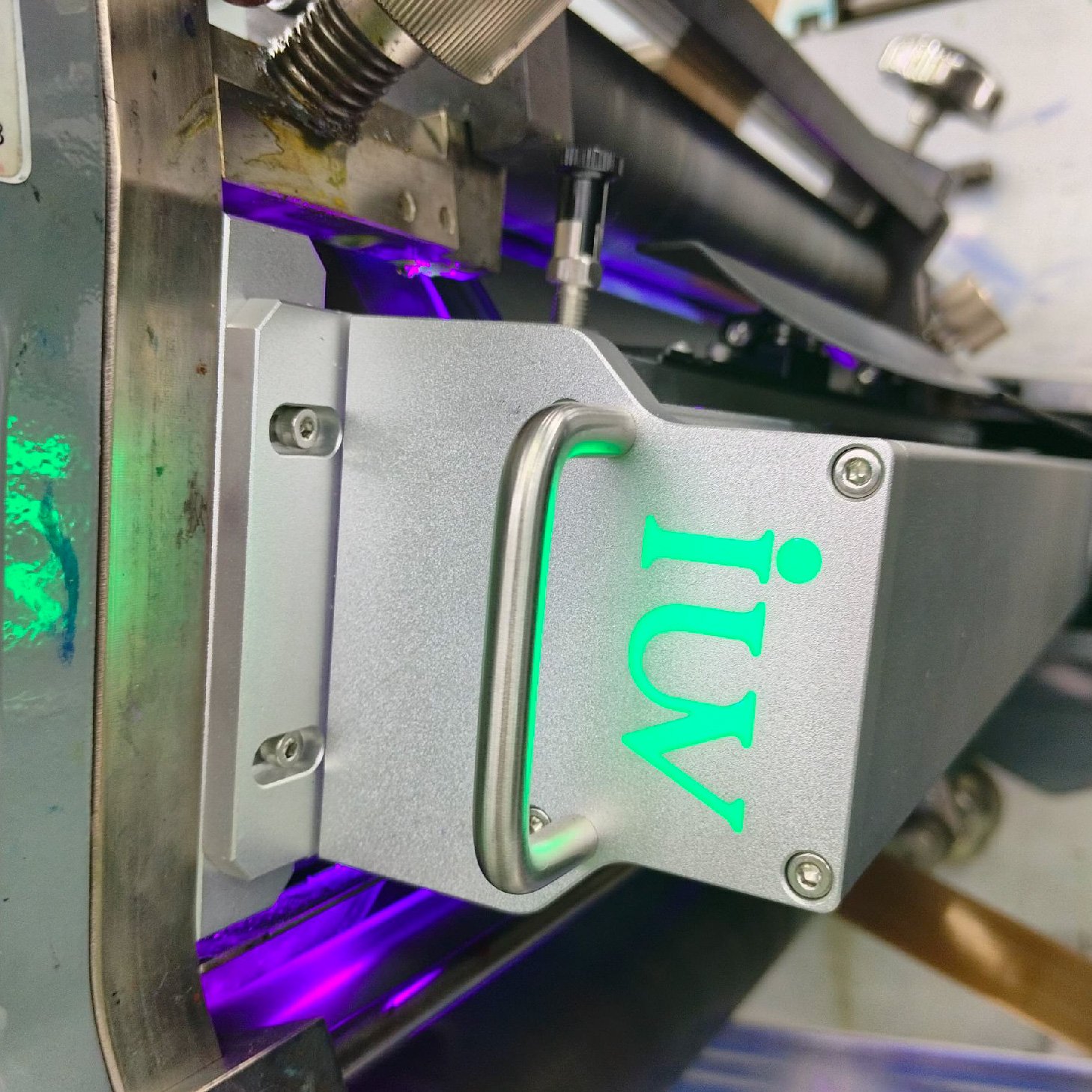
The lamp head must fit the press layout without exposing plates, anilox rolls, chamber seals, or open ink to stray UV energy. It must also allow inspection and cleaning of the optical window. Metallic inks can be demanding enough that a small loss of transmission becomes a production issue.
The controls should link output to press speed and should enter a safe state during stops, web breaks, and faults. A stationary web should not remain under full production exposure. This protects the material and reduces the risk of premature cure on press components.
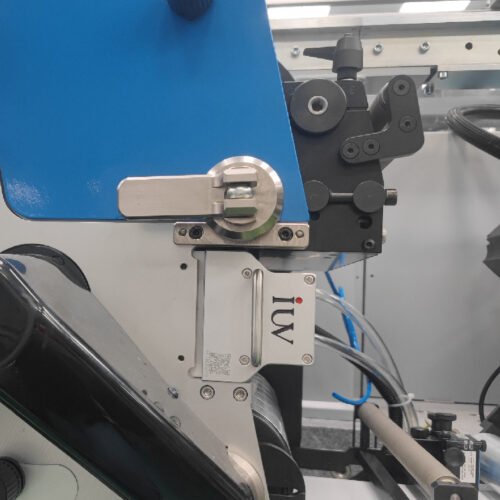
For retrofit projects, the survey should include interstation space, lamp-to-web clearance, web guide movement, cooling capacity, electrical integration, and maintenance access. The selected head should support the actual high-pigment job mix, not only the press’s nominal width and speed.
Maintain Optical Output and Cooling Stability
Lamp windows collect ink mist, dust, paper lint, coating splash, and adhesive debris. Contamination reduces delivered energy and can create uneven cure across the web. A metallic or opaque ink may reveal this loss sooner than a light process colour.
Cooling performance also influences output stability. Air-cooled systems need clean filters and working fans. Water-cooled systems need stable flow, suitable coolant condition, leak checks, and functioning alarms. A lamp head that thermally derates during a long run can create cure variation without a visible change in artwork.
Output should be measured periodically at the approved substrate plane and across the active print width. The results should be recorded by lamp head and compared over time. This helps identify gradual drift before it causes blocking, weak adhesion, or inconsistent metallic appearance.
Preventive maintenance should also include anilox inspection and ink-transfer checks. The cure condition depends on the optical system and the deposited ink film working together.
Troubleshoot Defects by Ink Type and Location
If only metallic ink fails rub or adhesion tests, compare its ink-film thickness, pigment loading, wavelength compatibility, final-cure position, and output with the process-colour stations. The issue may be specific to the metallic formulation rather than the lamp’s general capacity.
If opaque white remains tacky beneath a varnish, inspect white-ink laydown, final dose, varnish weight, and cure depth through the complete stack. A cured varnish surface does not prove that the white layer below has reached the required conversion.
If a defect appears at one web edge, inspect lamp alignment, optical-window contamination, cross-web output uniformity, and web tracking. If it appears after a long run, check cooling performance and output drift.
A structured diagnosis avoids random changes to lamp power. It identifies whether the defect comes from spectral mismatch, insufficient dose, excessive ink film, thermal conditions, or a local optical issue.
Conclusion
Selecting spectral output for metallic and opaque label inks requires an ink-specific approach to LED-UV curing. The chosen wavelength must match the photoinitiator chemistry, while the lamp head must provide sufficient irradiance and dose through the heaviest approved ink film at commercial speed.
Reliable production depends on controlled anilox-driven laydown, defined pinning and final-cure roles, cross-web output verification, thermal management, and direct cure testing. When the system is validated with metallic and opaque inks rather than only process colours, label presses can maintain stable cure, surface durability, and finished-roll quality.