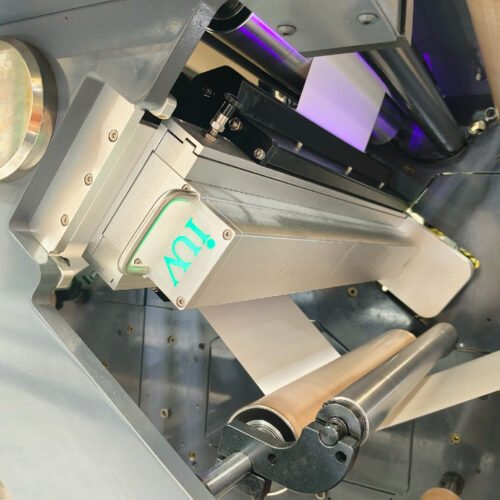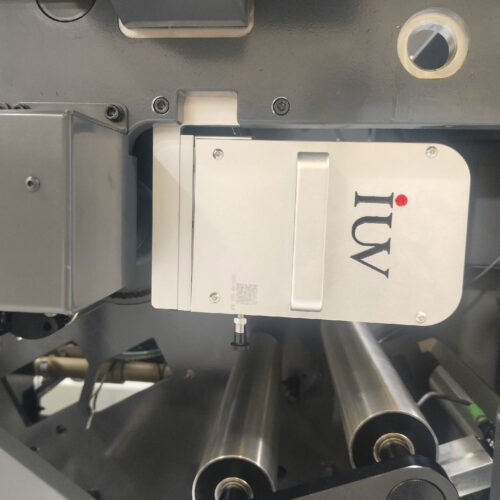
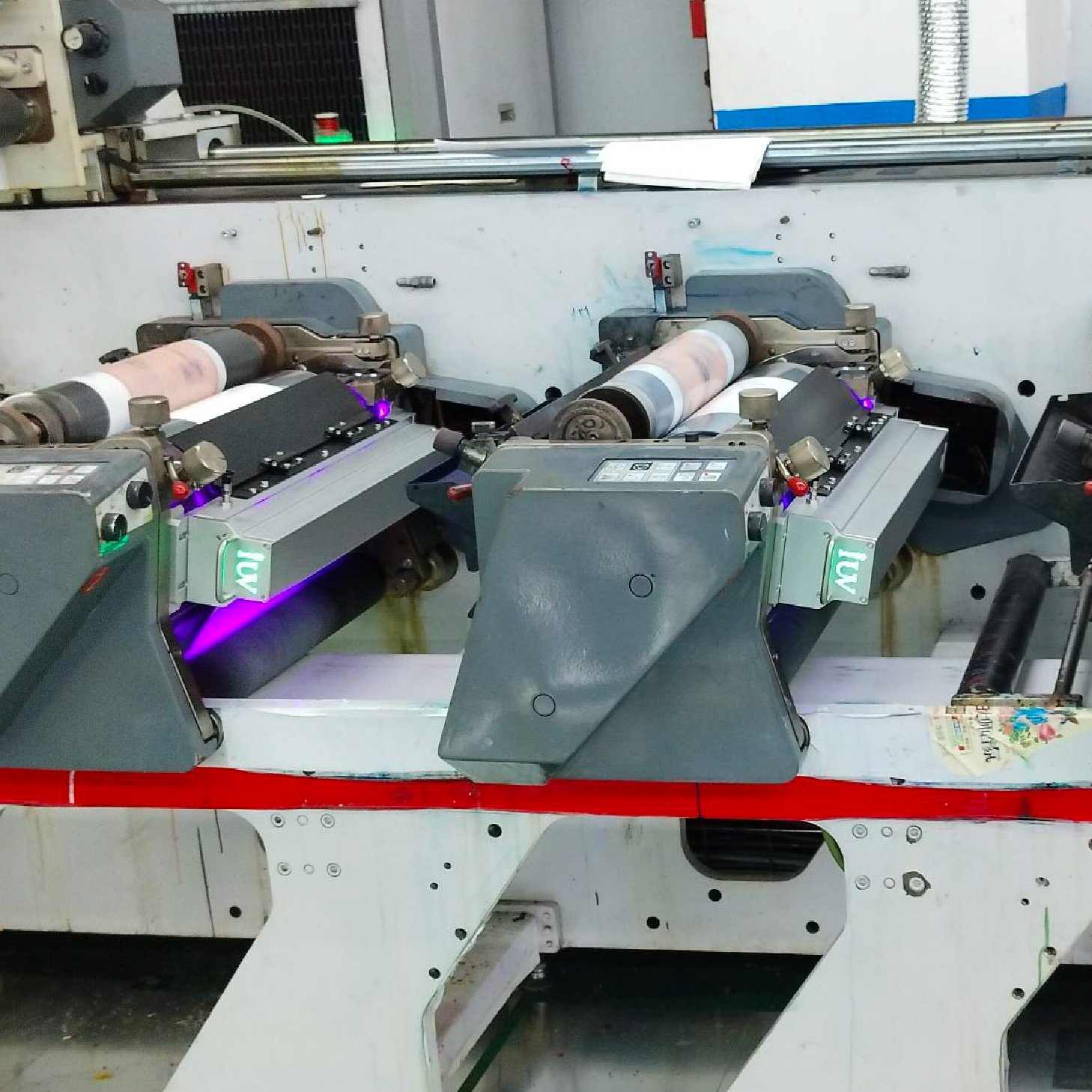
The shift from traditional mercury arc lamps to LED UV curing technology has redefined the narrow-web and label printing industry. This transition is not merely a hardware upgrade. It represents a fundamental change in how energy interacts with ink chemistry. For flexo and offset printers, the core of this transformation lies in the selection of photoinitiators. Choosing the right chemical components ensures that inks cure deeply and bond securely to diverse substrates at high press speeds.
The Shift in Spectral Output
Traditional mercury lamps emit a broad spectrum of UV light, ranging from UVC (short-wave) to UVA (long-wave). This “scattergun” approach allows ink formulators to use a wide variety of photoinitiators that react to different wavelengths. In contrast, LED UV lamps emit a very narrow, concentrated peak of energy. Most industrial LED systems for flexo printing peak at 365nm, 385nm, or 395nm.
This narrow output creates a specific challenge. If the photoinitiator in the flexo ink does not have an absorption peak that matches the LED lamp’s output, the curing process will fail. High-speed narrow-web presses require near-instantaneous polymerisation. Without a precise spectral match, printers face issues like wet ink on the rewind or poor solvent resistance.
Understanding Photoinitiator Mechanisms
Photoinitiators (PIs) are the catalysts that kickstart the curing process. When exposed to UV light, they absorb photons and generate reactive species—either free radicals or cations—that turn liquid monomers into solid polymers. In flexo ink formulation, we primarily categorize these into two types.
Type I Photoinitiators (Cleavage)
Type I PIs undergo unimolecular bond cleavage upon absorbing UV light. This action immediately produces two free radicals. These are highly efficient and are often the “workhorses” of LED-curable inks. For LED applications, phosphine oxides like TPO and BAPO are industry standards. They absorb light effectively in the 380nm to 400nm range, perfectly aligning with common LED lamp outputs. These PIs are excellent for “through-curing,” ensuring the ink bonds to the substrate surface.
Type II Photoinitiators (H-Abstraction)
Type II PIs, such as Benzophenone or Thioxanthones (ITX/DETX), require a co-initiator, usually an amine synergist. They do not break apart; instead, they pull a hydrogen atom from the synergist to create the radical. While Type II PIs are traditionally used for surface curing, their role in LED systems is more complex. LED lamps lack the short-wave UVC light that typically handles surface curing. Therefore, formulators must select specific Type II PIs that can still function under the longer UVA wavelengths provided by LEDs.
The Challenge of Surface Cure and Oxygen Inhibition
In narrow-web flexo printing, one of the biggest hurdles with LED technology is oxygen inhibition. Atmospheric oxygen penetrates the thin ink film and reacts with the generated radicals. This effectively “quenches” the reaction at the surface, leaving the ink feeling tacky or greasy.
Mercury lamps solve this with high-energy UVC light. LEDs do not have this luxury. To achieve a hard, dry surface on labels or flexible packaging, engineers must optimize the PI package. This often involves:
- Increasing the concentration of photoinitiators.
- Using higher-functionality monomers to speed up cross-linking.
- Adding amine synergists to consume oxygen at the ink-air interface.
- Utilizing high-intensity LED chips to overwhelm the oxygen inhibition through sheer radical density.
Pigment Interference in Flexo Inks
Flexo inks are heavily pigmented. Whether it is a dense carbon black or a titanium dioxide white, pigments compete with photoinitiators for UV light.
Black inks are notoriously difficult to cure because they absorb light across the entire spectrum. For LED curing, the 395nm wavelength is advantageous because long-wave UVA penetrates deeper into thick, dark ink layers than short-wave UVC. However, the photoinitiator must be powerful enough to capture the limited photons that reach the bottom of the ink film.
For white inks and coatings, the “yellowing” effect of certain photoinitiators is a concern. Many PIs that absorb in the long-wave UVA region (like TPO) have a naturally yellow tint. Engineers must balance the need for fast curing with the aesthetic requirements of the label, especially for clear-on-clear labels or high-end cosmetics packaging.
Substrate Considerations and Adhesion
The choice of substrate in narrow-web printing—ranging from thermal paper to synthetic films like PE, PP, and PET—impacts curing. LED UV is a “cold” curing process. Unlike mercury lamps, LEDs do not emit IR (infrared) heat toward the web. This is a massive advantage for printing on heat-sensitive shrink sleeves or thin films.
However, heat often helps the chemical reaction and promotes adhesion by slightly softening the substrate. Because LED systems lack this heat, the photoinitiator selection becomes even more critical. The ink must reach a high degree of conversion purely through photochemical means to ensure it bites into the plastic surface. Poor PI selection leads to “tape test” failures, where the ink easily pulls off the film after printing.
Low Migration for Food Packaging
For printers specializing in food labels or flexible packaging, photoinitiator selection is governed by strict regulatory frameworks. Standard PIs are often small molecules that can migrate through the substrate and contaminate food products.
In these cases, “polymeric” or “high molecular weight” photoinitiators are used. These molecules are too large to migrate. Formulating LED-curable, low-migration inks is a specialized field. The PIs must be highly reactive to compensate for their larger size and lower mobility. When choosing an LED system for food-grade flexo, the synergy between the lamp’s irradiance (mW/cm²) and the ink’s PI reactivity is the difference between compliance and a product recall.
Operational Benefits of Optimized Selection
When the photoinitiator package is perfectly tuned to the LED lamp, the operational benefits are significant.
- Higher Press Speeds: Efficient curing allows presses to run at 150-200 meters per minute without risking ink offset.
- Reduced Energy Consumption: LED lamps can be pulsed or dimmed. If the ink is highly reactive, the lamps can run at lower power levels, extending the life of the LED chips.
- Consistency: Unlike mercury bulbs that degrade over 1,000 hours, LEDs remain stable for over 20,000 hours. A well-selected PI package ensures that the print quality on day one matches the quality three years later.
Troubleshooting LED Curing Issues
If a narrow-web printer experiences curing failures after switching to LED, the photoinitiator is usually the first place to look. Engineers should evaluate the following:
- Absorption Overlap: Does the PI’s absorption curve cover the 385nm or 395nm peak of the lamp?
- Dose vs. Intensity: Is there enough total energy (mJ/cm²) reaching the web, or is the peak intensity (W/cm²) too low to overcome oxygen inhibition?
- Ink Film Weight: Flexo printing relies on thin films. If the anilox roll is delivering too much ink, the long-wave LED light might not reach the substrate, regardless of the PI choice.
- Shelf Life: Some highly reactive LED photoinitiators can reduce the shelf life of the ink, causing it to thicken or gel in the bucket.
The Future of LED Curing in Flexo
The industry is moving toward “multi-wavelength” LED systems and even more specialized chemistry. As we move away from certain chemicals due to environmental or health regulations (such as the reclassification of certain PIs in Europe), the search for sustainable, high-efficiency photoinitiators continues.
For the printing engineer, the goal remains the same: achieving a perfect cure at the lowest possible energy cost. Understanding the relationship between the 395nm photon and the photoinitiator’s molecular structure is no longer just for chemists. It is a vital skill for anyone managing a modern narrow-web or label printing facility.
By focusing on spectral matching, managing oxygen inhibition, and considering the specific needs of the substrate, printers can fully realize the advantages of LED UV technology. The result is a more stable, efficient, and environmentally friendly printing process that meets the demands of today’s fast-paced packaging market.