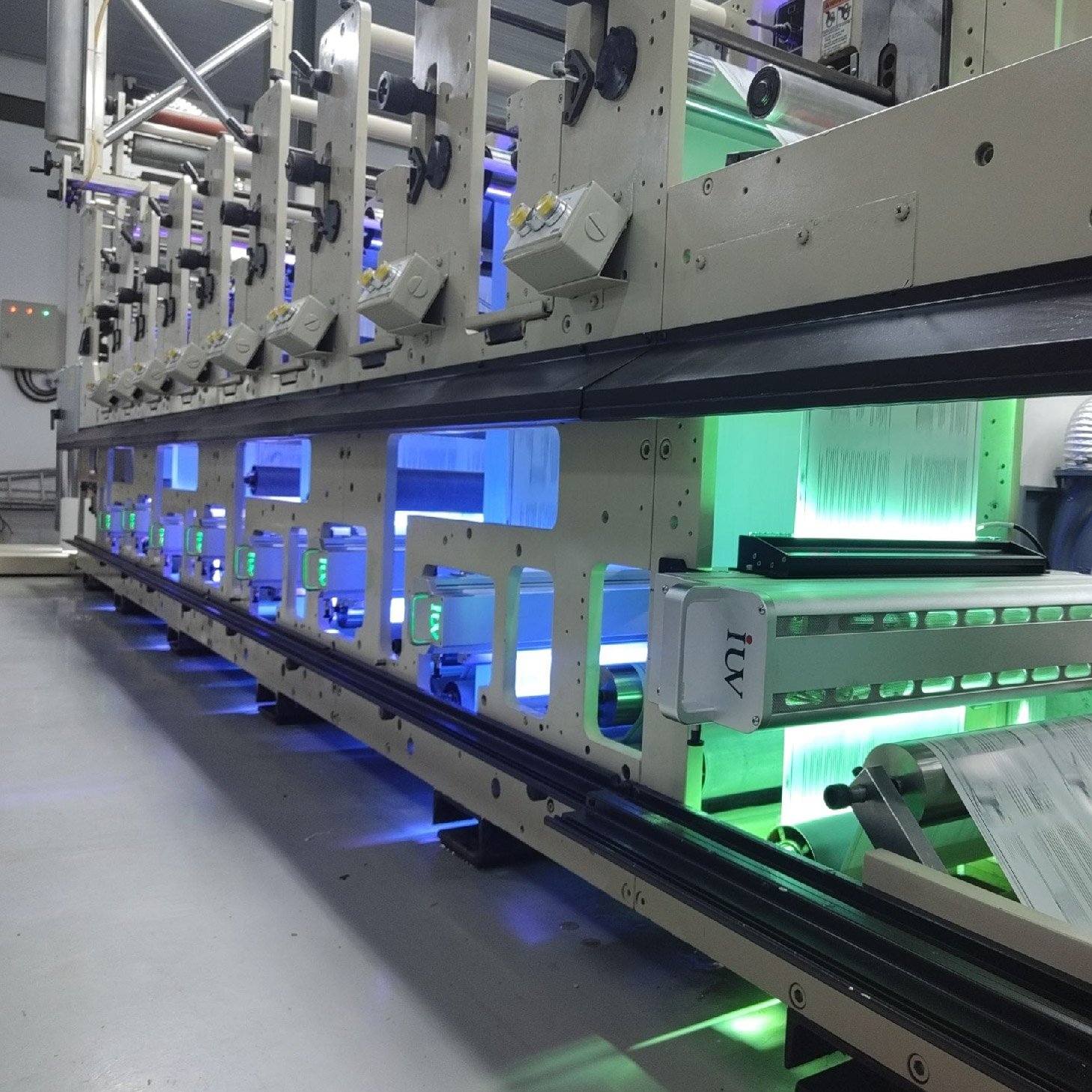
Curing uniformity is a critical factor in modern LED UV narrow web printing. High-speed label and narrow web presses require consistent energy distribution across the ink film to maintain print quality. Uneven curing can cause surface tack, inconsistent gloss, poor adhesion, and potential defects during downstream converting processes.
In flexographic, letterpress, and narrow web UV printing, LED UV diode density significantly affects curing uniformity. High diode density ensures consistent irradiance across the web width, while lower density may create uneven exposure, especially at elevated press speeds. Understanding this relationship allows converters to optimize curing performance for high-quality labels and packaging materials.
Defining LED UV Diode Density
LED UV diode density refers to the number of LED emitters across a given length of the curing unit. Higher density systems provide more light sources per unit area, creating smoother irradiance distribution. Each diode emits UV energy within a defined beam angle, and the overlap between adjacent beams determines the overall uniformity of exposure.
In narrow web presses, uniform irradiance ensures each part of the ink film receives adequate energy for full polymerization. Lower-density systems may have gaps between beams, producing uneven curing and visible print defects. As press speeds increase, insufficient diode coverage becomes more pronounced, making high-density arrangements essential for maintaining consistent print quality.
The Effect of High Web Speeds on Curing
High web speeds reduce the exposure time available under the UV lamp. At several hundred meters per minute, even small fluctuations in energy distribution can result in incomplete polymerization. Unevenly cured inks may appear dry visually but remain soft under pressure, causing blocking or marking during rewinding.
In narrow web label production, high-speed operation is common. Solids, opaque whites, and heavy coatings are particularly sensitive to curing inconsistencies. LED UV systems must deliver both adequate peak irradiance and uniform energy across the entire web to achieve reliable surface hardness.
Irradiance Overlap and Uniform Energy Distribution
Diode density directly impacts irradiance overlap. High-density arrays provide multiple overlapping beams, producing smooth energy distribution along the web direction and across the width. Low-density configurations rely on wider beam angles to cover the same area, which reduces peak intensity and may create irradiance valleys.
Consistent irradiance ensures complete polymerization of the ink film. Variations can lead to differences in surface hardness, adhesion, and chemical resistance. Uniform curing is especially important for multilayered or highly pigmented inks commonly used in label and narrow web printing.
Impact on Ink Polymerization and Print Quality
In LED UV flexographic printing, polymerization depends on energy dose and uniformity. Uneven curing results in partially polymerized ink at the surface or in thicker areas. This can manifest as tackiness, lower abrasion resistance, and inconsistent gloss.
Labels printed with unevenly cured ink may show defects during converting operations, such as die-cutting or stacking. High diode density minimizes these risks by delivering stable irradiance across varying ink film thicknesses. Consistent polymerization improves print quality and reduces waste.
Cross-Web Uniformity and Edge Effects
Maintaining uniform curing across the web width is critical in narrow web applications. Low diode density systems often show irradiance drop-off at the edges, causing softer ink and potential defects. High-density arrangements maintain energy consistency from edge to edge, supporting edge-to-edge printing and multi-lane label production.
Edge uniformity is particularly important in high-resolution printing where fine text and graphics must maintain clarity. Consistent cross-web irradiance also enhances adhesion and reduces the likelihood of blocking during rewinding.
Thermal Management and Diode Efficiency
LED diodes are sensitive to temperature. As operating temperature rises, output efficiency can decrease, creating uneven curing. High-density LED UV units typically include advanced cooling mechanisms to maintain stable temperature across all emitters.
Stable thermal conditions ensure uniform output, preventing localized under-cured areas. Low-density systems may experience hotspots or uneven cooling, which can amplify curing variation and reduce process stability in high-speed narrow web printing.
Balancing Diode Density and Peak Power
Peak power is important, but diode density often has a larger influence on curing uniformity. A high-power, low-density system can produce strong irradiance at select points but leave gaps elsewhere. High-density systems balance adequate peak intensity with even energy distribution, supporting consistent curing across the entire web.
This balance is crucial in flexographic label printing, where ink film thickness varies and consistent curing is required to avoid defects. Uniform energy ensures proper polymerization even in heavy solids and opaque coatings.
Effects on Different UV Inks and Coatings
Different inks and coatings react differently to curing uniformity. Highly pigmented inks, opaque whites, and functional coatings require stable, uniform energy delivery. Inadequate diode density can produce visible gloss variations, incomplete surface cure, or lower chemical resistance.
Transparent inks and varnishes may mask under-cured areas initially, but performance issues can emerge during die-cutting or post-press handling. High-density diode arrangements support consistent curing for diverse ink types, improving print reliability.
Practical Considerations for Label Converters
Label converters should evaluate diode density alongside press speed, substrate type, and ink formulation. Upgrading to high-density LED UV units can improve curing stability without increasing heat load or lamp distance excessively.
Uniform curing reduces the need for overexposure, preserving low-tension films and sensitive substrates. Process optimization should include validation across the press width, different ink types, and maximum production speeds to ensure consistent quality.
Ensuring Long-Term Process Reliability
High diode density contributes to stable curing performance over time. Degradation of individual emitters has minimal impact on overall energy distribution. This reliability supports repeatable quality across multiple production runs, critical for high-volume label and narrow web printing.
Stable curing reduces scrap, minimizes customer complaints, and enhances operational efficiency. Printers benefit from predictable ink behavior, consistent gloss, and reliable adhesion throughout production cycles.
Optimizing LED UV Systems for High-Speed Applications
Achieving uniform curing at high web speeds requires careful attention to diode density, optical design, cooling, and system integration. High-density LED UV units provide even irradiance, stable polymerization, and reliable print quality across complex label designs.
For narrow web and flexographic printing, this ensures that every ink layer receives the necessary energy dose, regardless of press speed or image complexity. Selecting systems with appropriate diode density allows converters to maintain consistent output while maximizing production efficiency.