UV LED curing for shrink sleeves offers flexographic printers a way to reduce thermal exposure when printing heat-sensitive films. However, lower infrared output does not eliminate every substrate stability problem. Successful production still depends on matching the UV LED curing system, ink formulation, wavelength, UV dose, and film characteristics.
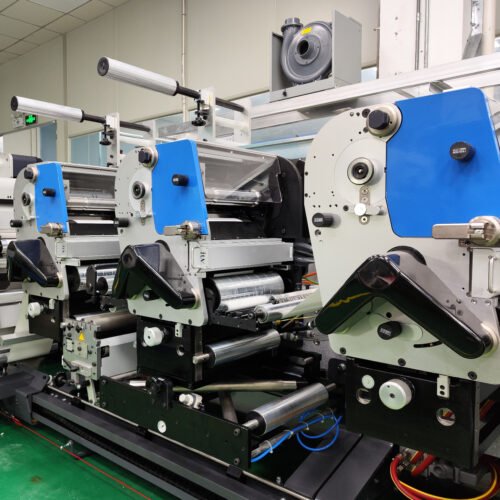
For label converters, shrink sleeves, unsupported films, and in-mold labels (IML) require different curing considerations. The main challenge is achieving complete ink curing without affecting film dimensions, registration, adhesion, or downstream processing. Existing narrow-web flexographic presses may also need adjustments to their curing units, cooling arrangements, and web transport conditions.
Why Do Shrink Sleeves, Unsupported Films and IML Require Different Curing Conditions?
Heat-sensitive substrates are printing materials whose physical properties or dimensions can change when exposed to excessive thermal energy.
Common materials include polyethylene terephthalate glycol (PETG), polyvinyl chloride (PVC), oriented polystyrene (OPS), and polypropylene (PP). Their thermal behaviour depends on material grade, thickness, orientation, coatings, and manufacturing conditions.
Although these materials may all be printed using UV-curable inks, their production requirements are not identical.
Shrink sleeve films
Shrink sleeve films are designed to contract when exposed to controlled heat during final packaging operations. They are commonly used for bottles, containers, and products with complex shapes.
During printing, premature shrinkage can cause dimensional changes before the material reaches the shrinking tunnel. These changes can affect colour registration, graphic alignment, and finished sleeve dimensions.
The cured ink must also withstand the subsequent shrinking process. As the film contracts, the printed ink layer must accommodate the material’s dimensional changes without cracking or losing adhesion.
For this reason, UV flexo printing on shrink films requires careful control of both curing conditions and ink flexibility.
Unsupported flexible films
Unsupported films travel through the printing press without a supporting liner or rigid backing.
Thin films can be particularly sensitive to temperature and web tension. Excessive thermal exposure may contribute to deformation, while unstable tension can cause stretching and registration problems.
The curing system must therefore deliver sufficient UV energy while maintaining stable material transport.
In-mold labels
In-mold labeling is a process in which a printed label is placed inside a mold before the plastic container is formed.
The label becomes integrated with the container during injection molding or blow molding. Polypropylene is commonly used for IML applications.
Unlike shrink sleeves, IML materials are not designed to contract around an existing container. Their main requirements include dimensional stability, ink adhesion, heat resistance, and compatibility with the molding process.
The printed surface must withstand subsequent manufacturing conditions. Insufficiently cured ink or unsuitable ink chemistry can affect the finished appearance and performance.
UV curing for IML labels therefore requires consideration of both printing conditions and molding requirements.
These three applications share a need for controlled curing, but their material requirements differ. Printers should establish separate production specifications for each substrate rather than applying identical settings to every film.
How Does UV LED Curing for Shrink Sleeves Change Heat Management?
Ultraviolet (UV) curing is a photochemical process that uses ultraviolet radiation to initiate polymerisation in inks, coatings, and other reactive materials.
Light-emitting diode (LED) curing systems generate UV radiation within selected wavelength bands. Their thermal characteristics differ from conventional mercury UV systems.
A mercury UV lamp produces broad-spectrum radiation, including infrared radiation that contributes to substrate heating. A UV LED curing system produces selected UV wavelengths with substantially lower infrared output from the emitting source.
This difference is particularly relevant when printing thin shrink sleeve films.
When a mercury UV lamp exposes a heat-sensitive film, the thermal load can increase the web temperature. If the temperature approaches the material’s shrink onset, dimensional changes may occur during production.
A UV LED curing system reduces this direct infrared contribution. This makes it easier to control the thermal conditions of sensitive materials.
However, UV LED curing does not mean zero substrate heating. The film can still absorb UV energy, while the printing process introduces other sources of heat.
Printers must therefore consider the complete thermal environment rather than evaluating the curing lamp alone.
The main differences between mercury UV and UV LED systems include:
Radiation output: Mercury UV lamps produce broad-spectrum radiation, while UV LED systems produce radiation within selected wavelength bands.
Infrared contribution: Mercury UV lamps emit infrared radiation, while UV LED systems have very low infrared emission from the UV-generating source.
Substrate temperature: Mercury UV systems generally introduce a greater radiant heat load, while UV LED systems reduce this particular source of heating.
Cooling arrangement: Mercury UV systems commonly use air cooling, while UV LED systems commonly use water cooling.
Operating characteristics: Mercury UV lamps require appropriate operating and thermal management procedures, while UV LED systems support instant on/off operation.
Maintenance requirements: Mercury UV systems require attention to lamp condition, reflectors, and ventilation. UV LED systems require attention to LED modules, optical surfaces, and cooling circuits.
For heat-sensitive film printing, the main benefit is reduced thermal exposure without sacrificing the required curing process.
A properly selected UV LED system can help converters process thinner substrates and materials that require more careful temperature management. However, ink compatibility, film properties, and actual production conditions remain essential.
UV LED technology reduces the thermal burden of curing, but substrate stability still depends on the complete printing process.
How Should Flexo Printers Set Up UV LED Curing for Heat-Sensitive Films?
Flexographic printing requires coordinated control of ink transfer, web movement, curing output, and substrate temperature. Each printing station introduces additional process conditions that can influence the finished material.
A suitable UV LED configuration should address the following factors.
1. Match the UV ink to the substrate
The ink must be compatible with the material and its intended application.
Shrink sleeve printing requires suitable adhesion and flexibility after curing. The ink film must withstand the dimensional changes associated with the final shrinking process.
IML applications require ink chemistry that can tolerate the relevant molding conditions. The printed label must maintain its appearance and performance during contact with the molding process.
Printers should confirm the following information with their ink suppliers:
- Recommended substrate types.
- Suitable surface treatment conditions.
- Compatible UV curing technology.
- Required wavelength range.
- Recommended curing conditions.
- Adhesion and flexibility requirements.
- Resistance requirements for subsequent processing.
A UV ink suitable for paper labels should not automatically be considered suitable for shrink sleeves or IML.
2. Confirm wavelength compatibility
Wavelength is the distance between successive peaks of a light wave. UV wavelength is measured in nanometres (nm).
Photoinitiators are chemical components in UV-curable inks that absorb suitable UV radiation and generate reactive species. These species initiate polymerisation.
Different photoinitiators respond to different wavelength ranges. UV LED equipment must therefore match the absorption characteristics of the ink formulation.
A wavelength mismatch can result in insufficient curing, even when the curing system appears to operate normally.
Printers should confirm the ink manufacturer’s recommendations before selecting a UV LED curing system or changing an existing configuration.
3. Establish the required UV dose
UV dose is the total radiant energy received by a unit area of the printed material during exposure. It is commonly expressed in millijoules per square centimetre (mJ/cm²).
Irradiance describes the UV power reaching the substrate per unit area at a particular moment.
Both measurements are relevant to curing performance.
High irradiance does not necessarily guarantee sufficient UV dose. Exposure time also affects the total energy received by the ink film.
When production speed increases, the time available for curing decreases. The UV LED curing system must provide sufficient energy within the shorter exposure period.
Printers should verify curing performance at actual production speed instead of relying only on equipment output settings.
4. Control web tension and substrate temperature
Shrink sleeve films require stable web handling throughout the press.
Excessive web tension can stretch the material and affect registration. Temperature changes can also influence dimensional stability and transport behaviour.
Chilled impression cylinders or cooling rollers may help manage substrate temperature. Their settings should match the film characteristics and the press configuration.
Maximum cooling is not necessarily the correct approach. Excessive cooling can influence material handling and other production conditions.
The objective is to maintain a stable operating temperature while preserving suitable web tension.
5. Evaluate ink coverage and film thickness
Heavy ink deposits can create additional curing challenges.
Solid colours, opaque white, and dense black areas may require more careful evaluation. Pigments can absorb or scatter UV radiation, affecting energy penetration through the ink film.
An excessively thick ink layer may also create adhesion or flexibility problems.
For flexographic printing, anilox selection, ink transfer, and print coverage should therefore be evaluated together with curing output.
6. Check curing unit position and cooling performance
The distance and alignment between the curing unit and the printed substrate influence the radiation reaching the ink film.
Contaminated optical windows, incorrect positioning, and inadequate cooling can affect operating consistency.
For multi-station presses, each curing unit should be checked separately. Different printing stations may have different coverage and curing requirements.
A stable UV LED curing configuration must coordinate optical positioning, cooling performance, output control, and production speed.
How Can Printers Verify UV Curing Without Distorting the Film?
Printers should verify curing performance through controlled production tests rather than relying on visual appearance alone.
A film may appear dry while still having insufficient curing or adhesion. Conversely, a properly cured ink film may still show defects caused by substrate treatment or mechanical handling.
The following sequence provides a practical inspection method.
Step 1: Record the substrate specifications.
Identify the film material, thickness, surface treatment, and relevant thermal characteristics.
For shrink sleeves, obtain the supplier’s information about shrink behaviour and recommended processing conditions.
For IML, confirm the material requirements of the intended molding process.
Step 2: Confirm ink and curing compatibility.
Record the ink formulation, wavelength requirements, curing recommendations, print coverage, and production conditions.
Check whether the ink is designed for the selected UV LED wavelength.
Do not assume that different UV ink formulations can share identical curing settings.
Step 3: Measure UV output and substrate temperature.
Use a suitable UV radiometer to evaluate irradiance and dose under defined production conditions.
Measure substrate temperature before and after the relevant curing stations.
Thin and transparent films can create measurement difficulties for some infrared temperature instruments. The measurement method should therefore be suitable for the material.
Step 4: Conduct curing and adhesion tests.
Evaluate surface tack, rub resistance, adhesion, and other properties required by the application.
For shrink sleeves, conduct additional testing after the intended shrinking process. Check for ink cracking, flaking, colour changes, and loss of adhesion.
For IML materials, verify the printed surface after the relevant molding process.
Step 5: Repeat testing at different production speeds.
A curing configuration that works at one speed may not provide sufficient curing at another.
Repeat the tests when changing production speed, ink formulation, film grade, or print coverage.
Record the validated settings for future production jobs.
This process allows converters to establish reliable operating conditions rather than relying on a single curing setting for different materials.
What Should OEMs Consider When Integrating a UV Curing System?
For printing machine manufacturers, heat-sensitive film applications create additional requirements during machine development.
A UV curing system must integrate with the mechanical structure, electrical architecture, cooling arrangement, and press control system.
Mechanical integration
The curing unit must fit the available installation space and provide suitable exposure geometry.
OEM engineers should evaluate the relationship between the curing unit, impression cylinder, web path, and printing stations.
Maintenance access and operator safety should also be considered during the original machine design.
Electrical and control integration
The UV curing system should support the output requirements of the intended applications.
Independent power supply control allows different curing units to operate according to their respective printing conditions.
Monitoring, diagnostics, and protection functions can also support stable machine operation.
Cooling integration
The cooling arrangement must match the selected curing technology.
Mercury UV systems commonly use air cooling. UV LED systems commonly use water cooling.
For water-cooled LED systems, engineers should consider circulation, heat removal, connection positions, maintenance access, and operating stability.
The cooling system should form part of the complete machine design.
Modular UV curing configuration
A modular UV curing system gives OEMs greater flexibility when configuring different press models.
Independent curing modules and power supplies can support different station arrangements and application requirements.
For printing equipment designed to support both mercury UV and UV LED technologies, interchangeable light box configurations can provide additional flexibility.
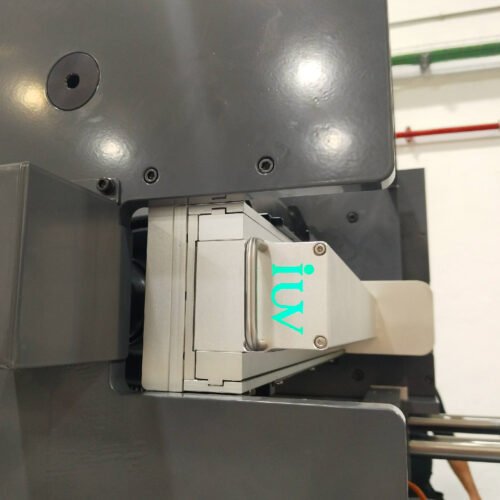
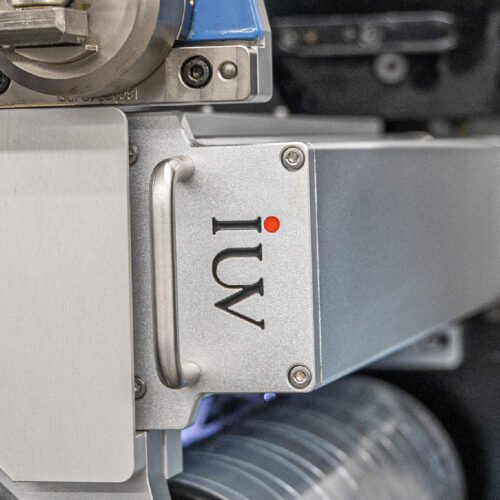
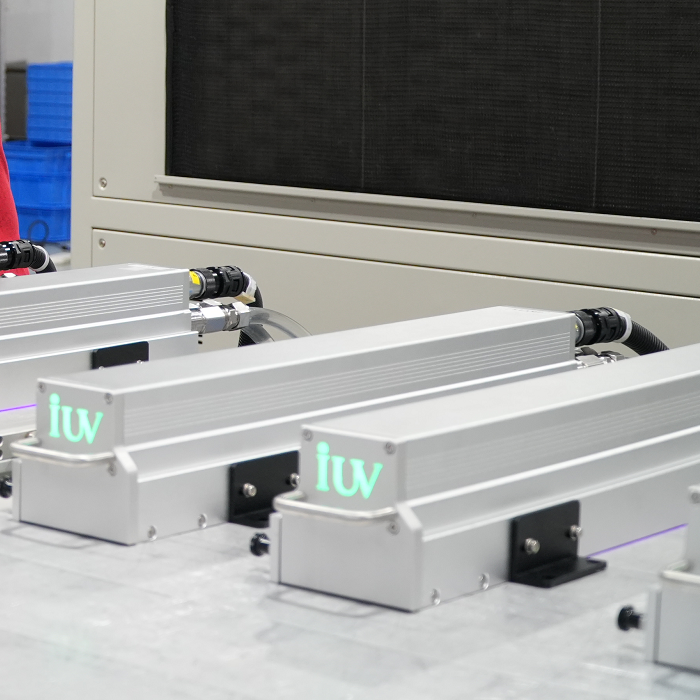
IUV provides LED UV curing systems, mercury UV systems, and interchangeable mercury-LED light box configurations. The appropriate configuration depends on the press design, ink compatibility, and production requirements.
Matched operating settings are necessary when changing between different curing technologies.
For OEM projects, engineers should confirm installation dimensions, electrical capacity, cooling requirements, control interfaces, and service accessibility before finalizing the press design.
Reliable integration depends on coordinating these elements rather than treating UV curing equipment as an isolated component.