Surface tackiness is a persistent quality concern in LED UV flexo printing, especially in label and narrow web production using low-tension films. The printed surface may appear dry during visual inspection, yet remain sensitive to pressure, leading to blocking during rewinding, marking in stacks, dust attraction, and unstable die-cutting. These issues reduce press efficiency and increase waste, particularly in high-speed label applications.
Low-tension films such as PE, PP, PET, and multilayer structures are widely used due to their flexibility, chemical resistance, and cost advantages. However, their low surface energy and limited thermal capacity make them unforgiving when curing conditions are not precisely controlled. With LED UV curing, the margin for error is smaller than with traditional UV systems, making surface tackiness a process control issue rather than a material defect.
The Effect of LED UV Curing Physics on Ink Surface Cure
LED UV curing systems operate with a narrow spectral output, typically centered at 365 nm, 385 nm, or 395 nm. This narrow-band emission changes the way photoinitiators activate and how polymer chains form within the ink film. In flexographic printing, this shift directly affects surface cure performance.
When the delivered energy is sufficient and well matched to the ink formulation, polymerization proceeds quickly and evenly. When the energy dose is marginal, curing may occur through the bulk of the ink film while the surface remains under-cured. This condition creates a print that feels set but still exhibits tack under pressure.
In narrow web presses, where exposure time is limited by speed, even small reductions in irradiance or lamp efficiency can result in incomplete surface polymerization. On low-tension films, this incomplete cure is immediately evident during rewinding and converting.
Why Low-Tension Films Amplify Surface Tack Problems
Low-tension films behave very differently from paper substrates in UV flexo printing. Their surface energy is often close to the minimum required for UV ink wetting and adhesion. If surface treatment is inconsistent or has decayed, ink interaction with the film becomes less uniform, increasing the risk of cure variation.
These films also provide no absorption pathway for ink components. All uncured or partially cured material remains on the surface. Unlike paper, where some ink constituents can migrate into the substrate, films leave no margin for incomplete polymerization.
Thermally, low-tension films dissipate heat rapidly and do not store residual warmth. LED UV curing produces minimal heat, which is beneficial for film stability but eliminates any secondary thermal assistance to curing. As a result, surface cure depends entirely on photon density and exposure consistency.
Ink Film Thickness and Anilox Control in Flexo Printing
Ink film thickness is one of the most influential variables in surface tackiness. In flexographic label printing, ink transfer is controlled by anilox volume, plate cell structure, impression pressure, and ink viscosity. On low-tension films, even a slight increase in ink thickness can overwhelm the available curing energy.
Thicker ink films require higher total energy to fully polymerize, particularly at the surface where oxygen interference is greatest. If curing capacity is not adjusted accordingly, the ink body may harden while the surface remains soft. This effect is often observed when converting presses from arc UV to LED UV without optimizing anilox specifications.
Reducing ink film thickness often improves surface hardness and slip properties. However, this adjustment must be balanced carefully to maintain color density, opacity, and visual consistency required in branded label applications.
Oxygen Inhibition and Its Role in Surface Tackiness
Oxygen inhibition is a fundamental limitation of free-radical UV curing and plays a significant role in LED UV flexo printing. Oxygen present at the ink surface interferes with polymer chain formation, slowing or stopping the curing reaction in the top layer of the ink film.
In LED UV processes, this effect is more visible because the energy spectrum lacks shorter wavelengths that can help overcome oxygen interference. Solid areas, heavy ink coverage, and coatings are particularly susceptible, while fine text and halftones may cure adequately.
On low-tension films, oxygen inhibition is more pronounced because the ink remains fully exposed at the surface. Without absorption or heat retention, the curing system must rely entirely on irradiance and exposure time to achieve a tack-free surface.
Press Speed as a Limiting Factor in Narrow Web Curing
Press speed directly determines exposure time in LED UV curing. As speed increases, the time available for polymerization decreases. If irradiance does not increase proportionally, the total energy dose falls below the threshold required for full surface cure.
In narrow web label production, high speed is often essential for productivity. However, running near the upper limits of curing capacity frequently leads to marginal surface cure. This condition may not be immediately visible but becomes evident during rewinding or downstream processing.
Balancing press speed with curing capability is critical. Stable surface cure requires consistent energy delivery across all printed areas at the target production speed.
Lamp Positioning and Uniform Energy Distribution
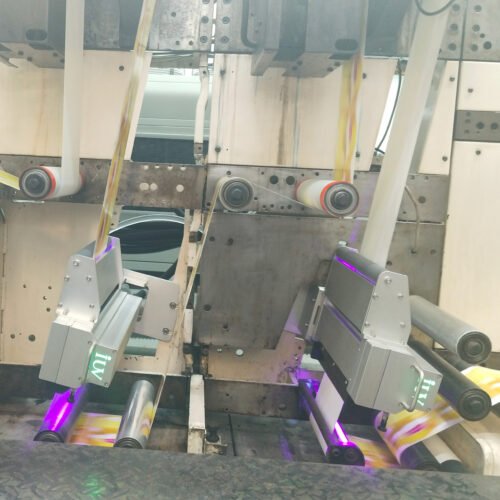
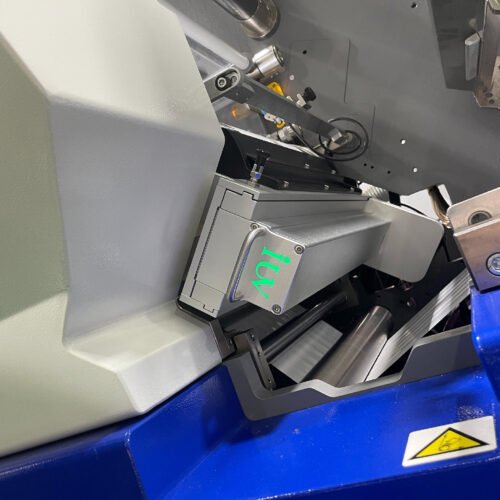
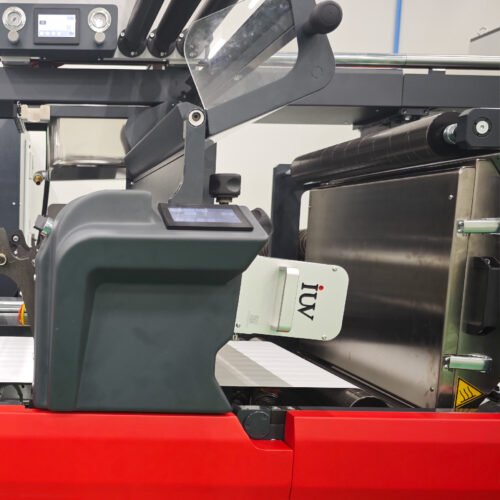
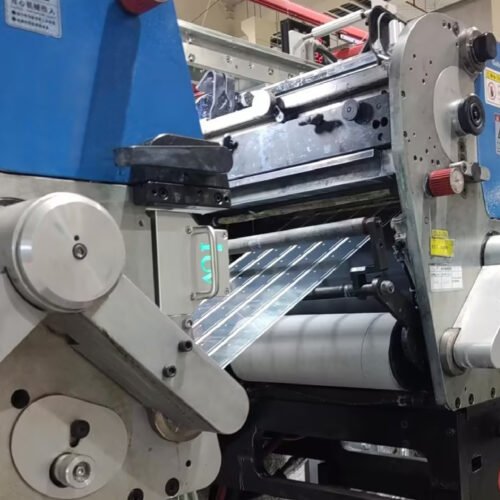
The effectiveness of LED UV curing depends heavily on lamp positioning. Working distance between the lamp and the ink surface has a direct impact on irradiance. Even small increases in distance can significantly reduce energy density at the substrate.
Uniformity across the web width is equally important. In narrow web presses, uneven irradiance can result from edge losses, cooling inconsistencies, or contamination on the lamp window. These factors create localized under-cured zones that often correspond with tacky edges or uneven gloss.
Routine inspection, cleaning, and calibration of LED UV lamps help maintain consistent curing conditions and reduce the risk of surface tackiness.
Surface Treatment Stability on Low-Tension Films
Surface treatment is essential for successful UV flexo printing on low-tension films. Corona or plasma treatment increases surface energy, improving ink wetting and anchorage. However, treatment effectiveness can decay over time, particularly on polyolefin films.
If surface energy drops below recommended levels, ink may not spread evenly, creating micro-variations in film thickness. These variations lead to localized differences in curing response and increase the likelihood of surface tack.
Verifying surface energy before printing helps ensure stable ink interaction and predictable curing behavior throughout the production run.
Mechanical Influences on Ink Laydown and Cure
Mechanical press settings indirectly affect surface cure quality. Excessive impression pressure increases ink transfer and film thickness. Unstable web tension can alter exposure consistency and lamp distance. Worn plates or damaged anilox rolls create uneven ink laydown.
Low-tension films magnify these effects due to their flexibility and sensitivity. Small mechanical variations can translate into significant differences in ink thickness and curing performance. Maintaining precise mechanical control is therefore essential in LED UV flexo printing.
Preventive maintenance and consistent setup procedures reduce variability and support stable surface hardness.
Process Alignment for Reliable Tack-Free Results
Eliminating surface tackiness requires alignment across the entire printing system. Curing capacity must match press speed and ink film thickness. Inks must be formulated for LED UV wavelengths. Substrate surface energy must be stable and verified. Mechanical settings must ensure uniform ink transfer and exposure.
When these elements are balanced, LED UV flexo printing delivers durable, non-tacky surfaces on low-tension films. The result is improved print quality, reduced waste, and smoother downstream converting.
Consistent Surface Cure in Label and Narrow Web Production
Surface tackiness is not an inherent limitation of LED UV curing. It is a process control challenge that can be managed through careful optimization of curing, ink, substrate, and press parameters.
For label printers working with low-tension films, understanding the interaction between narrow-band UV energy and film behavior is essential. A controlled curing process ensures that printed labels leave the press clean, stable, and ready for finishing, even at demanding production speeds.