Abstract
Tacky UV ink is a common production problem in label printing, flexographic printing and narrow-web converting. The printed surface may remain sticky even when the UV LED curing system appears to be operating normally. In some cases, the ink feels dry in one area but remains soft or tacky in another. This can lead to set-off, poor blocking resistance, unstable overprinting and reduced finishing quality.
Incomplete curing is not always caused by insufficient lamp power. Ink film thickness, LED wavelength, irradiance, delivered energy and photoinitiator response all influence the curing result. These factors interact with press speed, substrate properties and the position of the curing unit.
A reliable diagnosis must therefore examine the complete curing process. Increasing LED output without identifying the underlying cause may raise energy consumption or substrate temperature without resolving the defect. Understanding how ink thickness, wavelength and UV dose work together helps printers identify the correct adjustment and maintain stable production.
Introduction
UV ink is designed to polymerise when exposed to suitable ultraviolet radiation. During exposure, photoinitiators absorb UV energy and generate reactive species. These species initiate a chemical reaction that converts liquid ink components into a solid film.
When the reaction is incomplete, the printed surface may remain tacky. The defect can appear immediately after printing or become more noticeable during winding, stacking or finishing. It may affect the entire print or only selected colours and areas.
In label and narrow-web printing, several process variables can contribute to this condition. A high press speed reduces exposure time. A thick ink film requires sufficient UV energy through its depth. An unsuitable wavelength may limit photoinitiator activation. Low irradiance can also prevent the ink from receiving enough effective radiation.
For engineers and production managers, the key question is not simply whether the LED UV curing system is switched on. The important question is whether the ink receives the correct radiation under actual production conditions.
How UV LED Curing Works in Printing Applications
UV LED curing relies on semiconductor light sources that emit radiation within a defined wavelength range. Common industrial systems for printing use wavelengths around 365 nm, 385 nm and 395 nm. The selected wavelength must match the absorption characteristics of the ink’s photoinitiator package.
When the ink absorbs suitable radiation, photoinitiators produce reactive species. These initiate polymerisation and crosslinking within the ink film. The reaction develops from the exposed surface towards the underlying material, depending on the formulation and optical properties of the ink.
This process differs from simply drying water or solvent from a coating. UV ink curing involves a chemical reaction. A surface that feels dry does not necessarily indicate complete polymerisation throughout the film.
LED UV systems also produce a different spectral output from conventional mercury UV lamps. Their emission is concentrated within a narrower wavelength band. This makes ink and lamp compatibility particularly important.
A curing system can deliver substantial optical output but still produce poor results if the ink absorbs little energy at the emitted wavelength. Conversely, a suitable wavelength cannot compensate for inadequate irradiance or insufficient exposure.
Ink Film Thickness: Why a Thicker Layer Needs More Effective UV Energy
Ink film thickness is one of the first factors to investigate when UV ink remains tacky. A thin layer generally allows radiation to penetrate more easily. A thick layer can absorb or scatter more UV radiation before it reaches the lower part of the film.
The exposed surface may therefore cure faster than the ink close to the substrate. This can create a film with a relatively firm surface but insufficient internal conversion. The printed area may feel acceptable during initial inspection but remain soft under pressure or during subsequent processing.
In flexographic printing, ink film thickness is closely related to anilox selection, cell volume, ink rheology and plate characteristics. A high-volume anilox roll can transfer more ink to the substrate. Solid areas, heavy graphics and certain opaque colours may also create thicker deposits.
In narrow-web label production, these conditions can become more challenging when printing dense solids or white ink. White formulations often contain substantial pigment loading. Their optical properties can affect UV penetration and curing behaviour. The required curing conditions must be established for the specific ink formulation.
Offset printing presents different ink-transfer characteristics, but the same principle applies. Heavy ink coverage and multiple printed layers can increase the curing demand. A system that performs well on light coverage may struggle with a dense solid or a complex overprint.
When tackiness occurs only in heavy coverage areas, reducing the ink film may be more effective than immediately increasing LED output. Check the anilox specification, ink transfer, plate pressure and printing conditions. Any adjustment must preserve colour density, opacity and print definition.
LED Wavelength and Photoinitiator Compatibility
Wavelength determines which part of the UV spectrum reaches the ink. Photoinitiators do not respond equally to every wavelength. Each formulation has an absorption profile that influences how efficiently it uses the available radiation.
For example, an ink designed for a particular LED wavelength may cure efficiently under a compatible system. The same ink may perform poorly if exposed to a different wavelength with limited absorption overlap.
This issue can arise during a curing system retrofit. A press may previously have used mercury UV lamps with a broad spectral output. Replacing them with LED equipment changes the available radiation spectrum. Existing inks may not be suitable for the new source.
Ink suppliers can provide information about recommended LED wavelengths and curing conditions. Printers should confirm this information before changing the curing configuration. A successful trial with one colour does not prove that every ink in the range will behave in the same way.
The photoinitiator package also matters. Different colours and special-effect inks may use different formulations. White, opaque, black and heavily pigmented inks can present different curing requirements. Low-migration inks may also have specific formulation and process requirements.
If tackiness occurs across several colours, check whether the ink range is approved for the installed LED wavelength. If only one colour is affected, investigate its formulation, pigment loading and film thickness before changing the whole curing system.
LED Irradiance and UV Dose: Two Different Measurements
Irradiance and UV dose are closely related, but they describe different aspects of the curing process.
Irradiance refers to the UV power received per unit area at a given moment. It is commonly expressed in watts per square centimetre or milliwatts per square centimetre. It indicates the intensity of radiation reaching the printed surface.
UV dose, also called radiant exposure, represents the accumulated UV energy received over time. It is commonly expressed in joules per square centimetre or millijoules per square centimetre.
A useful engineering distinction is that irradiance describes the intensity of exposure, while dose describes the total accumulated energy. Both influence curing performance.
A system may show high peak irradiance but deliver insufficient dose if the exposure time is too short. This can happen when the press runs at high speed or the effective irradiation zone is narrow.
Conversely, a longer exposure does not always compensate for inadequate peak irradiance. The ink may require a certain intensity to initiate and sustain the reaction effectively. The required balance depends on the ink chemistry and the curing process.
For this reason, engineers should not evaluate a curing system using only its rated electrical power or maximum irradiance specification. The relevant measurements are those obtained at the actual working distance and under production conditions.
How Press Speed and Lamp Position Affect the Delivered Dose
Press speed directly influences the time that each printed area spends under the LED curing unit. As speed increases, exposure time decreases if the irradiation zone remains unchanged.
This means a setting that works at a low production speed may become insufficient at a higher speed. The problem can be especially visible when printing thick ink layers or demanding colours.
Lamp position also affects the radiation reaching the substrate. The distance between the LED window and the printed surface influences irradiance. Incorrect positioning, mechanical misalignment or an unsuitable installation height can reduce the effective output at the web.
The curing unit should cover the required printing width. If the irradiation area does not match the web width or print layout, some areas may receive different exposure conditions. This can produce uneven curing across the web.
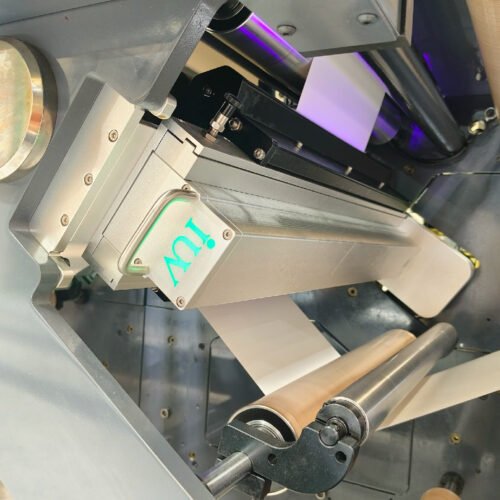
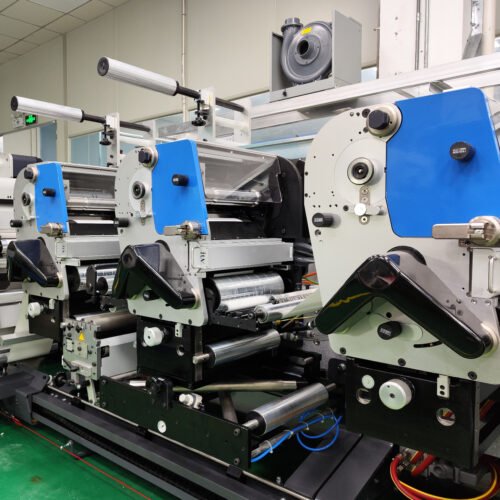
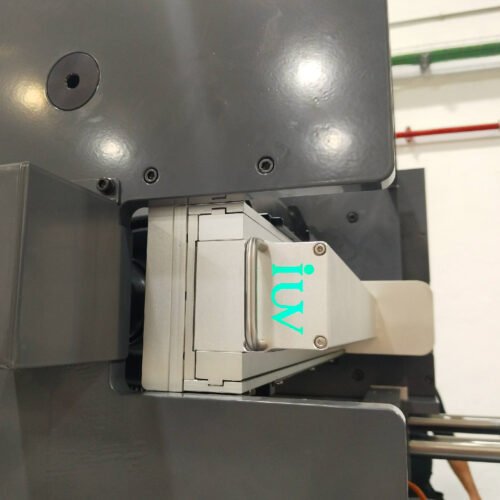
For narrow-web presses, the available installation space may restrict lamp positioning. Existing guards, rollers, cooling connections and other press components can influence the final arrangement. During a retrofit, engineers should assess the mechanical layout before confirming the curing configuration.
The relationship between speed, lamp position and dose should be verified during commissioning. Testing should include the normal production speed and the most demanding expected print conditions.
Oxygen Inhibition and Surface Tackiness
Oxygen inhibition is another possible cause of tacky UV ink. Oxygen in the surrounding air can interfere with free-radical polymerisation, particularly near the exposed surface of the ink film.
This can result in a surface that remains slightly sticky even when the underlying film has developed a reasonable level of cure. The effect depends on ink chemistry, formulation and curing conditions.
A common mistake is to assume that every tacky surface indicates insufficient total UV energy. In some cases, the problem is related to surface reaction conditions rather than the total dose alone.
Engineers should distinguish between surface tack and incomplete curing through the film. A surface may feel sticky while the underlying ink has reasonable adhesion and resistance. Alternatively, the entire film may remain soft or poorly bonded.
The distinction affects the corrective action. Increasing LED output may help some cases, but it is not a universal solution. The ink supplier should be consulted about the formulation and its expected surface-curing behaviour.
For demanding applications, the curing process must also be assessed against the required performance tests. Surface feel alone is not a reliable measurement of complete cure.
Substrate Properties and Thermal Considerations
The substrate can influence the practical curing window. Many label materials are thin and dimensionally sensitive. Filmic substrates may deform when exposed to excessive heat, while paper stocks can behave differently depending on coating and moisture content.
LED UV curing generally offers a different thermal profile from conventional mercury UV systems. However, the substrate can still receive heat from the curing unit, the press environment and the printed material itself.
If operators increase LED output to overcome tackiness, they should monitor the substrate temperature and web stability. Excessive heat may cause shrinkage, distortion, tension changes or registration problems.
This is particularly important in narrow-web production with pressure-sensitive label materials. A change in web dimensions can affect die-cutting accuracy and downstream converting.
Thermal management also influences the stability of the LED curing system. High-power LED units require effective heat removal from the LED modules. Water-cooled systems depend on suitable water flow, temperature control and chiller performance.
A cooling fault can cause the equipment to reduce output or operate outside its intended conditions. Engineers should check cooling alarms, water circulation and operating temperatures when curing performance changes unexpectedly.
Diagnosing Tacky UV Ink on a Production Press
A structured investigation is more effective than changing several settings at once. Begin by identifying where and when the tackiness occurs. Check whether it affects all colours, specific colours, heavy solids or only selected areas of the web.
The following checks can help narrow down the cause:
- Check the ink specification. Confirm that the ink is suitable for the installed LED wavelength. Ask the supplier for the recommended curing conditions and relevant technical data.
- Inspect the ink film. Review anilox volume, ink transfer, plate pressure and coverage. Pay particular attention to heavy solids and opaque colours.
- Verify press speed. Compare the current production speed with the conditions under which the ink previously cured successfully.
- Measure UV output. Use a suitable UV radiometer to check irradiance and dose at the working position. Confirm that the instrument is suitable for the wavelength being measured.
- Inspect lamp positioning. Check working distance, alignment, effective curing width and any mechanical obstruction.
- Review cooling performance. Check water flow, chiller operation, temperature alarms and signs of unstable LED output.
- Evaluate the cured film. Use appropriate adhesion, rub, blocking and other application-specific tests. Do not rely only on surface touch.
Make one controlled adjustment at a time. Record the ink batch, substrate, press speed, LED settings and test results. This creates a useful reference for future production runs.
Common Quality Defects Associated with Incomplete UV Curing
Tacky ink is not the only sign of inadequate curing. Several downstream defects may appear when the ink film has not developed sufficient resistance.
Set-off can occur when printed surfaces contact other surfaces during stacking or winding. Blocking may develop when adjacent label layers adhere under pressure. Poor rub resistance can cause printed graphics to lose definition during handling.
Incomplete curing can also affect overprinting. The next ink layer may not bond consistently with the previous layer. This can cause unstable intercoat adhesion, colour variation or defects during finishing.
In label production, these problems may become more serious during die-cutting, matrix stripping, laminating or varnishing. A printed web that appears acceptable immediately after curing may fail during later converting operations.
The corrective action depends on the defect pattern. If only heavy ink areas show poor resistance, investigate film thickness and penetration. If the entire web is affected at high speed, review dose and exposure conditions. If one colour behaves differently, check its formulation and wavelength compatibility.
Low-Migration Applications Require More Than a Tack-Free Surface
Food packaging and other sensitive applications may require low-migration UV ink systems. In these applications, a tack-free surface does not establish compliance with migration requirements.
The performance of the complete printing and packaging system matters. Ink formulation, curing conditions, substrate, printed coverage and downstream processing can all influence the final result.
Printers should follow the ink supplier’s processing instructions and the relevant requirements for the intended application. They should also maintain documented production conditions and appropriate quality checks.
A higher LED setting should not be treated as automatic proof of low migration. The actual curing process must be validated using suitable procedures and testing. This is particularly important when changing ink formulations, substrates, press speeds or curing equipment.
LED UV Retrofit Considerations for Existing Label and Flexo Presses
When tackiness appears after a mercury-to-LED retrofit, the investigation should include both the ink and the equipment configuration. The change in spectral output may require different inks or adjustments to the curing process.
Before installation, the press manufacturer, curing system supplier and ink supplier should confirm the intended operating conditions. The review should cover available electrical capacity, installation space, cooling requirements and press-speed signals.
The LED unit must be positioned to provide suitable coverage at the intended production width. Its output should also remain stable under normal operating conditions.
For an existing press, the original mercury UV configuration may have allowed a broad range of ink formulations. An LED retrofit may require a more specific approach to ink selection. This is not necessarily a limitation of the equipment. It reflects the different spectral characteristics of the two curing technologies.
Commissioning should include representative inks, substrates and print coverage. Test the press at realistic production speeds. Record the settings that achieve acceptable curing and verify the results through application-specific quality checks.
Maintenance Factors That Can Change Curing Performance
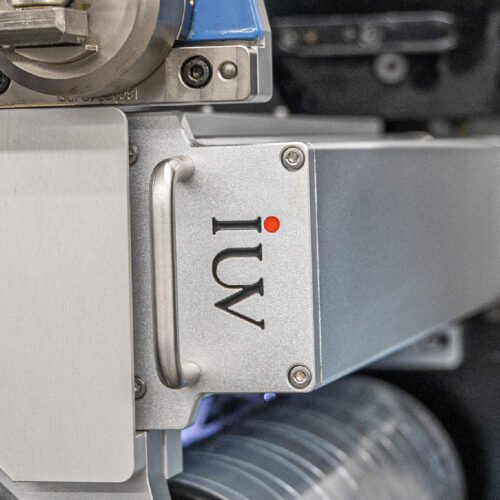
LED UV systems require regular inspection even though their light sources do not use conventional mercury lamp replacement routines. Dust, ink mist and other contamination can collect around the optical window and reduce the radiation reaching the substrate.
The optical window should be inspected and cleaned according to the equipment manufacturer’s instructions. Use approved cleaning materials to avoid damaging the surface.
Cooling performance should also be monitored. Check the chiller, water connections, filters and circulation conditions at the recommended intervals. Poor heat removal can affect equipment stability and service life.
Operators should record changes in curing performance, including unusual alarms, output fluctuations and maintenance work. A consistent maintenance record helps identify gradual changes before they become major production defects.
If you are experiencing tacky UV ink on your press, please feel free to contact the IUV team for expert advice and support.
Conclusion
UV ink stays tacky when the curing reaction does not develop as required. The cause may involve excessive ink film thickness, an unsuitable LED wavelength, insufficient irradiance, inadequate UV dose or oxygen inhibition.
In label and narrow-web printing, these factors interact with anilox selection, press speed, substrate properties and curing-unit position. A single increase in LED output may not solve the problem.
A reliable solution begins with identifying the defect pattern and checking the ink formulation against the installed wavelength. Engineers should then verify irradiance, dose, lamp position and cooling performance under actual production conditions.
For OEMs, printers and retrofit specialists, the objective is to establish a stable curing window. This means achieving the required ink performance without unnecessary energy input, excessive substrate heating or reduced production efficiency.