Summary
Retrofitting a flexographic label press with an LED UV curing system allows converters to improve energy efficiency, reduce heat exposure, and simplify routine maintenance without necessarily replacing the entire printing machine. The most suitable retrofit approach depends on the press layout, available installation space, electrical capacity, cooling arrangements, ink compatibility, and production requirements. Converters can choose between a full LED UV conversion, a partial retrofit, or a hybrid configuration that combines mercury UV and LED UV stations. A properly engineered installation can improve production stability while maintaining the curing performance required for modern label printing.
Introduction
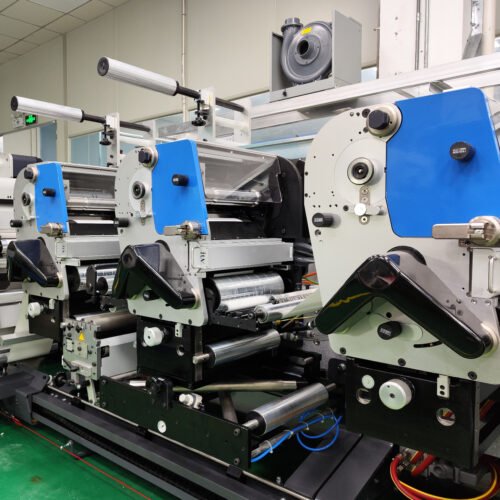
Flexographic printing remains a widely used process for producing self-adhesive labels, packaging labels, and other narrow-web printed products. Modern flexo presses often operate at high speeds and process a wide range of substrates, including paper, PE, PP, PET, and pressure-sensitive labelstock.
UV curing plays an important role in this process. It allows UV inks and coatings to polymerize rapidly between printing stations, supporting multi-color printing and continuous production.
Traditional mercury UV curing systems have served flexographic presses for many years. However, their heat output, electricity consumption, lamp replacement requirements, and maintenance workload can create challenges for converters seeking higher production efficiency.
LED UV curing provides another approach. It uses semiconductor light sources to deliver ultraviolet radiation at selected wavelengths. This technology can reduce unwanted heat transfer, lower energy consumption, and provide near-instant switching.
For existing flexographic label presses, the main question is not simply whether LED UV can replace mercury lamps. The more important issue is how to integrate the new curing system without disrupting the mechanical, electrical, and printing functions of the original machine.
A successful LED UV retrofit must therefore consider the complete production process, from ink transfer and curing performance to cooling, press controls, and finished label quality.
Why Flexographic Label Converters Consider LED UV Retrofits
The decision to retrofit an existing flexo press usually comes from a combination of operating costs and production requirements.
Mercury UV lamps generate broad-spectrum ultraviolet radiation but also produce considerable heat. In narrow-web printing, this heat can affect sensitive substrates and increase the demand for extraction and cooling.
This becomes particularly important when printing thin plastic films or pressure-sensitive materials. Excessive heat may contribute to web distortion, dimensional changes, and adhesive-related problems.
LED UV curing generates less unwanted infrared radiation at the substrate surface. This makes it useful for converters working with heat-sensitive label materials.
Energy consumption is another consideration. Mercury UV lamps generally consume more electricity during operation and require additional thermal management. LED UV systems can reduce the overall energy demand when the equipment is properly matched to the printing application.
For IUV LED UV curing solutions, electricity consumption can be approximately 70% lower than conventional mercury UV systems under comparable operating conditions. Actual savings depend on press configuration, operating hours, installed power, and production conditions.
Maintenance requirements also influence the decision.
Mercury lamps gradually lose output and require periodic replacement. Reflectors and other optical components also need regular inspection and cleaning.
LED UV systems do not use conventional mercury lamp tubes. Under specified operating conditions, their service life can exceed 30,000 hours. Actual performance depends on thermal management, electrical stability, and operating conditions.
For suitable applications, IUV LED UV solutions can reduce maintenance requirements by approximately 80% compared with conventional mercury UV systems. The actual reduction depends on the equipment configuration and maintenance activities included in the comparison.
These benefits make LED UV retrofitting attractive for converters seeking to improve existing production lines without investing in a completely new press.
Selecting the Right LED UV Retrofit Approach for an Existing Flexo Press
Not every flexographic press requires the same retrofit configuration. The correct approach depends on the original curing arrangement, production requirements, and the condition of the existing machine.
Three common approaches are available.
Full LED UV retrofit
A full retrofit replaces the existing mercury UV curing stations with LED UV systems.
This approach is suitable for converters planning a complete transition to LED-compatible UV inks and coatings. It provides a consistent curing technology across the press and can simplify long-term maintenance planning.
However, the change requires careful evaluation of every printing station. Ink formulations must be compatible with the selected LED wavelengths, and the new system must provide sufficient curing performance at the intended production speed.
Mechanical mounting positions, electrical connections, cooling arrangements, and control signals must also be checked.
Partial LED UV retrofit
A partial retrofit replaces selected mercury UV stations while retaining the remaining conventional curing units.
This approach allows converters to introduce LED UV gradually. It can be useful when certain stations have higher heat requirements or when the existing press already has a reliable mercury UV installation.
For example, a converter may initially install LED UV at stations processing heat-sensitive substrates. Other stations can continue using mercury UV while the company evaluates ink compatibility and production results.
The main engineering consideration is the coordination of different curing technologies along the same press.
Operators must ensure that the curing conditions at each station are appropriate for the ink and coating used. The transition between stations should not create inconsistent curing or unnecessary substrate heating.
Hybrid UV configuration
A hybrid UV system combines mercury UV and LED UV capabilities within a flexible curing arrangement.
This configuration can be useful for converters handling different printing jobs, ink systems, and substrate requirements.
For example, a press may use mercury UV for certain conventional UV applications and LED UV for jobs requiring lower heat exposure or improved energy efficiency.
A hybrid arrangement can also support a gradual transition toward LED-compatible printing processes.
The choice between full, partial, and hybrid retrofitting should be based on actual production requirements rather than the number of existing lamps alone.
Engineering Checks Before Installing an LED UV System
Before starting a retrofit project, the existing flexographic press should undergo a detailed technical assessment.
The first consideration is the mechanical installation.
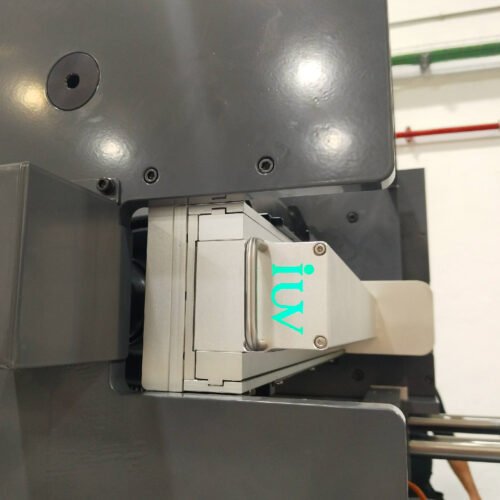
The available space around each printing station must be measured. Engineers need to confirm the mounting positions, curing head dimensions, working distance, and available clearance.
The LED UV unit must cover the required printing width. Its position should also provide suitable radiation distribution across the web.
Incorrect installation distance or alignment can create uneven curing, especially near the edges of the printed material.
The second consideration is the electrical system.
The existing press may have been designed around conventional mercury UV power supplies. LED UV equipment uses different electrical components and control requirements.
Engineers should verify the available voltage, current capacity, phase configuration, grounding, cable routing, and cabinet space.
The press control system must also support the required operating signals. These may include start and stop commands, safety interlocks, operating status, and coordination with press speed.
Emergency stops and protective functions must remain properly integrated after the retrofit.
Cooling is another important factor.
High-power LED modules generate heat internally, even though they transfer less unwanted heat to the substrate. This heat must be removed to maintain stable operating conditions.
Water-cooled LED UV systems require a suitable chiller, water circulation, and correctly sized connections. Water flow and operating temperature must follow the equipment specifications.
A poorly maintained cooling circuit can lead to excessive LED operating temperatures. Over time, this may reduce output stability and shorten component service life.
Air-cooled systems require appropriate airflow and clean ventilation paths.
Therefore, cooling capacity should be confirmed before selecting the final equipment configuration.
How LED UV Wavelength and Irradiance Affect Flexographic Ink Curing
LED UV curing performance depends on the relationship between wavelength, irradiance, energy dose, ink chemistry, and printing speed.
These factors must be considered together when retrofitting a flexographic press.
Common LED UV wavelengths include 365 nm, 385 nm, and 395 nm. Each wavelength has different compatibility characteristics depending on the photoinitiators used in the ink formulation.
Photoinitiators absorb ultraviolet radiation and generate reactive species that initiate polymerization.
If the selected LED wavelength does not match the ink’s absorption characteristics, curing may remain insufficient even when the equipment provides substantial UV output.
Converters should therefore confirm wavelength compatibility with their ink suppliers before installation.
Irradiance and energy dose are two separate parameters.
Irradiance describes the UV power reaching the printed surface at a particular moment. Energy dose represents the accumulated UV energy received during exposure.
In flexographic printing, the available exposure time depends on the press speed and the effective irradiation area.
As production speed increases, the substrate spends less time under the curing head. The system must provide sufficient curing performance within this shorter exposure period.
However, increasing irradiance alone does not guarantee complete curing. The ink formulation, film thickness, wavelength, and available exposure time remain important.
For converters, the correct approach is to validate curing performance at representative production speeds and ink coverage levels.
How Anilox Selection and Ink Film Thickness Influence Retrofit Results
Flexographic ink transfer directly affects the performance requirements of an LED UV curing system.
The anilox roller controls the amount of ink transferred to the printing plate. Its cell volume, line count, condition, and suitability for the ink influence the resulting ink film.
A higher ink volume generally produces a thicker deposited film. This increases the amount of material that must be cured.
If the available UV energy is insufficient for the ink film thickness, the surface may appear dry while the underlying layer remains incompletely polymerized.
This can lead to poor adhesion, reduced rub resistance, and problems during subsequent converting operations.
For example, a label converter printing solid areas with high ink coverage may experience different curing requirements from a job containing fine text and light halftones.
The same LED UV settings should not automatically be applied to every job.
Operators should establish suitable curing conditions for different ink colors, anilox specifications, and substrate types.
Ink viscosity and transfer consistency also matter. Excessive ink film thickness caused by incorrect anilox selection or unstable printing conditions may create curing problems that cannot be solved simply by increasing LED power.
A well-planned retrofit should therefore include an assessment of existing anilox specifications and typical ink coverage.
The printing process and curing system must work together to achieve consistent results.
Maintaining Registration and Print Quality After Retrofitting
Multi-color flexographic label printing requires accurate registration throughout the production process.
Each printing station transfers a separate color layer onto the moving substrate. The curing process must stabilize the printed ink without introducing unnecessary thermal changes.
With conventional mercury UV systems, heat accumulation can affect the dimensional stability of certain films.
This may influence web behavior and create registration challenges during long production runs.
LED UV reduces unwanted heat transfer to the substrate. This can help maintain more stable material dimensions, particularly when processing thin films and heat-sensitive labelstock.
However, LED UV does not automatically eliminate registration problems.
Web tension, substrate quality, roller alignment, printing pressure, and machine condition remain important.
Converters should monitor registration before and after retrofitting under the same production conditions.
Print appearance also needs evaluation.
Changes in ink formulation or curing conditions may affect gloss, surface characteristics, and overprint performance.
For applications involving varnishes or multiple coating layers, the compatibility of each material with the selected LED wavelength should be confirmed.
Oxygen inhibition can also affect surface curing.
In certain free-radical UV formulations, oxygen interferes with the polymerization reaction at the ink surface. This may leave the surface tacky despite apparently sufficient exposure.
The problem depends on ink chemistry, coating thickness, and curing conditions. Changing the LED wavelength or increasing output may not resolve the issue if the underlying formulation is unsuitable.
The ink supplier should help identify the appropriate formulation and curing conditions.
For food packaging and other applications with migration restrictions, converters must also evaluate the complete printing system.
Low-migration performance depends on ink selection, curing conditions, substrate characteristics, and downstream processing. LED UV equipment alone does not guarantee compliance with applicable migration requirements.
Production Testing and Troubleshooting After an LED UV Retrofit
A retrofit should not be considered complete immediately after mechanical and electrical installation.
Production trials are necessary to verify that the new curing system performs correctly under actual operating conditions.
The initial trial should establish a baseline using representative substrates, ink colors, printing speeds, and coverage levels.
Operators should begin with the ink supplier’s recommended LED curing conditions and the equipment manufacturer’s operating specifications.
The press can then be tested at different production speeds to evaluate curing consistency.
The following quality checks are particularly useful:
- Surface curing: Check for tackiness and uneven surface polymerization.
- Ink adhesion: Verify that the printed ink remains attached to the substrate.
- Rub resistance: Evaluate resistance to handling and friction.
- Overprinting: Confirm that subsequent ink or coating layers adhere correctly.
- Converting performance: Check die-cutting, slitting, and other downstream operations.
- Registration: Monitor dimensional stability during continuous production.
- Curing uniformity: Inspect the printed width for differences between the center and edges.
If the ink remains tacky, the investigation should start with wavelength compatibility and curing energy.
The ink film thickness, printing speed, and LED working distance should also be checked.
If curing differs across the web, inspect the LED head alignment, optical window, and radiation distribution.
Poor adhesion may result from insufficient polymerization, but substrate surface properties and ink compatibility should also be considered.
If the system experiences temperature-related alarms, inspect the cooling circuit, water flow, and heat exchanger condition.
Operators should also check electrical connections and ensure that the cooling equipment operates within the specified range.
A structured testing process helps identify whether the problem comes from the LED equipment, ink formulation, substrate, or printing conditions.
What Production Results Can Converters Expect from a Successful Retrofit?
The results of an LED UV retrofit depend on the original press condition and the production applications.
However, several improvements can be evaluated after installation.
Lower operating energy demand
LED UV can reduce electricity consumption compared with conventional mercury UV curing. The actual saving depends on the installed system, production hours, and cooling requirements.
For high-utilization label presses, the difference can become significant over time.
Reduced thermal impact on substrates
Lower unwanted heat transfer can help converters process thin films and pressure-sensitive materials more consistently.
This may reduce heat-related dimensional changes and improve production stability.
Less routine maintenance
LED UV systems eliminate conventional mercury lamp replacement and can reduce maintenance activities associated with traditional lamp systems.
Longer service life also helps reduce interruptions associated with routine lamp changes.
More flexible production scheduling
Near-instant LED switching can be useful for short production runs and frequent job changes.
Operators do not need to follow the same warm-up requirements associated with conventional mercury lamps.
More predictable curing conditions
When wavelength, irradiance, ink chemistry, and operating settings are properly matched, LED UV can provide consistent curing performance across different production jobs.
These results should be verified through production records rather than assumed from equipment specifications.
Converters can compare electricity consumption, maintenance hours, production interruptions, and print quality before and after installation.
This provides a more reliable basis for evaluating the financial and technical benefits of the retrofit.
Conclusion
Retrofitting a flexographic label press with LED UV curing equipment requires more than replacing conventional mercury lamps. Mechanical compatibility, electrical integration, cooling capacity, ink formulation, and production conditions all influence the final result.
Full LED UV conversion, partial retrofitting, and hybrid configurations provide different options for converters with different production requirements.
For label printers handling heat-sensitive materials, frequent job changes, or high production volumes, LED UV can offer practical advantages in energy consumption, thermal management, and maintenance.
The most reliable retrofit results come from a complete engineering assessment followed by controlled production testing.
By matching the LED UV system to the press configuration and printing process, converters can improve operating efficiency while maintaining the curing quality required for modern flexographic label production.