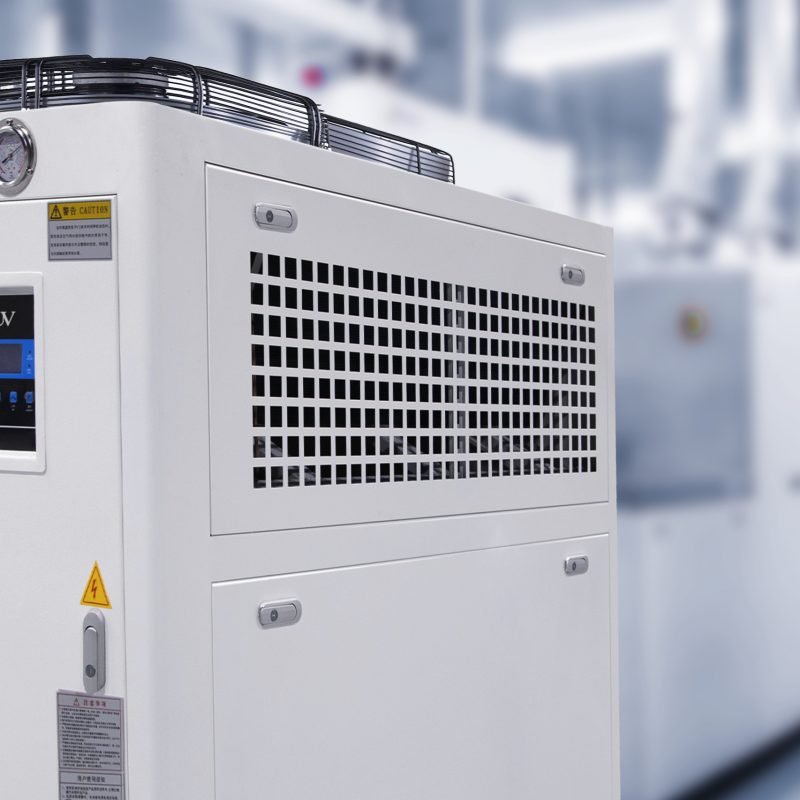
In UV curing systems, the design and selection of cooling systems play a vital role in curing effect, equipment performance and service life.Cooling systems ensure curing results and extend device life by effectively dissipating heat.
UV curing principle and cooling requirements
In order to ensure that the curing process is efficient and uniform, the power, wavelength and radiation intensity of the UV light source must be controlled. At the same time, excessively high temperatures may cause material deformation, failure or equipment damage.
Therefore, the role of selecting the correct cooling method is to maintain the stable output of the light source and extend the service life of the UV system by effectively reducing the operating temperature according to it’s owned characteristics.
About LED UV
In LED UV curing systems, LED light sources composes of semiconductor chips, which are very sensitive to temperature changes. Excessive temperature may cause the performance of LED chips to decline, affecting the brightness and stability of the light source and thus the curing results.
Why is water cooling better than air cooling for LED UV?
For LED UV curing systems, water-cooled systems are often preferable to air-cooled systems for the following reasons:
More efficient heat dissipation: Water has a higher specific heat capacity than air and can absorb and conduct more heat. In LED UV systems, the heat generated by LED chips can be quickly taken away by the water cooling system, thereby effectively controlling the temperature, preventing overheating of the LED chip, and improving the curing effect and the stability of the light source.
Avoid performance degradation: Excessive temperature can cause the LED light output to drop, color shift, and even shorten the service life.Water cooling system can more accurately control the temperature of the system and keep the chip in an ideal operating temperature range, thereby ensuring a stable curing effect and a longer service life.
Temperature uniformity: The air cooling system removes heat through air flow, but the air flow may not cover all heat sources, resulting in uneven temperature. The water cooling system can ensure that the temperature of the LED chip and the curing area remains uniform through the flow of liquid, which helps to uniformly cure the material and avoid incomplete curing due to uneven temperature.
Improve the stability and longevity: The stability of the LED UV light source is closely related to temperature management. Good temperature control can extend the service life of LED light sources and reduce the occurrence of failures caused by overheating, thereby extending the service life of the equipment.
About Traditional Mercury UV
As for mercury UV curing systems, the characteristics of the light source directly determine that it requires a certain temperature to maintain stable light output and curing effect. Mainly because the mercury lamp will activate the mercury vapour by generating heat to produce ultraviolet radiation during operation. During this process, the temperature inside the light box must be maintained within a certain range to ensure effective drying.
Mercury lamp UV systems have had two common cooling methods: air-cooled and water-cooled.Which of them is more suitable for mercury lamp UV?
The air cooling system take away heat from the lamp tube by blower which could maintain the relative temperature inside the light box.Because of the air-cooling method, the temperature inside the light box is kept in an ideal range. Mercury lamps require a certain operating temperature to ensure the stability of the intensity of ultraviolet rays and provide sufficient curing effect.
In contrast,water-cooled systems generally provide more cooling than air-cooled systems, but they can lead to low temperatures inside the light box, which in turn affects the operation of the mercury lamp. Too low a temperature may result in insufficient output of the mercury lamp, which can affect the quality and effectiveness of drying.
Why is air cooling better than water cooling for mercury UV?
For traditional mercury lamp UV curing systems, air-cooled systems tend to provide a more suitable temperature environment for optimum curing results. Here’s why:
Maintaining an ideal working temperature: Mercury lamps require a certain temperature to stably emit ultraviolet rays when working. Too low a temperature will affect the efficiency and stability of the light source.
Avoid insufficient curing caused by over cooling: Although the water cooling system has a strong cooling effect, it may reduce the temperature inside the light box too low, resulting in a weakened ultraviolet output, which in turn affects the curing effect. The air cooling system has a relatively weak heat dissipation capacity, which can avoid the problem of too low a temperature and maintain the stability of the curing effect.