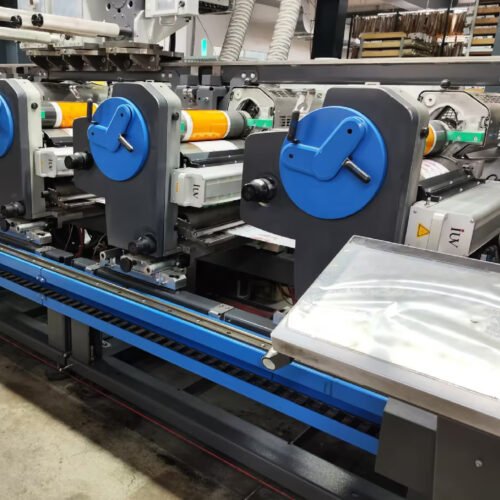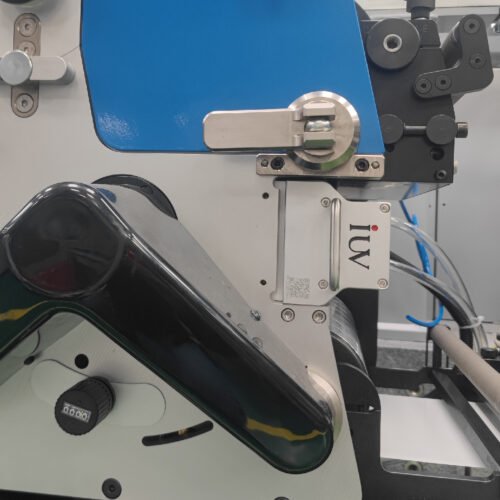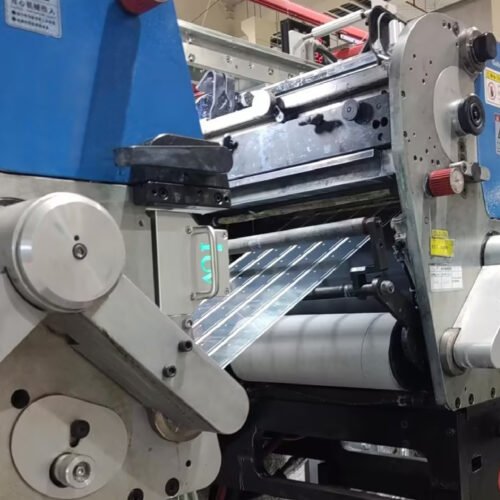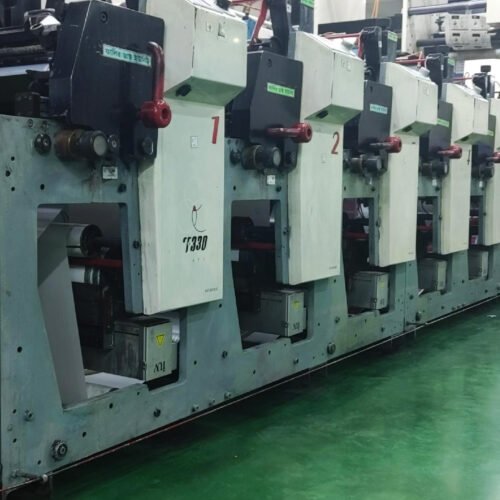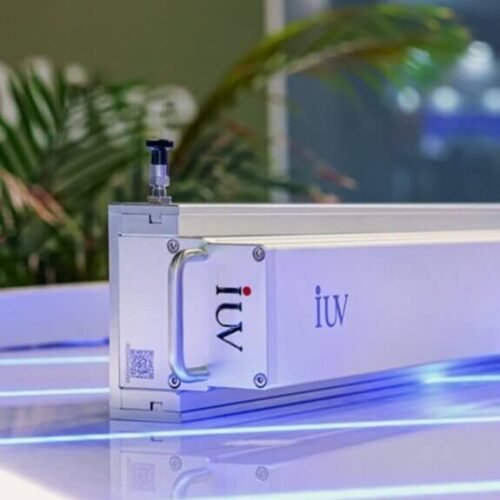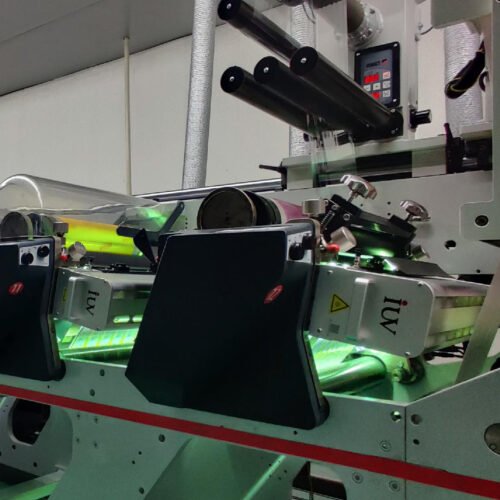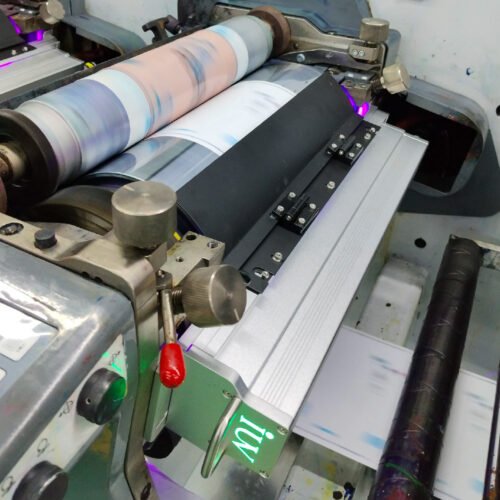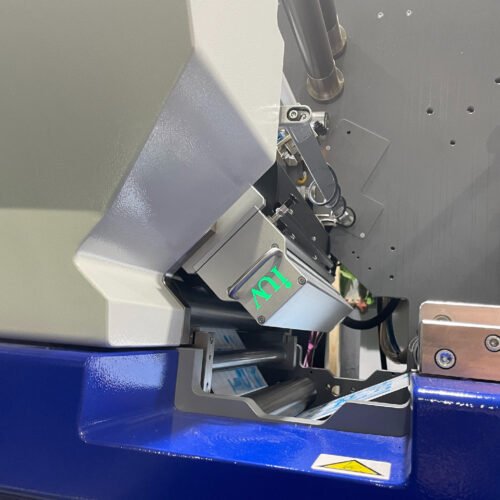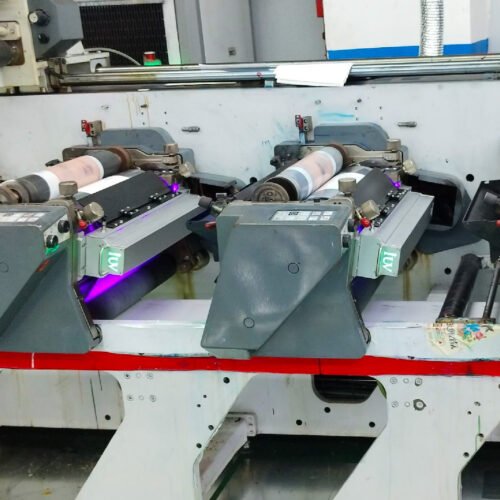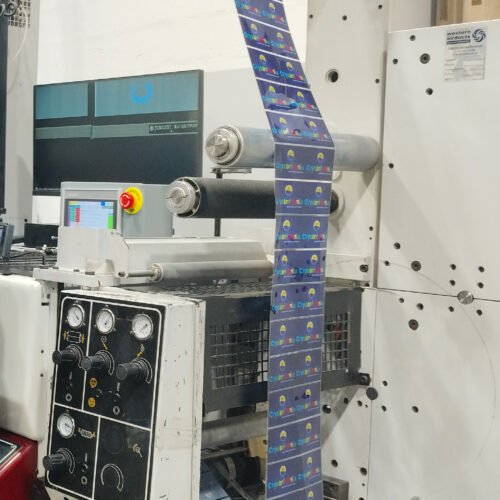

In modern label printing, curing quality is no longer judged only by whether the ink surface feels dry or passes a simple rub test. On narrow web presses running UV LED technology, the real difference between stable production and recurring quality issues often lies in how evenly curing energy is delivered across the print width. One of the most important process variables behind this stability is spectral uniformity across the web.
In practical terms, spectral uniformity refers to how consistently a UV LED curing system delivers usable wavelength energy from one side of the substrate to the other. In flexographic printing, narrow web offset, hybrid label production, and UV coating applications, this directly affects cure depth, surface cure, adhesion, gloss, color stability, and converting performance. If the energy profile changes too much across the web, the print result may appear acceptable at first while still carrying hidden curing variation from lane to lane.
This matters even more in premium narrow web production environments where print quality expectations are high and material tolerances are tight. Many converters working with advanced label press platforms, including Gallus-based production setups and other high-performance narrow web lines, depend on stable UV LED curing to protect print consistency from the first label to the last.
For that reason, measuring spectral uniformity is not a laboratory-only procedure. It is a practical engineering method for understanding whether the curing system is truly supporting repeatable production across the full active print width.
Why Spectral Uniformity Matters in UV LED Label Printing
In UV LED curing, it is possible for a system to show strong average output while still curing unevenly across the web. That is because curing performance is not defined by power alone. It is defined by how the usable optical energy is distributed across the substrate and how effectively that energy activates the ink chemistry at every lane.
In label printing, especially on narrow web flexographic presses, this becomes critical when the job includes dense solids, opaque white, high-build varnishes, tactile coatings, fine reverses, or complex wet-on-wet color structures. If one side of the web receives slightly different spectral conditions than the other, the resulting cure behavior may shift enough to affect print performance.
The first signs are often subtle. One edge may show weaker adhesion. A varnished area may appear slightly different in gloss. One lane may convert more cleanly than another. In some cases, the defect does not become visible until slitting, die-cutting, rewinding, or final application. By then, the real cause may be difficult to trace back unless the curing profile across the web has been measured properly.
Why Irradiance Alone Does Not Tell the Full Story
Most converters already understand the importance of irradiance and UV dose. These are essential curing parameters, but they do not always explain why a job behaves differently from one side of the web to the other. A radiometer may confirm that the lamp is producing sufficient output in one test position, yet still fail to reveal whether the spectral response remains consistent across the full curing width.
This is especially important with UV LED inks and coatings because their photoinitiator packages are designed around specific wavelength response windows. If the emitted energy profile changes across the web, the polymerization behavior can change as well. In practical production, that means two areas of the same label web may receive enough apparent energy to look cured while still reacting differently at the chemical level.
For narrow web converters running quality-sensitive work, especially those using premium press ecosystems associated with Gallus-compatible workflows, this is where spectral verification becomes a valuable process tool rather than an optional technical check.
The Production Value of Measuring Across the Full Web Width
Cross-web measurement is important because curing problems rarely stay isolated to the center of the lamp. In fact, some of the most common LED UV consistency issues appear near the outer edges or in repeated bands across the curing width. If only the center of the lamp is checked, these problems can remain hidden until they begin affecting output quality.
This matters in label printing because many jobs use nearly the full printable width, and even when they do not, converters still need predictable curing behavior across all active lanes. In multi-up production, one underperforming lane can still create significant waste. The curing system must therefore be evaluated across the same width that the press expects to run consistently.
This is why spectral uniformity measurement should be approached as a cross-web mapping exercise rather than a single-point lamp test.
Step 1: Stabilize the UV LED System Before Taking Any Measurements
The first and most important rule is to never evaluate spectral behavior on a cold curing system. UV LED heads do not behave the same at startup as they do after reaching normal thermal operating conditions. Output stability, optical behavior, and internal thermal balance all improve once the system has reached equilibrium.
Before testing begins, the curing system should be run long enough to stabilize under realistic production settings. Coolant temperature should be steady. Ambient conditions should be normal. Lamp output should match a typical working power level rather than an arbitrary bench value.
This is essential because many spectral irregularities only become visible after the head has reached production temperature. A lamp that appears uniform during a cold test may behave differently after sustained operation on press.
Step 2: Check Mechanical Alignment Before Blaming the Optical Profile
Before any instrument is placed under the lamp, the physical setup of the curing head should be verified. Many apparent cross-web output problems are not actually caused by diode performance. They are caused by mechanical alignment errors such as skewed mounting, uneven standoff distance, bracket shift, or lamp face mispositioning relative to the web.
The curing head should sit parallel to the substrate path and maintain a consistent working distance from one side of the web to the other. Even a small geometric difference can create a measurable change in optical delivery. If one side of the lamp is closer to the web, that side will naturally receive higher effective intensity and a different curing condition.
In narrow web flexographic and offset applications, these mechanical shifts can develop gradually over time due to vibration, maintenance activity, cassette replacement, or normal production wear. That is why geometry should always be checked before interpreting any spectral data.
Step 3: Use a Measurement Tool That Can Read UV LED Spectral Behavior Correctly
Not every UV measurement device is suitable for this task. A standard UV radiometer is useful for routine process checks, but it may not provide enough detail to evaluate wavelength behavior across the web. To assess spectral uniformity properly, the measurement instrument should be compatible with the actual UV LED wavelength range being used and, ideally, capable of resolving both intensity and spectral response.
This point is critical because sensors designed mainly for conventional mercury UV systems may respond inaccurately to narrowband LED sources. If the instrument is not matched to the curing technology, the resulting data may be misleading even when the measurement method appears correct.
In practical press environments, repeatability is just as important as instrument capability. The measurement tool must be used consistently at each cross-web position so that the final profile reflects the lamp, not the handling variation.
Step 4: Divide the Web Width Into Repeatable Measurement Zones
A useful spectral map cannot be built from one or two random points. The active curing width should be divided into repeatable measurement zones from edge to edge. These zones should represent the real printable area rather than only the centerline.
For narrow web label presses, this often means measuring at the operator side edge, intermediate quarter points, center, and drive side edge. If the application is especially sensitive or the curing width is broad relative to the job structure, more zones may be needed. What matters most is that the same positions are used each time.
This method makes it possible to identify whether the optical profile is balanced or whether one part of the lamp is falling behind. It also helps build a performance history that can be used later for maintenance comparison or process qualification.
Step 5: Measure Under Real Production Conditions, Not Idealized Bench Conditions
The curing system should be measured at the same approximate output level and geometry used during production. This is important because lamp behavior at low power or in an open bench condition does not always reflect real print conditions.
If the press normally runs a given ink set, substrate family, and speed range, the measurement should reflect that environment as closely as possible. In some cases, static measurement is sufficient. In others, especially on high-speed narrow web lines, dynamic process conditions should also be considered because thermal and optical behavior can shift under sustained operation.
At each cross-web zone, the operator should record the usable optical response and, where available, the spectral signature of the emitted energy. The goal is to build a practical process profile, not simply collect isolated numbers.
Step 6: Evaluate Consistency Across the Web, Not Just Peak Strength
A common mistake in UV LED troubleshooting is placing too much importance on whether the lamp reaches a high maximum number. In production, a slightly lower but highly uniform cross-web profile is often more valuable than a lamp with very strong center output and weak edge behavior.
That is because polymerization responds best to stable conditions. If one lane receives noticeably different optical energy than another, the chemistry of cure will not behave identically, even if both areas seem visually acceptable at first.
For this reason, the center of the lamp should be treated as a reference point rather than the only important point. The outer zones must remain close enough in performance to support consistent cure across the full print width. In label production, especially when printing full-width solids or heavy white structures, edge performance matters just as much as center performance.
Step 7: Investigate Any Repeating Cross-Web Irregularities
Once the profile is mapped, any repeated dips, peaks, or asymmetrical zones should be investigated. The pattern often reveals the root cause more clearly than the absolute numbers alone.
A gradual falloff toward the edges may suggest optical distribution limits or geometry-related behavior. A sharp drop in one localized zone may indicate contamination on the lamp face or optics. Repeating weak bands can point to diode grouping, internal cooling imbalance, or localized optical degradation. If one side consistently behaves differently from the other, mechanical alignment should be rechecked before assuming a diode issue.
In UV LED label production, these patterns are highly relevant because they often correlate directly with lane-specific print defects. What appears to be a random adhesion complaint may actually follow the same cross-web pattern every time once the curing system is measured correctly.
Step 8: Correlate the Spectral Profile with Real Press Symptoms
The most useful part of spectral measurement is not the data itself. It is what that data explains. Once the curing profile has been mapped, it should be compared with any known print or converting issues observed on press.
If one lane shows weaker adhesion, inconsistent gloss, lower scuff resistance, or different varnish behavior, the spectral map may reveal whether the curing system is contributing to the problem. In flexographic label printing, this kind of cross-web correlation is extremely valuable because many curing-related defects are otherwise difficult to isolate from ink, anilox, substrate, or press variables.
For converters running repeat work or premium label applications, this turns spectral measurement into a highly practical process optimization tool rather than a one-time diagnostic exercise.
Step 9: Make Spectral Mapping Part of Preventive Maintenance
Spectral uniformity should not be checked only after a problem appears. It should become part of the preventive maintenance routine for any serious UV LED production environment. Over time, optical surfaces accumulate contamination, cooling efficiency changes, and diode output gradually shifts. These changes often happen slowly enough that operators do not notice them until the process window becomes unstable.
Routine cross-web spectral checks help detect these changes before they become costly. This is particularly useful after maintenance events such as optical cleaning, coolant service, cassette replacement, or station realignment. A measured baseline taken during stable production provides a valuable reference point for future troubleshooting and process control.
In advanced label operations, especially where Gallus-compatible press workflows are expected to deliver repeatable premium quality, this kind of maintenance discipline supports both uptime and print consistency.
Step 10: Use the Results to Improve Curing Setup and Job Qualification
Once spectral behavior across the web is understood, the data can be used to improve more than just maintenance. It can also support smarter curing setup and job qualification. This is especially useful when introducing new substrates, new ink sets, heavier whites, specialty coatings, or challenging film constructions.
Instead of relying only on operator experience or trial-and-error adjustments, the curing process can be set based on measured optical behavior. That leads to more stable production, faster setup decisions, and fewer recurring quality surprises.
In narrow web printing, where throughput, consistency, and finishing reliability all matter, this is where spectral measurement delivers its real production value.
Conclusion
Measuring spectral uniformity across the web in UV LED curing systems is one of the most effective ways to improve curing reliability in modern narrow web production. It reveals how evenly the curing system is performing where it matters most: across the full active print width.
In label printing, flexographic production, offset label workflows, and hybrid UV applications, curing quality depends on more than high peak output. It depends on stable wavelength behavior, consistent optical delivery, correct lamp geometry, clean optics, thermal stability, and repeatable cross-web verification.
When converters treat spectral uniformity as a core process variable rather than a technical afterthought, they gain better print quality, more reliable adhesion, improved converting performance, and a more stable overall production window. In high-performance UV LED label printing, that level of control is essential.