Elevating Label Production: Mastering UV Curing with Specialty Inks
Label printing is a dynamic field. Manufacturers constantly seek ways to make their products stand out. This includes using unique inks that offer special effects or enhanced performance. However, applying these specialty inks effectively requires precise UV curing. Optimizing your UV curing systems is key to achieving vibrant, durable, and precisely printed labels.
Specialty inks in label printing cover a wide range. Think about metallic inks that gleam, fluorescent inks that pop, or textured inks that add a tactile dimension. Then there are high-resistance inks for harsh environments or food-safe inks for packaging. Each of these ink types has specific demands on the curing process. They need the right amount of UV energy delivered at the correct wavelength. Without this, you risk incomplete curing, poor adhesion, or compromised visual effects.
Understanding the UV Curing Process
UV curing uses ultraviolet light to instantly dry or “cure” inks, coatings, and adhesives. This process is photochemical. When UV light hits the photoinitiators within the ink formulation, it triggers a rapid polymerization reaction. This transforms the liquid ink into a solid, durable film. The speed and efficiency of this process are major advantages in high-volume label printing.
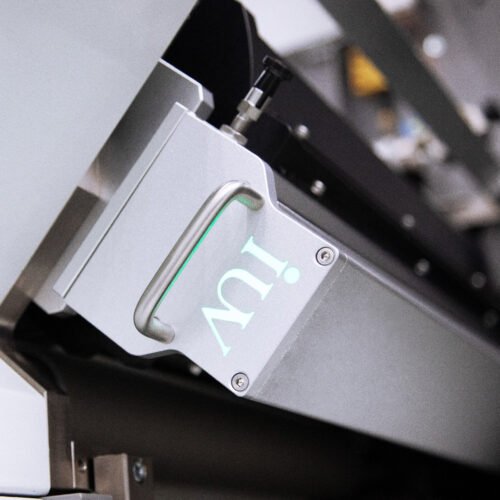
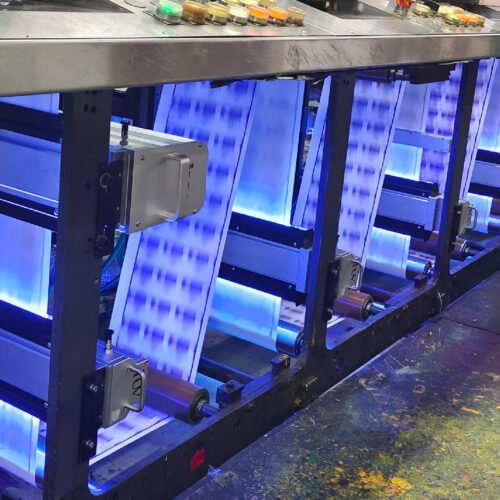
Traditional mercury vapor lamps have been the workhorse for UV curing. They emit UV light across a broad spectrum. However, LED UV curing technology is rapidly gaining traction. LEDs offer a more focused and controllable UV output. This is especially beneficial for specialty inks. They provide specific wavelengths tailored to the ink’s chemistry.
Challenges with Specialty Inks
Specialty inks often have unique formulations. Pigments can be denser or have different optical properties. This might affect UV light penetration. For example, metallic pigments can reflect UV light, hindering the curing of the ink layer beneath. White inks, with their high opacity, can also present a challenge. They may require higher energy or different wavelength outputs to cure fully.
Textured inks might have thicker laydowns. This means the UV light needs to penetrate a greater ink depth. Inks designed for specific resistances, like chemical or scratch resistance, often rely on specific cross-linking reactions. These reactions are highly dependent on receiving the precise UV dosage.
Optimizing LED UV Curing for Labels
LED UV curing systems offer a significant advantage here. They allow for precise control over wavelength and intensity. This makes them ideal for troubleshooting and optimizing the curing of specialty inks.
1. Wavelength Selection: Different photoinitiators are sensitive to specific UV wavelengths. While mercury lamps offer a broad spectrum, LEDs can be tuned to emit light in narrow bands, such as UVA (315-400 nm) or specific peaks like 365 nm, 385 nm, 395 nm, or 405 nm. For specialty inks, selecting an LED emitter with a wavelength that perfectly matches the ink’s photoinitiator system is crucial. This ensures maximum energy absorption and efficient curing. Consult your ink supplier for their recommended wavelength.
2. Irradiance and Dose: Irradiance is the power density of the UV light, measured in milliwatts per square centimeter (mW/cm²). The UV dose is the total energy delivered to the ink, calculated as irradiance multiplied by exposure time. For specialty inks, achieving the correct UV dose is critical. Too little dose leads to under-curing, resulting in poor adhesion, low rub resistance, and potential migration issues. Too much dose can degrade the ink or substrate, causing discoloration or brittleness.
With LED systems, you can precisely control both irradiance and exposure time. This allows you to fine-tune the UV dose for each specific specialty ink. Modern systems often feature adjustable power settings and variable speed controls, making this fine-tuning straightforward.
3. Uniformity: Consistent UV light delivery across the entire printed width is essential for label printing. Inconsistent curing can lead to variations in ink performance and appearance. Specialty inks, especially those with visual effects, will highlight any curing inconsistencies. LED UV systems are known for their excellent uniformity. However, regular checks and maintenance are still important. Ensure the LED array is clean and that there are no shadows or gaps in the light output.
4. Cooling and Ventilation: UV curing, even with energy-efficient LEDs, generates heat. This heat can affect the ink and the substrate, particularly sensitive materials like certain plastics used in labels. Adequate cooling and ventilation around the UV system are necessary. This helps maintain stable operating temperatures for both the LEDs and the printed material, preventing premature curing or material degradation.
5. Substrate Compatibility: The substrate you are printing on plays a significant role. Some substrates can absorb or reflect UV light, impacting curing efficiency. For example, clear or metallized films might require different curing strategies than paper. The heat generated by the curing process can also affect certain substrates. Always test your chosen ink and UV curing settings on your specific label stock to ensure optimal results.
6. Ink Layer Thickness: Thicker ink laydowns, common with some specialty inks for opacity or texture, present a challenge for UV penetration. Higher energy levels or longer exposure times might be needed. LED systems with higher power outputs can help address this. It’s also worth considering the ink’s transparency to the specific UV wavelength being used.
7. Pre-treatment and Post-treatment: Sometimes, pre-treating the substrate can improve ink adhesion and curing. Post-curing treatments might also be employed for specific performance enhancements. However, for most modern label printing with specialty inks and optimized UV curing, these are less common. The focus remains on getting the UV curing parameters right.
Benefits of Optimized UV Curing for Specialty Inks
By carefully optimizing your UV curing systems, especially with the advantages of LED technology, you unlock significant benefits. You achieve superior print quality with vibrant colors and sharp details. Specialty effects are rendered flawlessly and remain durable. Adhesion is excellent, and resistance to scratching, chemicals, and fading is enhanced. This leads to higher product acceptance, reduced waste, and increased customer satisfaction. It allows printers to offer more sophisticated and higher-value labels to their clients.
The Future is Precise
The evolution of specialty inks in label printing goes hand-in-hand with advancements in UV curing technology. As ink formulations become more sophisticated, so too must the curing processes. LED UV curing provides the precision and control needed to harness the full potential of these innovative inks. By understanding the interplay between ink chemistry, UV light, and your curing equipment, you can ensure every label produced is a testament to quality and innovation. Investing time in understanding and optimizing these parameters is not just good practice; it’s essential for staying competitive in the modern label printing landscape.