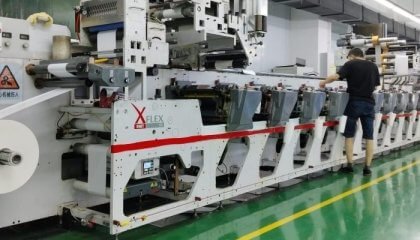
Achieving a perfect cure on non-absorbent surfaces like metallic foils and synthetic films presents unique challenges in the narrow web industry. Unlike paper, these substrates offer no “anchor” for the ink. Every millijoule of UV energy must work at the surface level to create a functional bond. For flexo and offset printers, mastering this process determines the difference between a high-quality label and a batch that fails the tape test.
Understanding the Substrate Challenge
Metallic and filmic materials share one common trait: they are non-porous. In traditional paper printing, some ink components soak into the fibers. This provides a mechanical bond. With films like PE, PP, or PET, and metallic foils, the ink sits entirely on top.
Filmic substrates are also highly sensitive to heat. Standard mercury vapor lamps emit significant infrared (IR) radiation. This heat can cause thin films to stretch, shrink, or lose register. Metallic substrates introduce a different problem: reflectivity. The shiny surface reflects UV light back through the ink layer. While this can speed up curing, it can also cause “pre-cure” issues on the printing plate or in the ink duct of an offset press.
The Shift to LED UV Curing
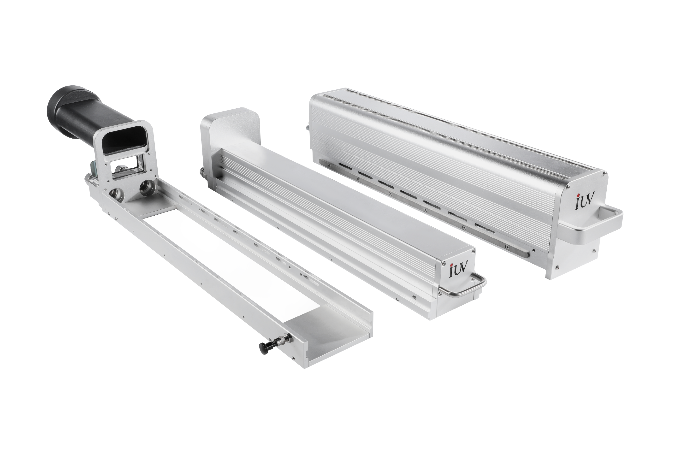
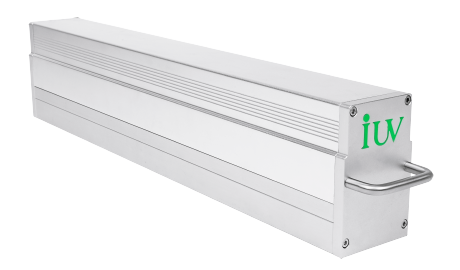
LED UV technology has transformed how we handle sensitive films. Unlike mercury lamps, LED systems emit a narrow band of UV light, typically at 385nm or 395nm. More importantly, they produce almost zero IR heat.
For narrow web flexo printers, this means you can run thinner films without the risk of distortion. The “cold” cure of LED allows for better tension control. In offset printing, the instant on/off capability of LED units reduces the heat buildup on the press rollers. This stability is vital when maintaining the delicate water-ink balance required for high-end metallic labels.
Surface Tension and Dyne Levels
You cannot talk about UV curing on film without discussing surface energy. Most plastic films are chemically inert and have low surface energy. If the ink’s surface tension is higher than the substrate’s surface energy, the ink will bead up. This is known as “poor wetting.”
Before the UV lamps even fire, the substrate usually requires corona treatment. This process increases the Dyne level of the film. For most UV inks, a Dyne level of 38 to 42 is the target. If you are printing on metallic foils, the surface might have residual oils from the rolling process. Flame treatment or specialized primers are often necessary to ensure the UV-cured polymer actually sticks to the metal.
Managing the Curing Profile
Curing is not just about raw power. It is about the balance between “dosage” (energy density) and “intensity” (peak power).
- Peak Intensity: This determines how well the UV light penetrates the ink layer. It is vital for highly pigmented metallic inks or thick white base coats used on clear films.
- Dosage: This is the total energy the ink receives over time. It ensures the chemical cross-linking is complete throughout the entire ink film.
When printing on metallic substrates, the UV light reflects off the foil. This effectively doubles the exposure for the bottom of the ink layer. While this helps with adhesion, it can lead to “over-curing,” making the ink film brittle. Brittle ink will crack when the label is die-cut or wrapped around a tight radius.
Ink Chemistry for Non-Porous Surfaces
UV inks for films and foils are formulated with specific monomers and photoinitiators. These components are designed to minimize shrinkage. When UV ink cures, it naturally shrinks. On a porous substrate, this doesn’t matter much. On a smooth film, high shrinkage causes the ink to “curl” away from the surface, leading to delamination.
In narrow web flexo, we often use low-migration inks for filmic food packaging. These inks require very precise UV output to ensure all photoinitiators are reacted. Any unreacted components can migrate through the film, causing safety issues and odor.
The Role of Oxygen Inhibition
One of the biggest hurdles in UV curing is oxygen inhibition. Oxygen in the air interferes with the radical polymerization process, especially at the very surface of the ink. This results in a “tacky” finish, even if the ink is hard underneath.
Filmic substrates often exacerbate this because the ink layers are applied very thin in processes like flexo. To combat this, high-intensity LED lamps are used to “flood” the surface with photons so quickly that the polymerization outruns the oxygen interference. Some high-end narrow web presses even use nitrogen inertion, replacing the oxygen around the UV lamp with nitrogen to create a perfect curing environment.
Heat Management in Narrow Web Printing
While LED is cooler than mercury, the UV reaction itself is exothermic—it generates its own heat. On thin PET or shrink sleeves, even this small amount of heat can be problematic.
Printers must use chilled impression rollers (chill rolls) to pull heat away from the film instantly. Controlling the temperature of these rolls is a critical part of the UV curing process. If the film gets too warm, it becomes elastic, and your registration will drift. In offset printing, heat can also change the viscosity of the ink, leading to “scumming” or “tinting” on the metallic substrate.
Reflection and Shielding in Metallic Printing
Metallic inks and substrates act like mirrors. When using UV lamps in a narrow web press, this reflected light can bounce back into the printing station. In flexo, this might cause ink to dry on the anilox roll. In offset, it can cause the ink on the blankets to harden.
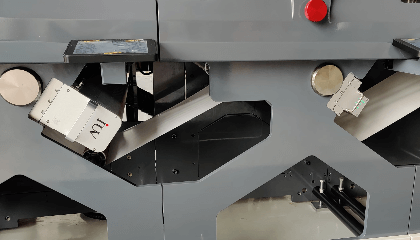
Proper shielding around the UV lamp housing is mandatory. Modern UV systems use “shuttered” housings or specialized light traps to ensure the UV energy stays focused on the substrate and doesn’t leak into the press components. When printing on foil, check your plates and rollers frequently for any sign of “stray” curing.
Testing for Cure Success
You cannot rely on a visual check to confirm UV curing on film or foil. You need a rigorous testing protocol:
- The Tape Test: Use a standardized tape (like 3M 610) to pull at the ink. If any ink lifts, the bond between the ink and the substrate failed.
- The Thumb Twist: Apply firm pressure with your thumb and twist. If the ink smears or moves, the internal curing (the “through-cure”) is incomplete.
- Chemical Resistance: Use a solvent like MEK (Methyl Ethyl Ketone) or Isopropyl Alcohol. Rub the cured surface with a soaked cloth. A fully cured ink should withstand a specific number of “double rubs” without dissolving.
- Radiometers: Use a UV radiometer regularly. These devices pass under the lamps and measure the actual millijoules being delivered. Do not wait for a job to fail to realize your lamps are degrading.
Optimization for Different Processes
Flexo Printing
In flexo, ink film thickness is controlled by the anilox volume. When printing on film, we typically use lower volume anilox rolls to keep the ink layer thin. This makes curing easier but requires high pigment loads to maintain color density. Ensure your LED or arc lamp intensity is matched to your press speed. If you speed up, you must increase the lamp power proportionally.
Offset Printing
UV offset on metallic paper or plastics requires a very tight water-balance. Excessive fountain solution will emulsify with the UV ink, significantly slowing down the curing process. Because offset ink layers are very thin, they are highly susceptible to oxygen inhibition. High-intensity LED units are usually the best choice for narrow web offset converters working with film.
Troubleshooting Common Issues
If you experience “brittle” ink on a metallic substrate, try reducing the UV power. The reflection might be over-curing the ink. If the ink is “tacky” on a film, check the Dyne level of the substrate first. If the Dyne level is fine, increase the UV intensity or check if your lamps are past their hour-life.
Another common issue is “adhesion drop-off” after 24 hours. Sometimes an ink appears cured immediately after printing but loses adhesion later. This is often due to “post-cure shrinkage.” Switching to a more flexible UV ink or increasing the corona treatment intensity can often solve this.
Final Thoughts on Process Control
Mastering UV curing on metallic and filmic substrates is a technical balance of chemistry, physics, and mechanical precision. By monitoring surface energy, controlling heat, and using the right UV technology—whether LED or mercury—printers can produce durable, vibrant labels on the most challenging materials. Constant testing and data-driven adjustments to the curing environment are the only ways to ensure consistent quality in the narrow web market.