The label printing industry faces a constant push for higher resolution and more intricate designs. Brand owners now demand microscopic text, complex guilloche patterns for security, and ultra-fine decorative lines that were once the exclusive domain of digital or gravure printing. For narrow-web flexographic converters, achieving this level of detail requires mastering the interaction between ink, substrate, and the curing source.
Traditional mercury vapor lamps served the industry well for decades. However, the shift toward LED UV curing has redefined the boundaries of print quality. In flexo label production, the ability to reproduce a 2-point font or a 30-micron line depends heavily on how the ink behaves the millisecond it hits the substrate. LED UV technology provides a level of control that mercury systems simply cannot match.
The Physics of Ink Spread and the Need for Instant Stability
In flexography, fine line reproduction is often a battle against “gain.” When the anilox roll transfers ink to the plate, and the plate contacts the substrate, the ink wants to spread. This lateral movement—often called “wicking” on paper or “bleeding” on film—is the primary enemy of sharp edges.
Traditional UV systems rely on a broad spectrum of light. While effective at curing, they also generate a massive amount of infrared (IR) energy. This heat lowers the viscosity of the ink before the polymerization process is complete. Thinner ink flows more easily, leading to blurred edges and lost detail in fine lines.
LED UV systems emit light in a narrow, concentrated band (usually 395nm or 385nm). Because they do not emit IR radiation, the substrate stays cool. This thermal stability ensures that the ink’s viscosity remains high. The ink stays exactly where the plate deposited it. For narrow-web printers working with heat-sensitive films like PE or thin BOPP, this lack of heat prevents material distortion, which is a major factor in maintaining registration for fine-line multi-color designs.
High-Intensity Output and Radical Polymerization
The chemical transition from liquid ink to a solid polymer film must happen almost instantaneously to preserve fine detail. LED UV lamps provide high peak irradiance. When the photoinitiators in the UV ink are exposed to this concentrated dose of light, they trigger a rapid chain reaction.
This “instant-on” polymerization freezes the ink droplets in place. In fine line reproduction, this is often referred to as “locking the dot.” When you are printing a line that is only a few microns wide, even a fraction of a second of delay in curing can cause the line to widen by 10% or 20%. LED UV’s high-intensity output ensures the cure happens fast enough to prevent this expansion.
Controlling the Cure Profile: Surface vs. Through-Curing
One of the technical challenges in UV flexo is balancing surface cure and through-cure. Mercury lamps produce short-wavelength UVC light, which is excellent for surface hardness, and long-wavelength UVA, which penetrates deeper. However, the lack of consistency in mercury bulbs as they age can lead to “skinning,” where the top layer is hard but the bottom is wet, causing the fine lines to “smear” under the pressure of subsequent print stations.
LED UV provides a consistent, monochromatic output. While it lacks the UVC component, modern ink chemistry has evolved to compensate. LED-curable inks are formulated with highly efficient photoinitiators that respond to the specific 395nm wavelength. This results in a more uniform cure throughout the ink film. For fine lines, this means the base of the line is as stable as the surface, preventing the “slumping” of ink that leads to loss of definition.
Improving Screen Counts and Anilox Selection
The move to LED UV often allows converters to use higher line-screen anilox rolls. To achieve fine line reproduction, you need a thin, consistent ink film. Thick ink films are prone to “squishing” under the printing plate, which ruins fine detail.
Because LED UV cures so efficiently, printers can run higher-pigment-load inks at lower film weights. A high-count anilox (e.g., 1200 lpi or higher) delivers a very small volume of ink. LED UV provides the energy density required to cure these thin films instantly. The result is a crisp, sharp edge that mimics the quality of offset printing but with the speed and versatility of flexo.
The Role of Pinning in Narrow Web Applications
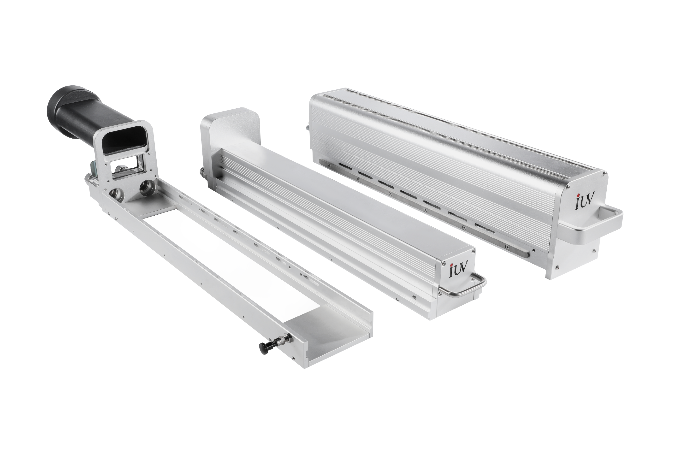
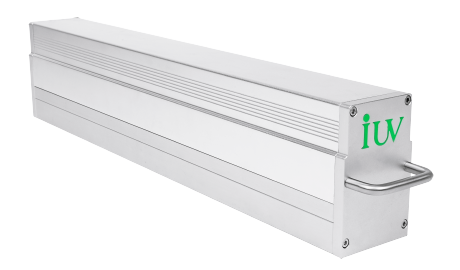
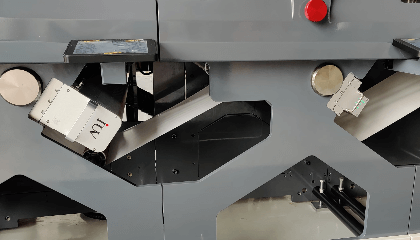
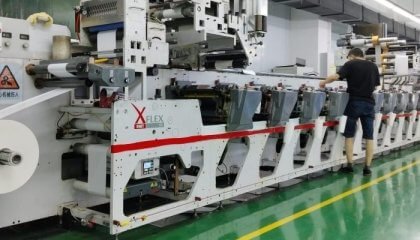
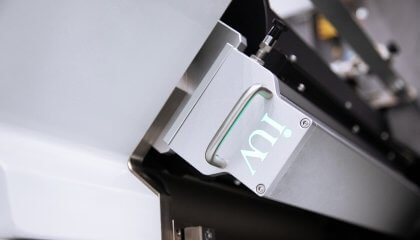
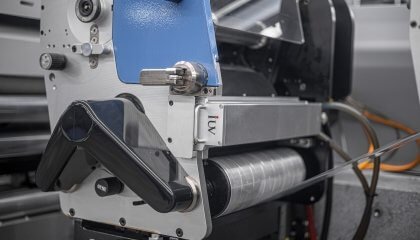
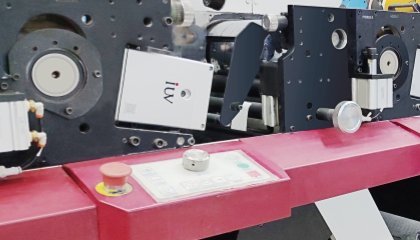
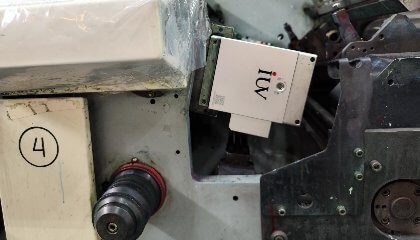
In narrow-web label presses, “pinning” is the process of partially curing the ink between color stations. This is where LED UV truly shines. Small LED “pinning” units can be placed after individual print stations to “freeze” the ink without fully curing it.
This technique is vital for fine lines that are part of a multi-color graphic. By pinning the ink, you prevent the subsequent colors from bleeding into the fine lines of the previous station. It allows for “wet-on-dry” or “wet-on-semi-dry” printing, which significantly improves the trapped detail. Traditional mercury systems are usually too bulky and generate too much heat to be used as inter-station pinning units in a typical narrow-web setup.
Substrate Versatility and Fine Detail
The label market is shifting toward thinner and more exotic films to save costs and improve sustainability profiles. These materials are often highly sensitive to the heat of traditional UV lamps. If a film stretches or shrinks by even half a millimeter due to heat, the fine lines in a design will lose their crispness and registration will fail.
LED UV’s cold-curing process opens the door to using 12-micron films and other heat-sensitive stocks. Because the material remains stable, the printer can maintain incredibly tight registration across a long press run. Fine lines stay aligned with their respective background colors or trapping zones, resulting in a professional, high-end look that is required for the wine, spirits, and cosmetic industries.
Consistency: The Key to Repeatable Quality
A major headache for equipment engineers is the degradation of mercury bulbs. As a bulb ages, its spectral output shifts and its intensity drops. This means the press operator must constantly adjust the press speed or the lamp power to maintain the same level of cure. This variability is the enemy of fine line reproduction.
LED UV modules have a lifespan of over 20,000 hours and maintain a consistent output throughout that time. From the first meter of the job to the last, the curing energy remains identical. This consistency means that once the press is dialed in for a specific fine-line job, the results are repeatable. You don’t have to worry about the lines becoming “fuzzy” halfway through a shift because a bulb is reaching the end of its life.
Ink Rheology and Dot Gain Management
Modern LED UV inks are designed with specific rheological properties. They are “shorter” inks, meaning they have less tendency to string or mist. When combined with the immediate curing of an LED lamp, the dot gain is significantly reduced.
In flexography, “physical” dot gain happens at the nip, but “optical” or “chemical” dot gain happens after the ink leaves the plate. LED UV addresses the chemical side of the equation. By minimizing the time the ink remains in a liquid state on the substrate, LED technology allows for a 1% or 2% dot to be held consistently on the plate and the substrate. This is the difference between a label that looks “printed” and one that looks “photographic.”
Operational Efficiency and Waste Reduction
Beyond the technical print quality, LED UV improves the economics of fine-line printing. Because there is no warm-up or cool-down time, the press can start and stop instantly. This reduces the amount of “setup waste”—the material used while waiting for the lamps to reach the correct temperature and for the operator to adjust the ink-water balance (in offset) or the curing speed (in flexo).
For labels with high-value decorative elements, reducing waste is essential. Fine lines are often the first thing to disappear if the press is not running at optimal conditions. With LED UV, the “stable” zone of the press is much larger, meaning the operator can reach the “good copy” faster and stay there longer.
Conclusion: The New Standard for Flexo Labels
The adoption of LED UV curing is no longer just about energy savings; it is about print capability. To compete in a market that demands microscopic precision, converters must look at the curing system as a critical component of the optical path.
LED UV provides the thermal stability, wavelength consistency, and high peak intensity required to push flexo labels into the realm of high-definition printing. By eliminating the heat-induced spread of ink and providing a stable environment for thin film substrates, LED technology allows for the reproduction of fine lines that are sharper, more consistent, and more complex than ever before. For the professional narrow-web printer, this technology is the most effective tool available for bridging the gap between traditional flexo and the highest standards of modern packaging design.